HAZOP Training Course: A Complete Guide to Process Safety and Hazard Identification

Hazardous Area Classification UAE Safety Standards for Oil and Gas Industries
November 4, 2026
Top Safety Consultants Thailand: The Ultimate Guide to EHS & Compliance
November 5, 2026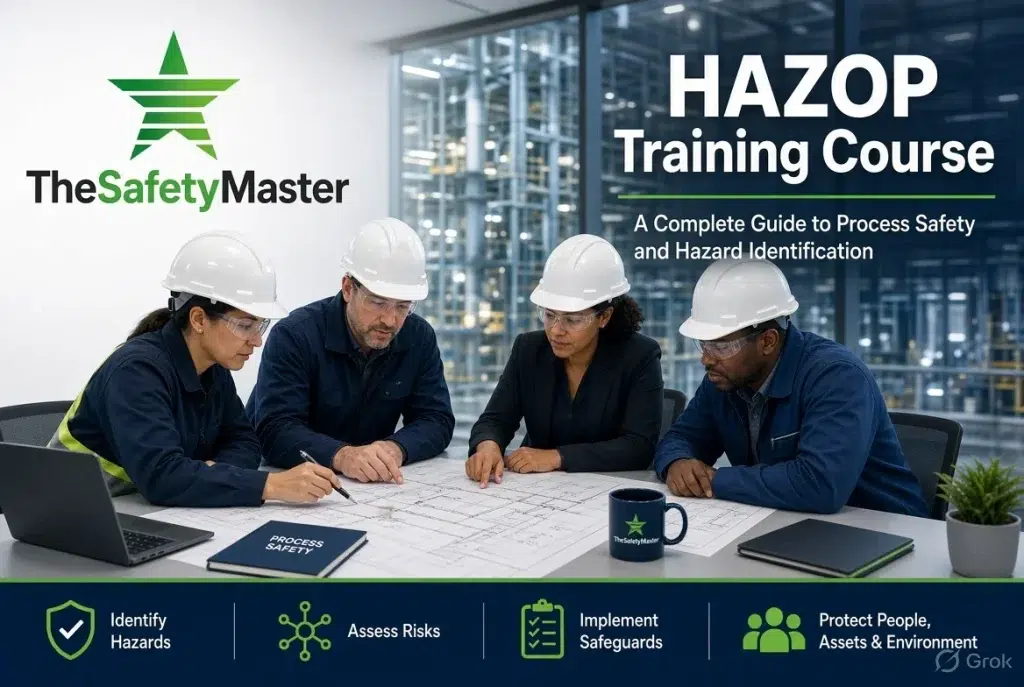
A well-structured HAZOP Training Course is essential for anyone involved in process safety. At The Safety Master, we deliver practical, industry-focused training that helps engineers, safety professionals, and operations teams master Hazard and Operability (HAZOP) studies — one of the most powerful techniques for identifying hazards and improving plant operability.
This complete guide explains what HAZOP is, how it works, why proper training matters, and how The Safety Master’s HAZOP Training Course equips you with real-world skills to protect people, assets, and the environment.
What Is a HAZOP Study?
HAZOP (Hazard and Operability Study) is a structured, team-based technique used to examine a process design or existing facility for potential deviations from the intended design intent. It identifies hazards that could harm people, the environment, or assets, as well as operability issues that reduce efficiency or reliability.
The method is standardized in IEC 61882:2016 (Hazard and Operability Studies – Application Guide). It is accepted under major regulations such as OSHA Process Safety Management (PSM) in the US and equivalent frameworks worldwide.
HAZOP works by dividing the process into manageable sections called nodes and applying standardized guide words to process parameters (flow, pressure, temperature, level, composition, etc.) to generate deviations for analysis.
Why Process Safety Professionals Need HAZOP Training
Untrained or poorly facilitated HAZOP studies often miss critical scenarios, produce weak recommendations, or waste time. A proper HAZOP training course teaches:
- Correct application of the methodology
- Effective facilitation and team leadership
- Accurate recording of causes, consequences, safeguards, and actions
- Integration with other tools such as LOPA, What-If, and risk matrices
- Compliance with standards and regulatory expectations
Trained participants contribute more effectively as team members or leaders, improving study quality and reducing the risk of major process incidents.
Core HAZOP Methodology: Step-by-Step Process
A typical HAZOP follows these key stages:
1. Define Scope and Objectives
Establish boundaries, objectives (new design, modification, revalidation, or Management of Change), documentation requirements, and risk acceptance criteria.
2. Assemble the Multidisciplinary Team
A balanced team usually includes:
- Independent HAZOP leader/facilitator
- Process engineer
- Operations representative
- Instrument/control engineer
- Maintenance or mechanical engineer
- Safety specialist
- Scribe/recorder
Team size of 5–8 people is generally optimal.
3. Gather and Freeze Documentation
Key inputs include Piping & Instrumentation Diagrams (P&IDs), Process Flow Diagrams (PFDs), material safety data, operating procedures, and design basis documents. P&IDs should be at an “Approved for HAZOP” stage and frozen during the study.
4. Divide the Process into Nodes
Nodes are sections with a clear, uniform design intent — typically a vessel, line segment between equipment, or a defined operating step in batch processes.
5. Apply Guide Words Systematically
For each node and relevant parameter, the team applies guide words to create deviations.
6. Analyze Causes, Consequences, Safeguards, and Actions
For every credible deviation the team identifies:
- Possible causes
- Potential consequences (including worst-case)
- Existing safeguards
- Whether additional recommendations are needed
Findings are recorded on a HAZOP worksheet.
7. Document, Report, and Follow Up
Actions are assigned, prioritized, and tracked to closure. The final report becomes part of the process safety information.
HAZOP Guide Words and Process Parameters
Standard guide words include:
Guide Word Meaning Example Deviation No/NoneCompletenegationNoflowMoreQuantitativeincreaseHighpressureLessQuantitativedecreaseLowtemperatureAsWellAsQualitativeincreaseContaminationPartOfQualitativedecreaseIncompletecompositionReverseOppositedirectionorintentReverseflowOtherThanCompletesubstitutionWrongmaterial
Common parameters: Flow, Pressure, Temperature, Level, Composition, Phase, Reaction, Time, Mixing, etc.
Benefits of Completing a HAZOP Training Course
- Systematic hazard identification before incidents occur
- Improved operability and reduced downtime
- Stronger regulatory compliance (OSHA PSM, Seveso, etc.)
- Better-quality recommendations and action tracking
- Career advancement for process safety and engineering roles
- Ability to lead or contribute effectively to real studies
What to Look for in a Quality HAZOP Training Course
A strong course typically covers:
- Fundamentals of process safety and hazard identification
- Detailed HAZOP methodology aligned with IEC 61882
- Guide words, parameters, nodes, and worksheets
- Team roles, facilitation skills, and common pitfalls
- Practical exercises and case studies (continuous and batch processes)
- Recording, reporting, and action management
- Links to LOPA, SIL, and Management of Change
- Assessment and recognized certification
Both online self-paced and instructor-led options exist. Look for courses that include real P&ID exercises, software tools where relevant, and clear certification pathways.
Who Should Attend a HAZOP Training Course?
- Process, chemical, and mechanical engineers
- Safety and process safety specialists
- Operations and maintenance supervisors
- Project and design engineers
- Anyone expected to participate in or lead Process Hazard Analyses
Conclusion
A high-quality HAZOP Training Course is one of the most effective investments you can make in process safety competence. By mastering the structured approach of nodes, guide words, and systematic analysis, you help prevent incidents and improve operational reliability.
The Safety Master is committed to delivering practical, results-oriented HAZOP training that empowers professionals and strengthens organizational safety culture.
Ready to take the next step? Explore The Safety Master’s HAZOP Training Course and build the skills that protect people, assets, and the environment.
Frequently Asked Questions (FAQs)
The main purpose is to systematically identify potential hazards and operability problems by examining deviations from the design intent of a process.
Courses range from 2–5 days for intensive instructor-led programs to self-paced online formats that can be completed over several weeks, depending on depth and certification requirements.
While specific training is not always mandated by name, regulators such as OSHA require competent Process Hazard Analyses. HAZOP is one of the accepted methods, so trained personnel are essential for compliance.
HAZID is typically a higher-level hazard identification exercise used early in a project. HAZOP is more detailed and focuses on deviations from design intent at the P&ID level.
A single course provides a strong foundation. Effective leadership usually requires additional practical experience, mentoring, and often advanced facilitation training.