How to Select the Right Process Hazards Analysis Method for Industrial Operations

Online Process Safety Management Training: Courses for Operational Excellence
October 12, 2026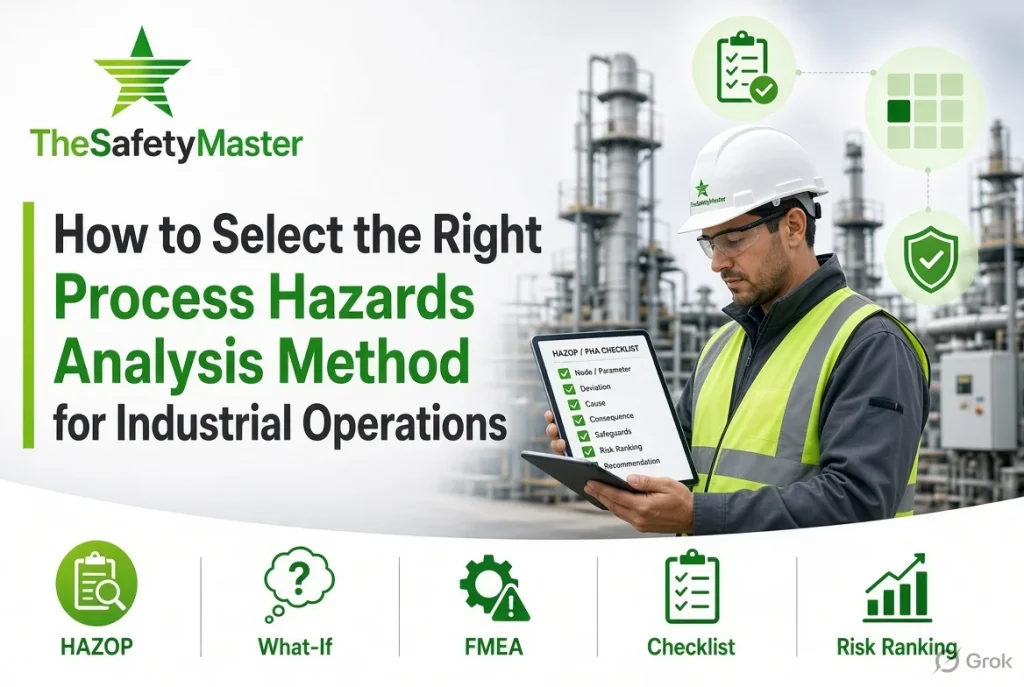
Selecting the right Process Hazards Analysis (PHA) method is one of the most important decisions in industrial process safety. A well-chosen technique identifies hazards thoroughly, supports regulatory compliance, and strengthens operational excellence. An unsuitable method can leave critical risks undetected or waste valuable time and resources.
At The Safety Master, we help organisations across chemical, petrochemical, oil & gas, pharmaceutical, and manufacturing sectors choose and apply the most appropriate PHA techniques. This guide explains how to select the right Process Hazards Analysis method for industrial operations based on process complexity, lifecycle stage, team capability, and regulatory needs.
What Is a Process Hazard?
A process hazard is any condition, event, or deviation in an industrial process that has the potential to cause harm to people, the environment, assets, or business continuity. Common process hazards include overpressure, high temperature, loss of containment, runaway reactions, toxic releases, fires, explosions, and equipment failures.
Process Hazard Analysis systematically identifies these hazards, evaluates their causes and consequences, assesses existing safeguards, and recommends additional controls where needed. PHA is a core requirement under OSHA’s Process Safety Management standard (29 CFR 1910.119) and forms a key element of effective Process Safety Management systems.
Common Process Hazard Analysis Methods
OSHA accepts several methodologies that are appropriate to the complexity of the process. The most widely used methods include:
1. Checklist Analysis
Checklist Analysis uses predetermined questions based on codes, standards, and historical experience. It is fast, easy to apply, and suitable for well-understood, simple processes or routine reviews. Its limitation is that it may miss novel or unexpected hazards not covered in the checklist.
2. What-If Analysis
What-If Analysis is a structured brainstorming technique in which the team asks “What if…?” questions about possible deviations and failures. It is flexible, useful in early design stages or for simpler systems, and works well when combined with a checklist (What-If/Checklist).
3. Hazard and Operability Study (HAZOP)
HAZOP is a highly structured, team-based method that examines process deviations using guide words (No, More, Less, Reverse, As Well As, Other Than) applied to parameters such as flow, pressure, temperature, and level at defined nodes. It is the preferred method for complex continuous processes and is widely regarded as one of the most thorough traditional PHA techniques.
4. Failure Modes and Effects Analysis (FMEA)
FMEA examines individual equipment or component failure modes, their causes, effects, severity, likelihood, and detectability. It is particularly effective for mechanical systems, control systems, and equipment reliability studies. It is less efficient at identifying combinations of failures or pure process deviations.
5. Fault Tree Analysis (FTA)
FTA is a top-down, deductive method that starts from an unwanted top event and works backward to identify combinations of causes. It is useful for complex or high-consequence scenarios that require quantitative insight.
6. Other Supporting Techniques
HAZID (Hazard Identification) is often used for high-level screening early in a project. Layer of Protection Analysis (LOPA) is frequently applied after a qualitative PHA to evaluate the adequacy of independent protection layers.
How to Select the Right Process Hazards Analysis Method
Choosing the correct method depends on several practical factors:
Process Complexity
Simple, well-established processes with limited deviation potential often suit Checklist or What-If methods. Complex continuous chemical or petrochemical processes with interacting systems generally require HAZOP. Equipment-focused or control-system analysis is better served by FMEA.
Lifecycle Stage
Early design or conceptual stages benefit from What-If or HAZID. Detailed engineering and existing operating plants typically use HAZOP or What-If/Checklist. Major modifications and revalidations often reuse or update the original method.
Available Documentation and Team Experience
HAZOP requires accurate P&IDs and a multidisciplinary team (process, operations, instrumentation, maintenance, and safety). When documentation is limited or the team is less experienced, What-If/Checklist can be more practical.
Regulatory and Corporate Expectations
For OSHA-covered processes, the method must be appropriate to the complexity of the process. Many organisations standardise on HAZOP for high-hazard units while using lighter methods for simpler systems.
Time and Resource Constraints
Full HAZOP studies on complex units can take days or weeks. What-If or Checklist reviews can be completed more quickly while still meeting the intent of PHA when applied correctly.
A practical approach used by many facilities is to combine methods: HAZOP for the main process, FMEA for critical equipment or control systems, and LOPA for high-risk scenarios requiring quantified risk reduction.
How Often Must a Process Hazard Analysis Be Updated?
Under OSHA 29 CFR 1910.119(e)(6), a Process Hazard Analysis must be updated and revalidated at least every five years after the initial PHA is completed. The five-year period is measured from the completion date of the previous PHA or revalidation.
Revalidation does not always require starting from a blank page. The team reviews the existing analysis against current process conditions, recent changes, incident history, and the required PHA content elements. However, significant process changes, major modifications, new chemicals, or incidents identified through Management of Change (MOC) procedures often trigger an earlier update. Best practice is to treat the five-year cycle as a minimum and review relevant portions of the PHA whenever the risk profile of the process changes.
Process Hazard Analysis Training
Effective PHA depends on competent facilitators and knowledgeable team members. Process Hazard Analysis training equips participants with practical skills in guide-word application, node definition, consequence evaluation, safeguard assessment, and recommendation writing.
The Safety Master offers specialised Process Hazard Analysis training that covers HAZOP, What-If, Checklist, FMEA, and related techniques. Training helps organisations build internal capability, improve study quality, and ensure compliance with regulatory expectations. Both online and classroom formats are available to suit different learning needs.
Process Hazard Analysis Software
Modern process hazard analysis software significantly improves efficiency, consistency, and documentation quality. Popular tools support multiple methodologies (HAZOP, What-If, FMEA, LOPA, etc.), enable real-time team collaboration, generate reports automatically, track recommendations to closure, and store Process Safety Information in one place.
Well-known platforms include PHAWorks, PHA-Pro, BakerRisk PHA-Tool, and integrated PSM software solutions. Choosing software that matches your preferred methods and reporting requirements helps maintain accurate, auditable PHA records throughout the process lifecycle.
Best Practices for Successful PHA Studies
- Select a method appropriate to complexity rather than defaulting to the most rigorous option every time.
- Assemble a multidisciplinary team with process knowledge and independent facilitation where needed.
- Use accurate, up-to-date Process Safety Information (P&IDs, operating procedures, material data).
- Document assumptions, deviations, causes, consequences, safeguards, and recommendations clearly.
- Track recommendations to closure and feed findings into operating procedures, mechanical integrity, and emergency planning.
- Integrate PHA results with Management of Change and periodic revalidation cycles.
Conclusion
Selecting the right Process Hazards Analysis method is not a one-size-fits-all decision. It requires matching the technique to process complexity, lifecycle stage, available information, and regulatory context. Checklist and What-If methods serve simpler or early-stage needs, HAZOP remains the standard for complex continuous processes, and FMEA excels at equipment and control-system analysis.
Regular revalidation every five years (or sooner when changes occur), competent Process Hazard Analysis training, and appropriate software tools help organisations maintain high-quality studies that protect people, assets, and operations.
The Safety Master supports industrial facilities with expert PHA facilitation, method selection guidance, specialised training, and practical tools that strengthen process safety performance. Contact our team to discuss the most suitable Process Hazards Analysis approach for your operations.
Frequently Asked Questions
Q-What are the most common methods used for process hazard analysis?
The most common methods are HAZOP, What-If, What-If/Checklist, Checklist, FMEA, and Fault Tree Analysis. HAZOP is widely used for complex continuous processes, while What-If and Checklist are popular for simpler systems or early design stages.
Q-Which comes first, Hazid or HAZOP?
HAZID (Hazard Identification) is typically performed earlier as a high-level screening study during the conceptual or early design phase. HAZOP is a more detailed, structured study usually conducted later when process design is better defined and accurate P&IDs are available.
Q-What is the correct procedure in hazard analysis?
A typical PHA procedure includes: defining the scope and selecting the method, gathering Process Safety Information, assembling a multidisciplinary team, dividing the process into nodes or systems, systematically identifying deviations or failure modes, evaluating causes and consequences, assessing existing safeguards, ranking risk, generating recommendations, documenting the study, and tracking recommendations to closure. The exact steps vary slightly by method.
Q-What are the different types of hazard analysis methods?
Common types include qualitative methods (Checklist, What-If, HAZOP, HAZID), semi-quantitative methods (FMEA with criticality ranking, LOPA), and quantitative methods (Fault Tree Analysis, Event Tree Analysis, full Quantitative Risk Assessment). Selection depends on the level of detail and numerical risk insight required.
Q-What are the 7 types of hazards?
In industrial and workplace contexts, hazards are often categorised as: physical (noise, temperature, radiation), chemical (toxic, flammable, reactive substances), biological, ergonomic, psychosocial, mechanical/electrical, and process-related hazards (overpressure, loss of containment, runaway reactions). Process Hazard Analysis primarily focuses on process-related and chemical hazards.
Q-What are the differences between FMEA and PHA?
PHA is the overall process of identifying, evaluating, and controlling process hazards and can use several techniques. FMEA is one specific technique within the PHA family that focuses on equipment or component failure modes and their effects. HAZOP (another PHA method) examines process deviations using guide words, while FMEA examines how individual components can fail. FMEA is often preferred for equipment and control systems; HAZOP is preferred for continuous process flows.