Industrial Safety Audit Improvement as per IS 14489

What You Need to Know about Electrical safety audit
January 12, 2022
How to Conduct a Hazard Identification and Risk Assessment
January 25, 2022
Industrial safety is an essential part of every manufacturing plant, chemical facility, power plant, warehouse, and other industrial workplace. A proper Industrial Safety Audit helps organizations identify unsafe conditions, evaluate existing safety systems, and take corrective actions before incidents occur.
IS 14489:2018 – Occupational Health and Safety Audit — Code of Practice provides a structured approach for conducting occupational health and safety audits. It focuses on systematic, objective, documented, and independent evaluation of workplace safety systems.
For organizations looking to improve workplace safety, The Safety Master can support the development and implementation of effective safety audit practices, risk controls, and corrective-action systems.
What Is an Industrial Safety Audit?
An Industrial Safety Audit is a systematic examination of workplace activities, equipment, processes, documents, and safety-management practices. Its purpose is to determine whether safety requirements are being followed and whether existing controls are effective.
A safety audit does more than identify violations. It helps management understand where safety performance can be improved. The audit can cover areas such as machinery safety, electrical safety, fire protection, chemical safety, personal protective equipment, emergency preparedness, maintenance, work permits, training, and risk management.
According to IS 14489:2018, an occupational health and safety audit is a systematic, objective, documented, and independent evaluation of occupational health and safety systems and procedures.
Why Is Industrial Safety Audit Important?
A workplace may have safety policies and procedures, but their effectiveness depends on actual implementation. An audit helps compare documented procedures with what is happening on the shop floor.
Major Benefits of an Industrial Safety Audit
- Identifies unsafe acts and unsafe conditions
- Helps identify potential hazards
- Evaluates existing risk-control measures
- Detects gaps in safety procedures
- Improves emergency preparedness
- Supports legal and statutory compliance
- Improves employee safety awareness
- Helps management prioritize corrective actions
- Reduces the possibility of accidents and losses
- Supports continual safety improvement
The National Safety Council of India also describes safety audits as a management tool for verifying compliance, identifying deviations, and finding conditions that could lead to accidents or significant losses.
Understanding IS 14489:2018
IS 14489:2018 is the first revision of the Indian Standard for Occupational Health and Safety Audit — Code of Practice. It provides guidelines for establishing, planning, conducting, and documenting occupational health and safety audits.
Objectives of IS 14489 Safety Audit
The standard provides a framework to:
- Evaluate the effectiveness of safety and health programs.
- Identify workplace hazards and deficiencies.
- Verify implementation of safety procedures.
- Assess compliance against defined audit criteria.
- Identify nonconformities and observations.
- Recommend corrective and preventive actions.
- Encourage continual improvement of safety performance.
The standard recognizes both internal and external audits, with suitably qualified and experienced auditors involved in the audit process.
Key Areas Covered in an Industrial Safety Audit
A comprehensive audit should examine the complete safety-management system rather than focusing on only one department.
Safety Management System
The auditor reviews the organization’s safety policy, responsibilities, procedures, safety objectives, communication systems, and management involvement.
Hazard Identification and Risk Assessment
The audit should evaluate whether workplace hazards are identified systematically and whether risks are assessed and controlled appropriately.
Machinery and Mechanical Safety
Machinery, guarding systems, interlocks, emergency stops, maintenance practices, lifting equipment, and other mechanical hazards should be examined.
Electrical Safety
Electrical installations, earthing, protection systems, panels, cables, electrical work practices, and inspection records should be evaluated.
Fire and Emergency Safety
The audit should review fire prevention measures, firefighting systems, emergency exits, alarms, emergency plans, evacuation procedures, and emergency drills.
Personal Protective Equipment
The auditor should check whether appropriate PPE is identified, available, maintained, and correctly used by workers.
Chemical Safety
For industries handling hazardous chemicals, the audit can examine chemical storage, labeling, handling procedures, Safety Data Sheets, spill control, and emergency response arrangements.
Industrial Safety Audit Process as per IS 14489
A successful audit requires proper planning and systematic execution.
1. Audit Planning
The organization should establish the audit scope, objectives, criteria, locations, departments, processes, and audit team.
2. Document Review
Important documents and records should be reviewed before or during the audit.
These may include:
- Safety policy
- Risk assessments
- SOPs
- Work permits
- Training records
- Incident records
- Inspection reports
- Emergency plans
- Maintenance records
- Statutory documents
- Previous audit reports
3. Site Inspection
The audit team visits the workplace to verify actual conditions. Physical inspection is important because documentation alone cannot demonstrate how effectively safety procedures are implemented.
4. Employee Interaction
Discussions with workers, supervisors, engineers, and managers can reveal practical safety issues that may not be visible during document review.
5. Identification of Findings
Audit findings should be based on objective evidence. These can include nonconformities, observations, unsafe conditions, or opportunities for improvement.
6. Corrective Action
Each significant finding should have an appropriate corrective action, responsible person, target date, and method of verification.
7. Follow-Up and Continual Improvement
The audit should not end when the report is issued. Corrective actions need to be tracked and verified for effectiveness.
How to Improve Industrial Safety After an Audit
An audit provides value only when the findings are converted into measurable improvements.
Prioritize High-Risk Findings
Not every finding has the same level of risk. High-risk hazards should receive immediate attention, while lower-risk observations can be managed through planned improvement programs.
Apply the Hierarchy of Controls
Organizations should prioritize effective engineering and administrative controls instead of depending only on PPE.
The general hierarchy includes:
- Elimination
- Substitution
- Engineering controls
- Administrative controls
- Personal protective equipment
Strengthen Employee Training
Training should address the hazards employees actually face in their jobs. Refresher training, toolbox talks, emergency drills, and competency assessments can strengthen safety performance.
Improve Preventive Maintenance
Equipment failures can create serious safety risks. Preventive maintenance, inspection, testing, and timely repair should form part of the safety improvement program.
Track Corrective Actions
A corrective-action tracker can help management monitor:
- Audit finding
- Risk level
- Corrective action
- Responsible department
- Target completion date
- Actual completion date
- Verification status
Common Findings During Industrial Safety Audits
Industrial safety audits frequently identify issues related to workplace conditions and management systems.
Poor Housekeeping
Blocked walkways, oil spills, poor material storage, and accumulated waste can increase the likelihood of slips, trips, falls, and fire.
Inadequate Machine Guarding
Missing or damaged guards can expose workers to moving machinery and create serious injury risks.
Improper PPE Usage
PPE may be available but incorrectly selected, poorly maintained, or not consistently used.
Incomplete Risk Assessments
Risk assessments that are outdated or do not cover non-routine activities may leave important hazards uncontrolled.
Weak Emergency Preparedness
Organizations may have emergency plans but lack effective drills, communication systems, trained response teams, or adequate emergency equipment.
Industrial Safety Audit Checklist
A practical audit checklist can include the following areas:
| Audit Area | Key Points to Check |
|---|---|
| Safety Management | Policy, objectives, responsibilities |
| Risk Assessment | Hazard identification and risk controls |
| Machinery Safety | Guards, interlocks, inspections |
| Electrical Safety | Earthing, panels, protection systems |
| Fire Safety | Extinguishers, alarms, exits |
| Chemical Safety | Storage, labeling, SDS, handling |
| PPE | Availability, selection, usage |
| Work Permits | Hot work, confined space, electrical work |
| Emergency Response | Plans, drills, emergency teams |
| Training | Induction, refresher, competency |
| Housekeeping | Cleanliness, access, storage |
| Incident Management | Reporting, investigation, corrective actions |
| Maintenance | Inspection and preventive maintenance |
| Legal Compliance | Applicable statutory requirements |
Role of The Safety Master in Industrial Safety Improvement
The Safety Master can help organizations strengthen their industrial safety performance through structured safety audits, risk assessment, safety-management support, and corrective-action planning.
A professional audit approach can help an organization move beyond simply finding problems. The objective should be to understand the root cause, implement suitable controls, verify effectiveness, and continuously improve safety performance.
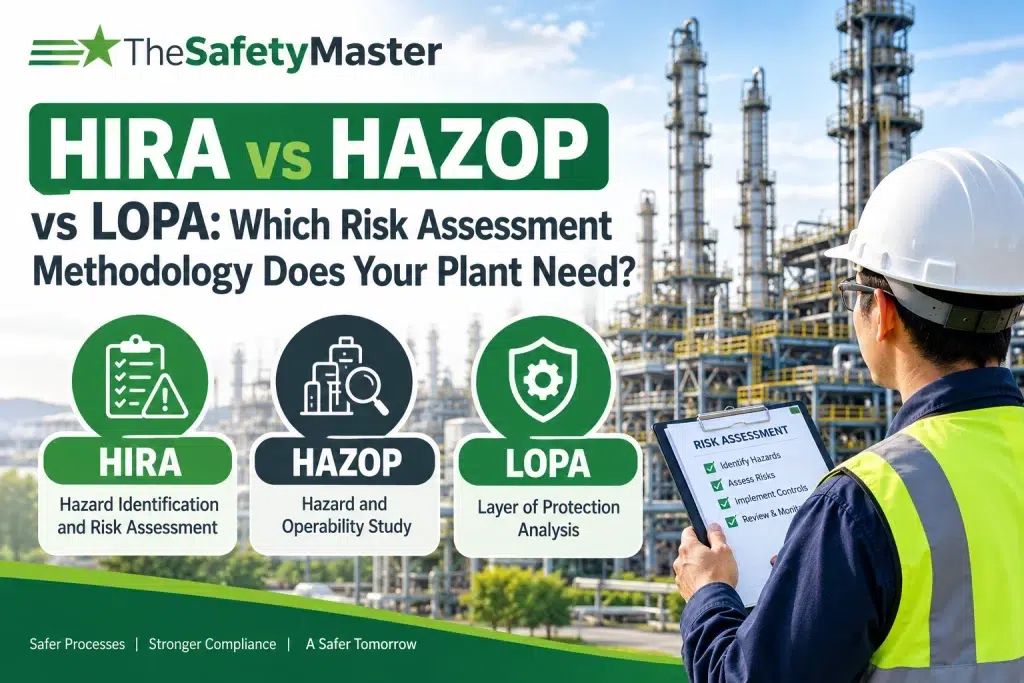
For industries dealing with significant process or operational hazards, an integrated approach involving safety audits, HIRA, HAZOP, emergency planning, process safety, and compliance assessment can provide a stronger safety-management framework.
Conclusion
An Industrial Safety Audit as per IS 14489 is an important tool for evaluating workplace safety systems and identifying opportunities for improvement. The value of an audit is not limited to producing a report; its real benefit comes from implementing corrective actions and verifying that those actions effectively reduce risk.
Organizations should therefore treat safety audits as a continuous improvement process, rather than a one-time compliance activity. By combining systematic auditing, employee involvement, risk assessment, corrective actions, training, and management commitment, industries can create safer and more reliable workplaces.
With its focus on safety auditing and industrial risk management, The Safety Master can help organizations build practical safety improvement programs aligned with their operational needs.
Frequently Asked Questions
Q-What is an Industrial Safety Audit?
An Industrial Safety Audit is a systematic evaluation of workplace safety systems, processes, equipment, documentation, and working conditions. It helps identify hazards, safety gaps, nonconformities, and opportunities for improvement.
Q-What is IS 14489?
IS 14489:2018 is the Indian Standard titled Occupational Health and Safety Audit — Code of Practice. It provides guidance for establishing, planning, conducting, and documenting occupational health and safety audits.
Q-What are the main objectives of an IS 14489 safety audit?
The main objectives are to evaluate safety systems, identify hazards and nonconformities, verify implementation of safety procedures, assess effectiveness of controls, and identify opportunities for continual improvement.
Q-Who can conduct a safety audit as per IS 14489?
The audit should be conducted by suitably qualified and experienced auditors. IS 14489 recognizes both internal and external audits.
Q-What is checked during an Industrial Safety Audit?
An audit may examine safety management systems, risk assessments, machinery, electrical systems, fire safety, chemical safety, PPE, emergency preparedness, training, maintenance, work permits, housekeeping, incident management, and applicable legal requirements.
Q-Is IS 14489 the same as ISO 45001?
No. They serve different purposes. IS 14489 provides a code of practice for conducting occupational health and safety audits, while ISO 45001 specifies requirements for an occupational health and safety management system. IS 14489:2018 references ISO 45001:2018 among its related standards.
Q-How can an Industrial Safety Audit improve workplace safety?
An audit identifies gaps between required and actual safety performance. When findings are prioritized according to risk and followed by corrective actions and effectiveness verification, the audit can support continual improvement.
Q-Why choose a professional safety consultant?
A competent safety consultant can provide an independent assessment, identify hidden risks, organize findings by priority, and help the organization develop practical corrective and preventive actions.