HIRA vs HAZOP vs LOPA: Which Risk Assessment Methodology Does Your Plant Need?

HAZOP Study: How Process Deviations Are Identified Before They Become Major Incidents
September 11, 2026
Industrial Fire Safety Audit: A Technical Framework for Identifying Critical Fire Risks
September 16, 2026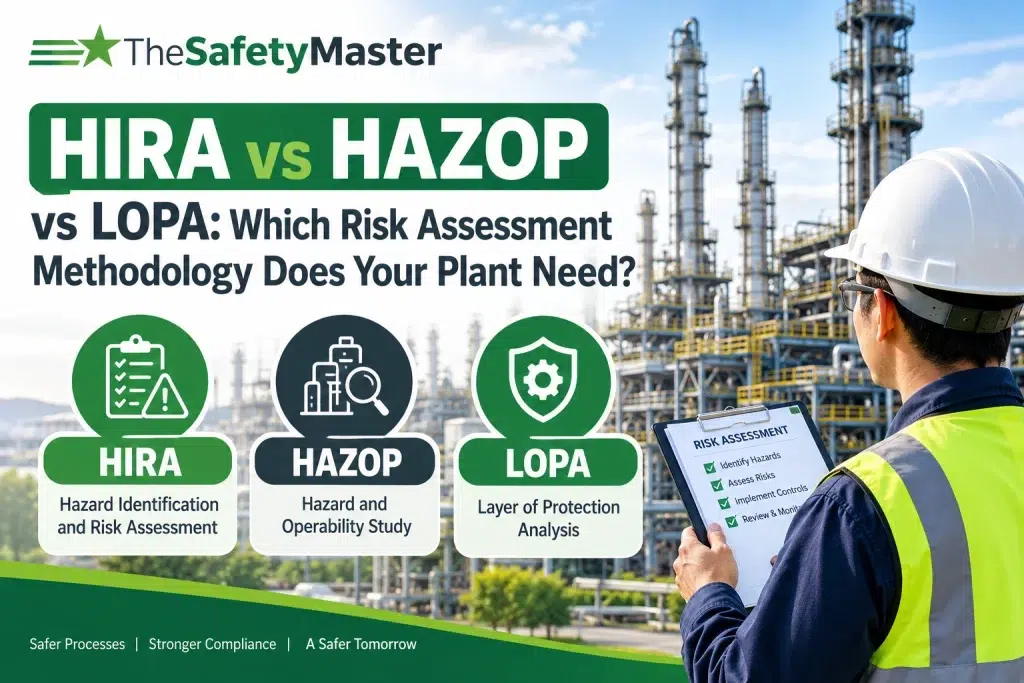
In high-hazard process industries—such as petrochemicals, pharmaceuticals, chemical manufacturing, and heavy engineering—ensuring operational safety and regulatory compliance is paramount. Industrial facilities face dynamic operational risks that, if unmanaged, can lead to catastrophic equipment failure, severe injuries, financial loss, and environmental disasters.
To mitigate these hazards, safety managers and plant engineers rely on structured risk assessment frameworks. Three of the most widely recognized methodologies are Hazard Identification and Risk Assessment (HIRA), Hazard and Operability Study (HAZOP), and Layer of Protection Analysis (LOPA). While all three share the overarching goal of preventing incidents, they differ significantly in scope, depth, execution timing, and analytical complexity.
Selecting the right combination of these studies is critical for establishing a robust Process Hazard Analysis (PHA) framework. In this article, The Safety Master breaks down the differences, applications, and integration strategies of HIRA, HAZOP, and LOPA to help you determine which risk assessment tool your plant needs.
Understanding the Fundamentals: Definitions and Frameworks
Before comparing these methodologies side-by-side, it is essential to understand what each tool designed to accomplish within an industrial safety lifecycle.
What is HIRA (Hazard Identification and Risk Assessment)?
Hazard Identification and Risk Assessment (HIRA) is a broad, qualitative risk assessment method used to identify potential workplace hazards, evaluate associated risks, and implement preventive controls. HIRA covers all aspects of plant operations, including routine activities, non-routine maintenance, physical hazards (slips, trips, falls, ergonomic risks), electrical safety, and environmental threats.
- Key Objective: Identify workplace hazards site-wide and rank them based on severity and likelihood using a qualitative risk matrix.
- Scope: General facility operations, occupational health and safety (OHS), physical hazards, and baseline plant safety.
- Output: A comprehensive risk register highlighting priority hazards and recommended corrective actions.
What is HAZOP? (HAZOP Full Form & HAZOP Study Explained)
The HAZOP full form stands for Hazard and Operability Study. A HAZOP study is a structured, highly systematic, and qualitative examination of a complex process system. Led by a trained chairperson and a multidisciplinary team, HAZOP uses a set of standardized “guidewords” (e.g., No, More, Less, As Well As, Reverse) combined with process parameters (e.g., Flow, Pressure, Temperature, Level) to identify potential deviations from design intent.
- Key Objective: Identify process deviations that could lead to operational upsets, equipment damage, or hazardous releases.
- Scope: Detailed Process & Instrumentation Diagrams (P&IDs), piping, controls, and process flow conditions.
- Output: A detailed HAZOP log sheet listing causes, consequences, existing safeguards, and recommendations.
What is LOPA? (Layer of Protection Analysis)
Layer of Protection Analysis (LOPA) is a semi-quantitative risk assessment technique used to evaluate the effectiveness of existing safeguards and determine if additional independent protection layers (IPLs) are required to reduce process risk to an acceptable level (ALARP — As Low As Reasonably Practicable).
- Key Objective: Quantify the frequency of initiating events and evaluate whether protective layers sufficiently mitigate high-consequence scenarios.
- Scope: Specific high-risk process scenarios identified during qualitative studies like HAZOP.
- Output: Quantified target risk reduction requirements and target Safety Integrity Levels (SIL) for safety instrumented functions.
Deep-Dive Comparisons: Choosing the Right Tool
Understanding how these methodologies interrelate helps industrial plants avoid redundant efforts while ensuring total risk coverage.
HAZOP vs PHA vs LOPA
A common area of confusion is how HAZOP and LOPA fit into Process Hazard Analysis (PHA).
- Process Hazard Analysis (PHA): An umbrella term for a collection of structured evaluations used to identify and manage process safety hazards. PHA encompasses various methods including What-If Analysis, Checklist, HAZID, HAZOP, and LOPA.
- HAZOP: The primary qualitative tool used within a PHA to uncover complex process failure modes.
- LOPA: The semi-quantitative tool applied after a HAZOP to analyze critical scenarios where qualitative judgment alone is insufficient.
+-------------------------------------------------------------------+
| PROCESS HAZARD ANALYSIS (PHA) |
| |
| +--------------------+ --> +------------+ --> +---------+ |
| | Qualitative Phase | | Detailed | | Semi- | |
| | (HAZID / Checklists| | Deviation | | Quant | |
| | & Baseline HIRA) | | (HAZOP) | | (LOPA) | |
| +--------------------+ +------------+ +---------+ |
+-------------------------------------------------------------------+
LOPA vs HAZOP
While both HAZOP and LOPA evaluate process risks, they operate at different levels of analytical depth:
| Feature | HAZOP Study | LOPA (Layer of Protection Analysis) |
| Approach | Qualitative (Guideword-driven) | Semi-Quantitative (Numerical order-of-magnitude) |
| Focus | Identifying all possible process deviations | Evaluating specific high-consequence scenarios |
| Safeguard Assessment | Lists existing safeguards without strict independence testing | Strictly evaluates Independent Protection Layers (IPLs) |
| Primary Output | Action items for design/procedural improvements | Target Risk Reduction & SIL Ratings |
| When Applied | Detailed Engineering / Operating Phase | Post-HAZOP for critical scenarios |
HAZOP vs HAZID
- HAZID (Hazard Identification): A high-level qualitative exercise conducted during the early conceptual or preliminary engineering phase of a project. It identifies major process hazards, facility layout risks, and external threats before detailed designs are finalized.
- HAZOP: A granular study conducted during the detailed engineering phase when P&IDs, equipment specifications, and operating procedures are fully defined.
LOPA vs SIL
It is common to compare LOPA vs SIL (Safety Integrity Level), but they perform complementary functions within functional safety management:
- SIL (Safety Integrity Level): A measure of safety system performance defined by international standards like IEC 61508 and IEC 61511. SIL levels range from 1 to 4, representing the required level of risk reduction for a Safety Instrumented Function (SIF).
- LOPA: The methodology used to determine the target SIL requirement. Through LOPA, safety engineers calculate whether existing IPLs meet risk tolerance criteria or if a SIF with a specific SIL rating is necessary.
Industry-Specific Contexts: What Does LOPA Mean in Aviation/Airlines?
While LOPA is primarily associated with chemical and process safety, the acronym also appears in other sectors. In aviation maintenance and commercial airline management, LOPA stands for “Layout of Passenger Amenities” (or Layout of Passenger Accommodation). It refers to the technical engineering drawing showing the configuration of cabin seating, galleys, emergency exits, and lavatories inside an aircraft.
When evaluating risk assessment frameworks for industrial plants, ensure your team refers to Layer of Protection Analysis as defined by process safety standards.
HIRA vs HAZOP vs LOPA: Comparison Summary
| Criteria | HIRA | HAZOP | LOPA |
| Primary Application | Workplace & Operational Risk | Chemical & Process System Deviations | Critical Process Safety Scenarios |
| Methodology | Qualitative | Qualitative | Semi-Quantitative |
| Required Inputs | Work Procedures, Equipment List | Final P&IDs, Operating Manuals | HAZOP Cause-Consequence Data |
| Team Requirement | EHS Officers, Supervisors, Ops | Multidisciplinary Engineering Team | Risk & Functional Safety Specialists |
| Regulatory Alignment | ISO 45001, OHS Regulations | OSHA 1910.119 (PSM), Process Safety | IEC 61511 / CCPS Guidelines |
How The Safety Master Optimizes Plant Risk Assessment
Navigating process safety regulations, selecting appropriate hazard identification methodologies, and conducting team-based workshops can be challenging. The Safety Master delivers end-to-end Process Safety Management (PSM) and risk assessment consulting tailored to your plant’s specific needs.
Our Core Risk Assessment Services
- Comprehensive HIRA Implementation: Establishing standardized site-wide hazard registers compliant with national and international standards.
- Expert-Led HAZOP Studies: Facilitated by certified HAZOP chairpersons with extensive domain expertise across chemical, oil & gas, pharmaceutical, and manufacturing industries.
- Advanced LOPA & SIL Allocation: Precise semi-quantitative evaluation of safeguards to ensure cost-effective compliance with IEC 61511 standards.
- Integrated Process Hazard Analysis (PHA): Tailored risk management solutions that streamline compliance, minimize downtime, and protect workforce health.
Partnering with The Safety Master ensures your plant chooses the right methodologies at the right stages—saving time, optimizing engineering costs, and building a sustainable culture of safety.
Frequently Asked Questions (FAQs)
Q-Which comes first, HAZID or HAZOP?
HAZID comes before HAZOP. HAZID (Hazard Identification) is performed during the early conceptual or feasibility design phase to identify macro-level hazards. HAZOP is conducted later, during the detailed engineering phase, when complete P&IDs and process details are available.
Q-What is the difference between HAZOP and HIRA?
HIRA evaluates general occupational, physical, and operational hazards across an entire workplace (such as machinery safety, ergonomics, and maintenance tasks). HAZOP focuses specifically on process deviations (like changes in pressure, temperature, or flow) in fluid or chemical systems using structured guidewords.
Q-What is the difference between risk assessment and HIRA?
Risk assessment is a broad concept that includes any process of identifying hazards, evaluating risk, and implementing controls. HIRA is a specific, formal methodology used within occupational health and safety management systems to systematically map and manage those risks.
Q-What is the difference between HAZOP and risk assessment?
Risk assessment is the general practice of identifying and mitigating risks. HAZOP is a specialized, qualitative Process Hazard Analysis (PHA) tool designed specifically for analyzing complex process systems through parameter deviations and guidewords.
Q-What are two types of risk assessments?
The two main categories of risk assessment are:
- Qualitative Risk Assessment: Evaluates hazards based on descriptive scales (e.g., High, Medium, Low severity and likelihood) without exact numerical values (e.g., Baseline HIRA, HAZOP).
- Quantitative Risk Assessment (QRA) / Semi-Quantitative Risk Assessment: Uses numerical frequencies, probabilistic calculations, and statistical data to evaluate risk and safeguard requirements (e.g., LOPA, Fault Tree Analysis).