Mastering the HIRA Method: A Comprehensive Study and Training Guide

How Process Hazard Analysis Plays a Crucial Role in the Indian Process Sector
October 19, 2023
Enhancing Fire Safety: The Crucial Role of Fire Safety Audits
October 19, 2023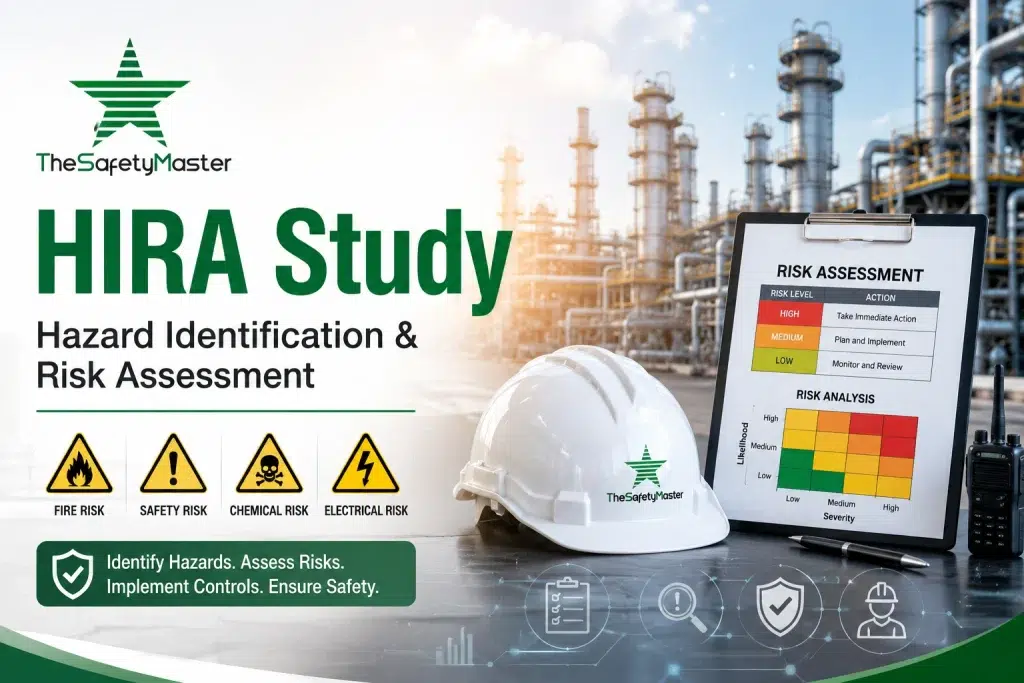
Introduction: Why HIRA Matters in Workplace Safety
In any modern industrial, manufacturing, or corporate setup, occupational health and safety (OH&S) is the highest priority. One of the most powerful and fundamental tools used to achieve a safe working environment is HIRA—Hazard Identification and Risk Assessment.
Whether you are an EHS professional, a safety engineer, or a plant manager, understanding how to systematically identify hazards and evaluate associated risks is critical. This blog serves as your complete guide, exploring everything from foundational concepts to professional HIRA training & certification, safety documents, and practical answers.
What is HIRA in Safety?
HIRA stands for Hazard Identification and Risk Assessment. It is a structured, systematic process used to recognize workplace hazards associated with any job, activity, process, equipment, or environment, and then evaluate the risks arising from those hazards to determine appropriate control measures.
- Hazard: Anything with the potential to cause harm (e.g., chemicals, moving machinery, heights, electrical wiring).
- Risk: The likelihood that a hazard will cause harm, combined with the severity of that harm.
The Core Concept of HIRA
The continuous loop of HIRA flows through these stages:
$$\text{Hazard} \rightarrow \text{Risk} \rightarrow \text{Risk Evaluation} \rightarrow \text{Control Measures} \rightarrow \text{Monitoring}$$
Implementing a robust HIRA process ensures that organizations take proactive, preventive action rather than reacting after an incident occurs.
What is the 4 Step of HIRA?
While methodologies can vary by sector, the core workflow typically breaks down into key structured phases commonly referred to as the steps of the HIRA process:
- Step 1: Define the Activity or Process
- Clearly outline the scope, job, or operation being assessed (e.g., working at height, confined space entry, chemical handling, or equipment maintenance).
- Step 2: Identify Hazards
- Spot all physical, chemical, biological, ergonomic, and electrical hazards that could cause injury or damage.
- Step 3: Assess the Risk
- Evaluate the Likelihood (how often it could happen) and Severity (how bad the consequences would be) to calculate an overall risk rating using a standard risk matrix.
- Step 4: Determine and Implement Control Measures
- Apply the Hierarchy of Controls (Elimination, Substitution, Engineering, Administrative, and PPE) to reduce risks to an acceptable or As Low As Reasonably Practicable (ALARP) level.
Mastering the Hira Method a Comprehensive Study and Training Guide Answers
If you are looking for Mastering the hira method a comprehensive study and training guide answers, here are the key takeaways you need to understand:
- What is the main purpose of HIRA? To protect workers, prevent asset damage, ensure regulatory compliance, and eliminate workplace injuries before they happen.
- Who should be involved in a HIRA study? A multi-disciplinary team comprising safety officers, supervisors, operators, and subject-matter experts who deeply understand the specific process.
- Is HIRA a one-time activity? No. HIRAs must be regularly reviewed, especially after process modifications, machinery updates, new material introductions, or workplace incidents.
Mastering the Hira Method a Comprehensive Study and Training Guide Questions
To test your knowledge or prepare for internal assessments, here are essential Mastering the hira method a comprehensive study and training guide questions you should be able to answer:
- How do you differentiate between a hazard and a risk? (A hazard is the source of potential harm; risk is the chance and severity of that harm actually occurring.)
- What is the Hierarchy of Controls, and why is PPE considered the last resort? (PPE protects the individual, but it does not remove the underlying hazard, whereas higher-level controls like elimination or engineering changes eradicate or isolate the hazard entirely.)
- What factors determine the Risk Rating score? ($\text{Risk} = \text{Likelihood} \times \text{Severity}$).
Mastering the Hira Method a Comprehensive Study and Training Guide Quiz
Test your understanding with this mini-quiz modeled after professional Mastering the hira method a comprehensive study and training guide qui modules:
- Q1: Which of the following represents an engineering control?
- A) Wearing safety glasses
- B) Machine guarding and local exhaust ventilation (Correct)
- C) Conducting a safety toolbox talk
- Q2: When should a HIRA review be triggered?
- A) Only once every 10 years
- B) Only after a fatal accident
- C) During routine updates, plant modifications, or post-incident investigations (Correct)
HIRA Safety Documents and Reports
A complete HIRA study must culminate in official HIRA safety documents. These records provide documented proof of compliance, risk profiles, and hazard mitigations to auditors and management.
Key Components of a HIRA Study Report:
- Objective & Scope: Defining what plant area, equipment, or activity was evaluated.
- Assessment Team Details: Names and designations of participants.
- Risk Matrix Table: Detailed mapping of activities, identified hazards, existing safeguards, likelihood/severity scores, and proposed residual risks.
- Action Plan: Assigning ownership, target dates, and corrective tasks for risk reduction.
HIRA Training & Certification by The Safety Master
Mastering risk assessment methodologies requires structured learning. The Safety Master Private Limited offers expert-led HIRA Training & Certification programs designed for EHS professionals, managers, engineers, and workers.
Benefits of Professional HIRA Training:
- Learn practical hazard identification techniques for routine and non-routine operations.
- Master the correct utilization of risk matrices.
- Gain confidence in implementing the hierarchy of controls effectively.
- Drive safety culture transformation and regulatory compliance across your organization.
Access Free Resources: HIRA PDF and Training PPT
To support your professional growth and continuous learning, you can access helpful reference materials:
- Hazard Identification and Risk Assessment (HIRA pdf free download): Look for standard corporate safety templates and guidelines to build compliant assessment registers.
- HIRA training PPT free download: Ideal for corporate trainers and safety officers looking to conduct internal awareness sessions for employees.
(Tip: Reach out directly to industrial safety consultants like The Safety Master for official training modules, customized PPTs, and certification guidance.)
Conclusion
Mastering the HIRA method is a vital milestone for any safety-conscious organization or individual professional. By following a disciplined 4-step framework, utilizing correct risk matrices, and implementing proactive control measures, workplaces can dramatically reduce incidents and foster a resilient safety culture.
To take your organization’s occupational health and safety standards to the next level, partner with The Safety Master for comprehensive HIRA studies, training, and certification solutions today.