Reliable Quantitative Risk Assessment Services in Malaysia for Major Hazard Installations and Industrial Sites

Professional HAZOP Study and Risk Assessment in Singapore for Chemical and Oil Refineries
November 27, 2026
How to Achieve Behavior-Based Safety Implementation in UAE to Eliminate Workplace Hazards
November 27, 2026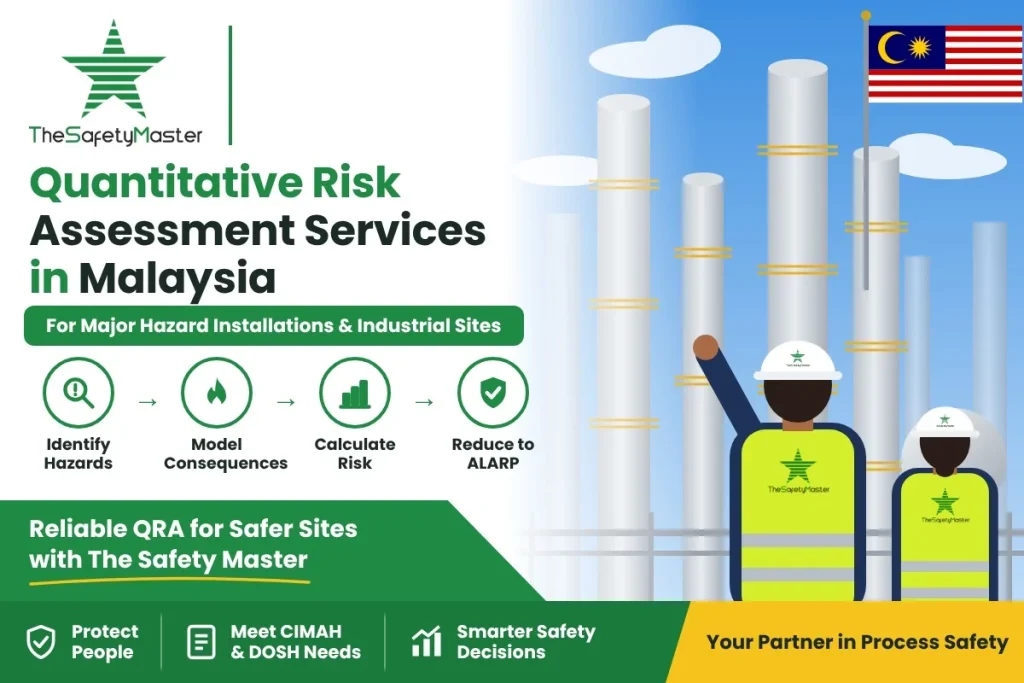
Malaysia’s oil and gas terminals, petrochemical complexes, LPG depots and chemical plants handle hazardous substances in quantities that can harm people well beyond the plant fence. A fire, explosion or toxic gas release at one of these sites can affect workers, neighbouring factories, homes and the environment within minutes. That is why regulators, insurers and investors increasingly expect site owners to show their risk in numbers, not just in words.
This is where Quantitative Risk Assessment Services in Malaysia become essential. At The Safety Master, we help major hazard installations and industrial sites measure, understand and reduce their risk with clear, defensible QRA studies that support compliance and better decisions.
What Is Quantitative Risk Assessment (QRA)?
Quantitative Risk Assessment is a structured method that estimates how likely a major accident is and how severe its consequences would be. Instead of labelling a hazard “high” or “low”, a QRA calculates risk using failure frequencies, release scenarios, weather data, population data and validated consequence models.
The result is a set of measurable outputs, such as individual risk contours and societal risk (F-N) curves. These show exactly where the risk sits, who is exposed and whether the level is tolerable. Management can then prioritise safeguards based on facts rather than assumptions.
Why QRA Matters for Major Hazard Installations in Malaysia
Regulatory Expectations Under CIMAH and DOSH
In Malaysia, industrial activities involving hazardous substances are governed by the Occupational Safety and Health Act 1994 and the Occupational Safety and Health (Control of Industrial Major Accident Hazards) Regulations 1996, commonly known as the CIMAH Regulations. Major hazard installations must prepare a Report on Industrial Activity, supported by a registered Major Hazard Competent Person, and submit it to the Department of Occupational Safety and Health (DOSH).
A robust QRA is a core part of that report. It demonstrates that the installation’s major accident hazards have been identified, assessed and controlled. Non-major hazard installations also need to demonstrate safe operation, and a QRA or consequence study is often the clearest way to do it.
Business Benefits Beyond Compliance
A QRA is far more than a regulatory document. It also helps you:
- Protect employees, contractors and surrounding communities
- Make informed decisions on plant layout, expansion and new projects
- Justify investment in fire protection, gas detection and emergency shutdown systems
- Set safe distances for control rooms, occupied buildings and site boundaries
- Strengthen emergency response plans with realistic scenarios
- Support insurance negotiations and stakeholder confidence
Who Needs Quantitative Risk Assessment Services in Malaysia?
The Safety Master supports a wide range of high-hazard and industrial facilities, including:
- Oil and gas terminals, refineries and offshore support bases
- Petrochemical and specialty chemical plants
- LPG, LNG and fuel storage depots
- Power plants and utility facilities
- Pharmaceutical, fertiliser and manufacturing sites using hazardous chemicals
- Warehouses storing flammable or toxic substances
- Pipelines and industrial parks planning new developments
If your site stores or processes hazardous substances near, at or above threshold quantities, a QRA should be part of your risk management system.
The Safety Master’s QRA Methodology
Our approach follows internationally recognised practice and is adapted to Malaysian regulatory expectations. Every study is transparent, traceable and easy for management and regulators to review.
Step 1: Hazard Identification
We begin by reviewing process flow diagrams, P&IDs, material inventories and plot plans. Through site visits and workshops, we identify credible loss-of-containment scenarios, from small leaks to full-bore ruptures of vessels, pipelines and tanks.
Step 2: Frequency Analysis
Each scenario is assigned a likelihood using recognised failure-rate databases, adjusted for your equipment, operating conditions and safeguards. Event trees then model how a release may develop, for example into a jet fire, flash fire or vapour cloud explosion.
Step 3: Consequence Modelling
Using proven modelling software, we calculate how far each hazardous outcome could reach and how it would affect people and structures.
Fire Scenarios
We model jet fires, pool fires, flash fires and fireballs, estimating thermal radiation levels and their effect on people and equipment.
Explosion Scenarios
We assess vapour cloud explosions and vessel bursts, calculating overpressure levels that can damage buildings and injure occupants.
Toxic Dispersion
For toxic substances such as ammonia, chlorine or hydrogen sulphide, we model gas cloud dispersion under local Malaysian weather conditions to estimate toxic exposure zones.
Step 4: Risk Calculation and Presentation
Frequencies and consequences are combined with population and ignition data to produce:
- Individual risk contours plotted on your site and surrounding area
- Societal risk F-N curves showing the likelihood of multiple-fatality events
- Risk ranking identifying the scenarios that contribute most to overall risk
Step 5: Risk Evaluation and Recommendations
Results are compared against recognised risk tolerability criteria. Where risk is not as low as reasonably practicable (ALARP), we recommend practical, cost-effective measures, such as improved isolation, additional detection, layout changes or building reinforcement.
Key Deliverables You Can Expect
Every QRA project from The Safety Master includes:
- A detailed QRA report suitable for regulatory submission and internal use
- Scenario lists, assumptions and data sources, fully documented
- Consequence maps for fire, explosion and toxic hazards
- Individual and societal risk results with clear visuals
- A prioritised action plan to reduce risk
- A management presentation explaining findings in plain language
Why Choose The Safety Master for QRA in Malaysia?
Experienced Process Safety Specialists
Our team brings hands-on experience in process safety, hazard analysis and major accident prevention across oil and gas, chemical and manufacturing industries.
Regulatory Understanding
We understand DOSH expectations and CIMAH requirements, so your QRA is structured to support your Report on Industrial Activity and demonstration of safe operation.
Practical, Actionable Results
We do not simply deliver numbers. We explain what the results mean for your operations and recommend realistic improvements that fit your budget and schedule.
Integrated Safety Services
QRA works best alongside other studies. The Safety Master also supports HAZOP, HAZID, fire and explosion analysis, SIL studies, emergency response planning and safety audits, giving you one partner for complete risk management.
When Should You Update Your QRA?
A QRA is a living document. You should review or update it when:
- New process units, tanks or pipelines are added
- Hazardous inventories or operating conditions change
- New buildings, occupied areas or nearby developments appear
- A significant incident or near miss occurs
- Regulators or insurers request a review
- Management of Change (MOC) affects major hazard scenarios
Keeping your QRA current ensures your risk picture always reflects reality.
Frequently Asked Questions
Q-Is QRA mandatory in Malaysia?
For major hazard installations under the CIMAH Regulations, a risk assessment is a key part of the Report on Industrial Activity submitted to DOSH. A QRA is the most widely accepted way to meet this requirement.
Q-How long does a QRA study take?
Most studies take a few weeks to a few months, depending on site size, number of scenarios and data availability.
Q-What information do I need to provide?
Typically, plot plans, P&IDs, process data, material inventories, population data and details of existing safeguards.
Concal.lusion
Major accidents are rare, but their impact can be devastating. A well-executed QRA gives you the clarity to protect people, meet regulatory obligations and invest wisely in safety. If you are looking for reliable Quantitative Risk Assessment Services in Malaysia, The Safety Master is ready to help your major hazard installation or industrial site turn risk data into confident, practical action.
Contact The Safety Master today to discuss your QRA requirements and request a tailored propos