14 Essential Elements of Process Safety Management for High-Hazard Industries

How to Choose the Best Fire Safety Audit Companies in India: A Complete Guide
September 28, 2026
How to Conduct an Effective Workplace Safety Audit: A Step-by-Step Checklist
September 29, 2026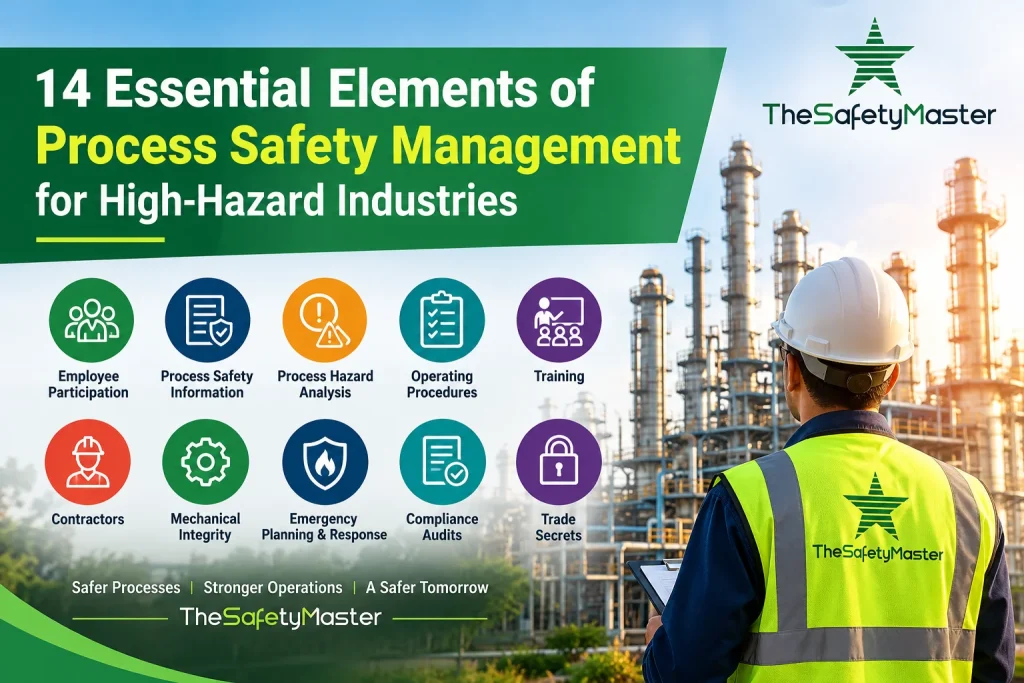
Process Safety Management (PSM) is a structured approach used to identify, assess, and control hazards associated with highly hazardous chemicals and industrial processes. It is especially important in industries such as chemicals, petrochemicals, oil and gas, pharmaceuticals, refineries, and manufacturing facilities.
The 14 elements of Process Safety Management provide a systematic framework for managing process hazards throughout the life of a facility. The Safety Master helps organizations strengthen process safety through audits, risk assessments, training, and practical safety management solutions.
What Is Process Safety Management?
Process Safety Management is a management system designed to prevent major incidents such as fires, explosions, toxic releases, and uncontrolled chemical reactions.
Unlike personal safety, which mainly focuses on preventing individual injuries, process safety focuses on preventing failures in processes, equipment, systems, and controls that can result in serious incidents.
An effective PSM program combines technical information, operating procedures, employee training, maintenance, emergency planning, management controls, and continuous improvement.
What Are the 14 Elements of Process Safety Management?
The 14 elements commonly associated with OSHA’s Process Safety Management standard are:
- Employee Participation
- Process Safety Information
- Process Hazard Analysis
- Operating Procedures
- Training
- Contractors
- Pre-Startup Safety Review
- Mechanical Integrity
- Hot Work Permit
- Management of Change
- Incident Investigation
- Emergency Planning and Response
- Compliance Audits
- Trade Secrets
Each element supports a different part of the process safety lifecycle.
1. Employee Participation
Employees who work directly with hazardous processes have practical knowledge about equipment, procedures, and workplace risks.
Employee participation ensures that workers can contribute to PSM activities such as:
- Process hazard analysis
- Procedure development
- Hazard identification
- Incident investigations
- Safety reviews
- Management of change
- Corrective actions
Involving employees can help identify hazards that may not be obvious from technical documents alone.
2. Process Safety Information
Process Safety Information (PSI) provides the technical foundation for identifying and understanding process hazards.
It may include information about:
- Hazardous chemicals
- Chemical properties
- Process chemistry
- Process equipment
- Operating limits
- Safety systems
- Equipment design
- Piping and instrumentation diagrams
Accurate and updated information is important because many PSM activities depend on this information.
3. Process Hazard Analysis
Process Hazard Analysis (PHA) is used to identify potential hazards and evaluate how they could affect people, equipment, the environment, and operations.
Common PHA techniques include:
- HAZOP
- What-If Analysis
- What-If/Checklist
- Failure Mode and Effects Analysis
- Fault Tree Analysis
- Process Hazard Analysis checklists
A PHA should identify potential causes, consequences, existing safeguards, and recommendations for reducing risk.
4. Operating Procedures
Written operating procedures explain how processes should be operated safely during different stages.
Procedures may cover:
- Initial startup
- Normal operations
- Temporary operations
- Emergency operations
- Normal shutdown
- Emergency shutdown
- Startup after maintenance
Procedures should be clear, accessible, and periodically reviewed.
5. Training
Employees must understand the hazards associated with their jobs and know how to operate processes safely.
PSM training can cover:
- Process hazards
- Operating procedures
- Emergency procedures
- Safe work practices
- Equipment operation
- Chemical hazards
- Incident prevention
Refresher training should also be provided when required and when significant process or procedural changes occur.
6. Contractors
Contractors may work around hazardous processes during construction, maintenance, inspection, or other activities.
A contractor safety program should address:
- Contractor selection
- Safety performance
- Hazard communication
- Site-specific requirements
- Safe work practices
- Emergency procedures
- Contractor training
- Performance monitoring
Effective contractor management helps ensure that external workers understand the risks of the facility.
7. Pre-Startup Safety Review
A Pre-Startup Safety Review (PSSR) confirms that important safety requirements have been completed before a new or modified process is placed into service.
The review can verify:
- Equipment installation
- Safety procedures
- Training
- Process safety information
- Hazard analysis recommendations
- Emergency systems
- Management of change requirements
PSSR helps prevent a new or modified process from starting before essential safety controls are ready.
8. Mechanical Integrity
Mechanical Integrity focuses on maintaining equipment and systems that are important for process safety.
It can include inspection and maintenance of:
- Pressure vessels
- Storage tanks
- Piping systems
- Relief systems
- Emergency shutdown systems
- Pumps
- Compressors
- Safety-critical instruments
Inspection and testing help identify deterioration or failures before they create major process hazards.
9. Hot Work Permit
Hot work includes activities that can produce an ignition source, such as welding, cutting, brazing, or other spark- or flame-producing work.
A hot work permit system helps control ignition hazards by checking conditions such as:
- Flammable materials
- Gas testing
- Fire protection
- Nearby equipment
- Required isolation
- Fire watch
- Work area preparation
Proper authorization and precautions are essential before performing hot work near hazardous processes.
10. Management of Change
Management of Change (MOC) controls changes that could affect process safety.
Changes may involve:
- Equipment
- Chemicals
- Technology
- Procedures
- Operating conditions
- Instrumentation
- Process parameters
A proper MOC process evaluates the technical basis, safety impact, required procedures, training needs, and authorization before implementing a change.
11. Incident Investigation
Incident investigations help organizations understand why an incident or near miss occurred.
A good investigation should identify:
- What happened
- When and where it happened
- Immediate causes
- Contributing factors
- Root causes
- Corrective actions
- Preventive actions
The objective is to learn from incidents and prevent similar events from happening again.
12. Emergency Planning and Response
High-hazard facilities need effective emergency plans for events such as:
- Fire
- Explosion
- Toxic gas release
- Chemical release
- Equipment failure
- Natural hazards
- Other process emergencies
Emergency plans should define responsibilities, communication methods, evacuation arrangements, emergency equipment, and response procedures.
13. Compliance Audits
Compliance audits evaluate whether the PSM program is being implemented properly.
Audits can examine:
- PSM procedures
- Training records
- PHA documentation
- MOC records
- Mechanical integrity
- Incident investigations
- Contractor management
- Emergency response
- Corrective actions
Audit findings should be documented, assigned to responsible persons, and tracked until closure.
14. Trade Secrets
Trade secret provisions address situations where confidential information is involved in process safety activities.
Organizations still need to provide necessary information to appropriate personnel when it is required for safe operation, hazard assessment, emergency response, or other PSM activities, subject to applicable requirements.
Why Are the 14 PSM Elements Important?
The 14 elements work together rather than operating as separate activities.
For example, a change in equipment may require Management of Change. The change may also require an updated PHA, revised Process Safety Information, employee training, updated operating procedures, and possibly a Pre-Startup Safety Review.
This integrated approach helps organizations identify hazards before they become major incidents.
PSM vs Occupational Safety Management
Process safety and occupational safety address different types of risks.
Occupational safety generally focuses on hazards such as:
- Slips and falls
- Electrical hazards
- Manual handling
- Machine safety
- Personal protective equipment
Process safety focuses more on:
- Loss of containment
- Fires
- Explosions
- Toxic releases
- Chemical reactions
- Equipment failures
- Process deviations
A strong HSE program needs both approaches.
How Can Organizations Improve Their PSM Program?
Organizations can strengthen Process Safety Management by:
- Keeping process safety information updated
- Conducting systematic hazard studies
- Reviewing operating procedures regularly
- Providing role-specific training
- Managing contractors effectively
- Maintaining safety-critical equipment
- Controlling process changes
- Investigating incidents and near misses
- Conducting periodic PSM audits
- Tracking corrective actions
- Practicing emergency response
- Encouraging employee participation
Regular review is important because processes, equipment, personnel, and operating conditions can change over time.
Role of The Safety Master in Process Safety Management
The Safety Master supports organizations with process safety and risk management solutions designed to identify hazards, evaluate risks, and improve safety performance.
Organizations can use structured approaches such as PHA, HAZOP, HIRA, PSM audits, safety training, and management systems to build stronger process safety practices.
A properly implemented PSM framework can help organizations understand process hazards, strengthen safeguards, and maintain better control over high-risk operations.
Frequently Asked Questions
Q-What are the 14 elements of Process Safety Management?
The 14 elements are Employee Participation, Process Safety Information, Process Hazard Analysis, Operating Procedures, Training, Contractors, Pre-Startup Safety Review, Mechanical Integrity, Hot Work Permit, Management of Change, Incident Investigation, Emergency Planning and Response, Compliance Audits, and Trade Secrets.
Q-What are the 14 elements of a safety management system?
The 14 elements listed above specifically refer to the OSHA Process Safety Management framework. Other safety management systems may use different structures and numbers of elements.
Q-How many elements are there in PSM?
The OSHA Process Safety Management framework contains 14 elements. These elements address different areas of process hazard identification, prevention, control, operation, maintenance, training, and management.
Q-What are the essential elements of a safety management system?
Essential elements commonly include leadership and commitment, hazard identification, risk assessment, operational controls, training and competence, emergency preparedness, incident investigation, monitoring, auditing, and continual improvement. The exact structure depends on the safety management system being used.
Q-What are the 7 elements of ISO 45001?
ISO 45001 does not use a simple seven-element PSM structure. Its requirements are organized around clauses covering areas such as organizational context, leadership and worker participation, planning, support, operation, performance evaluation, and improvement.
Q-What are the 8 elements of safety management?
There is no single universal eight-element safety management model. Different organizations and standards divide safety management into different categories. Common areas include leadership, planning, risk management, competence, operational control, emergency preparedness, performance monitoring, and improvement.
Q-What are 5 elements of safety?
Five commonly used areas are leadership and commitment, hazard identification, risk control, training and communication, and monitoring and improvement. The exact five elements can vary depending on the safety framework.
Q-What are the key elements of an HSE management system?
Key elements generally include leadership and commitment, legal compliance, hazard and risk management, operational controls, training, emergency preparedness, incident management, performance monitoring, audits, and continual improvement.