Industrial Fire Safety Audit: A Technical Framework for Identifying Critical Fire Risks

HIRA vs HAZOP vs LOPA: Which Risk Assessment Methodology Does Your Plant Need?
September 14, 2026
Electrical Safety Audit: Identifying Shock, Arc Flash, Short-Circuit and Fire Hazards
September 17, 2026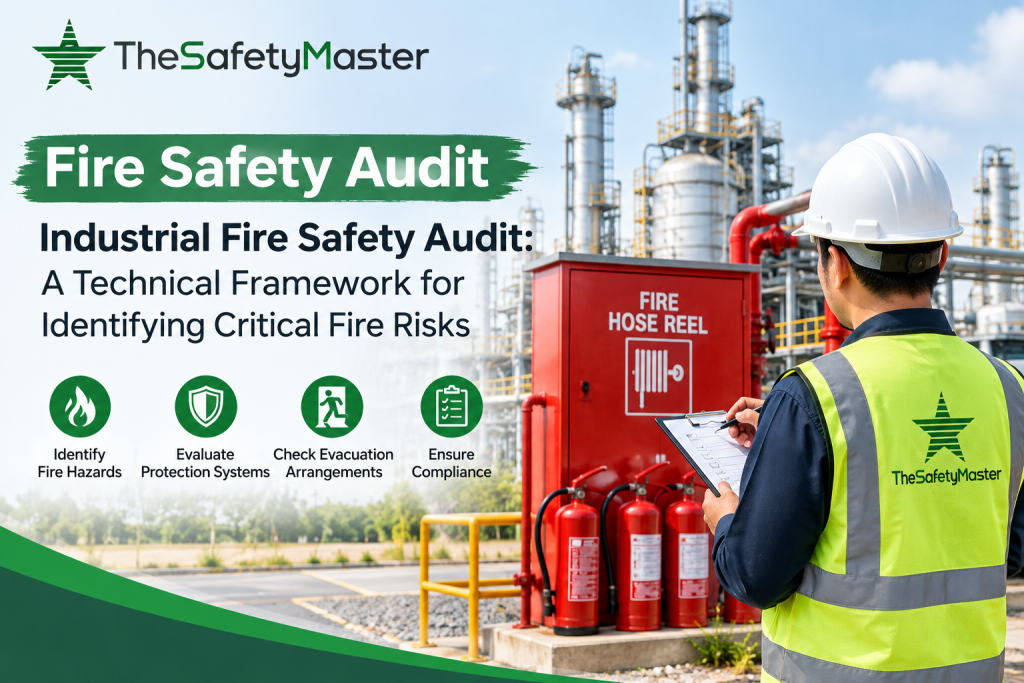
A Fire Safety Audit is a systematic review of fire hazards, protection systems, emergency arrangements, and safety practices within an industrial facility. Manufacturing plants, warehouses, chemical facilities, process industries, and other workplaces can have complex fire risks due to combustible materials, electrical equipment, hot work, flammable liquids, gases, and industrial processes.
A well-planned Fire Safety Audit helps identify unsafe conditions before they lead to a fire emergency. It also helps organizations review their fire prevention measures, emergency preparedness, fire protection equipment, evacuation arrangements, and compliance requirements. The Safety Master provides professional safety solutions that can help organizations identify and control workplace fire risks.
What Is an Industrial Fire Safety Audit?
An industrial Fire Safety Audit is a structured examination of a facility’s fire hazards and fire protection arrangements. The audit looks at both physical conditions and management practices.
Key Areas Covered in a Fire Safety Audit
A technical audit may review:
- Fire hazards and ignition sources
- Electrical installations
- Flammable and combustible materials
- Fire detection and alarm systems
- Fire extinguishers
- Hydrant and sprinkler systems
- Fire pumps and water supply
- Emergency exits and escape routes
- Emergency lighting and signage
- Fire doors and compartmentation
- Hot work activities
- Storage arrangements
- Emergency response procedures
- Fire drills and training
- Housekeeping practices
- Inspection and maintenance records
Why Industrial Facilities Need Fire Risk Identification
Industrial facilities can contain multiple sources of fire simultaneously. A small ignition source can become a major incident when fuel, oxygen, and poor control measures are present.
A Fire Safety Audit helps identify these conditions and recommends practical corrective actions.
Technical Framework for an Industrial Fire Safety Audit
A structured audit should follow a consistent methodology so that important hazards are not missed.
1. Review Facility Information
Before the physical inspection, auditors should understand the facility’s:
- Process activities
- Building layout
- Occupancy
- Raw materials
- Finished products
- Chemical storage
- Production equipment
- Utilities
- Fire protection systems
- Previous fire incidents
- Emergency procedures
Documents to Review
Important documents may include:
- Fire protection drawings
- Emergency response plans
- Equipment inspection records
- Fire drill records
- Electrical inspection reports
- Fire system maintenance records
- Training records
- Risk assessments
- Relevant statutory approvals
2. Identify Fire Hazards
The next step is to identify sources that could start or spread a fire.
Common Industrial Fire Hazards
Some common hazards include:
- Electrical short circuits
- Overloaded electrical systems
- Hot surfaces
- Welding and cutting
- Flammable liquids
- Flammable gases
- Dust accumulation
- Poor chemical storage
- Combustible packaging
- Improper waste disposal
- Smoking in restricted areas
- Poor housekeeping
Ignition Source Assessment
Auditors should examine potential ignition sources and determine whether adequate controls are in place.
For example, hot work areas should have suitable authorization, isolation, fire watch, and post-work monitoring arrangements.
3. Evaluate Fire Protection Systems
Fire protection systems are an important part of an industrial audit.
Active Fire Protection
The audit may examine:
- Fire alarms
- Smoke and heat detectors
- Sprinkler systems
- Hydrant systems
- Fire extinguishers
- Fire pumps
- Fire water tanks
- Foam systems
- Gas suppression systems where applicable
Fire Extinguisher Inspection
The auditor should check whether extinguishers are:
- Suitable for the expected fire class
- Correctly located
- Clearly accessible
- Properly identified
- Periodically inspected
- Maintained in usable condition
Passive Fire Protection
Passive protection can include:
- Fire-rated walls
- Fire doors
- Fire stopping
- Fire-resistant construction
- Compartmentation
- Protected escape routes
These measures can help limit fire and smoke spread.
4. Assess Emergency Evacuation Arrangements
An industrial facility should provide safe and accessible escape routes.
Evacuation Checklist
The audit can assess:
- Number and location of exits
- Exit accessibility
- Emergency lighting
- Exit signage
- Assembly points
- Escape route obstructions
- Evacuation procedures
- Special arrangements for vulnerable persons
- Emergency communication systems
Fire Drill Evaluation
Fire drills can help determine whether employees understand emergency procedures. The audit should consider drill frequency, employee participation, evacuation time, communication, and lessons identified from previous drills.
5. Evaluate Fire Safety Management
Fire safety is not limited to equipment. Management systems are also important.
Important Management Controls
The audit should consider:
- Fire safety responsibilities
- Employee training
- Contractor management
- Permit-to-work systems
- Hot work controls
- Inspection programs
- Maintenance programs
- Emergency response plans
- Incident reporting
- Corrective action tracking
Fire Risk Rating and Corrective Actions
After identifying hazards, findings can be categorized according to their potential severity and likelihood.
Typical Finding Categories
An organization may classify findings as:
- Critical
- High
- Medium
- Low
The exact classification should be based on the organization’s approved risk matrix and applicable requirements.
Corrective Action Plan
Each significant finding should have:
- Hazard description
- Location
- Risk level
- Recommended action
- Responsible person
- Target completion date
- Verification status
This approach makes the audit more useful than simply producing a list of observations.
Role of Standards in Fire Risk Assessment
Organizations should select applicable standards according to their location, building type, industry, fire hazards, and legal requirements.
ISO 31000 and Fire Risk
ISO 31000 provides general principles and guidelines for risk management. It is not a fire-specific risk assessment standard.
For fire safety, organizations may also need to consider applicable fire codes, building regulations, occupational safety requirements, and relevant international or national standards.
Benefits of an Industrial Fire Safety Audit
A properly conducted Fire Safety Audit can help organizations:
- Identify critical fire hazards
- Improve fire prevention controls
- Review fire protection systems
- Improve emergency preparedness
- Reduce unsafe conditions
- Strengthen employee awareness
- Identify maintenance gaps
- Prioritize corrective actions
- Support regulatory compliance
- Improve overall fire safety management
Fire Safety Audit Checklist for Industrial Facilities
A practical checklist can cover:
Building and Occupancy
- Building construction
- Occupancy classification
- Fire compartments
- Fire-rated doors
- Escape routes
- Exit doors
Electrical Safety
- Electrical panels
- Cable condition
- Earthing
- Overloading
- Temporary connections
- Electrical maintenance
Fire Protection
- Fire extinguishers
- Hydrants
- Sprinklers
- Fire alarms
- Fire pumps
- Fire water storage
- Emergency lighting
Process Safety
- Flammable materials
- Hot work
- Chemical storage
- Gas cylinders
- Combustible dust
- Process equipment
Emergency Preparedness
- Emergency plan
- Fire drills
- Employee training
- Assembly points
- Emergency communication
- Emergency response team
How The Safety Master Can Support Fire Safety
The Safety Master focuses on safety and risk-management solutions for industrial and workplace environments. A professional audit approach can help organizations systematically identify hazards, evaluate existing controls, document gaps, and develop corrective actions.
The objective of an industrial Fire Safety Audit is not only to find problems but also to provide a practical framework for reducing fire risk and improving emergency preparedness.
FAQs
Q-What is the purpose of a fire audit?
The purpose of a fire audit is to systematically identify fire hazards, evaluate existing fire prevention and protection measures, check emergency preparedness, and identify corrective actions. It can also help an organization review applicable fire safety and regulatory requirements.
Q-What is the ISO standard for fire risk assessment?
There is no single ISO standard that serves as a universal, dedicated fire risk assessment standard for every facility. ISO 31000 provides general principles and guidelines for risk management, while fire risk assessment may also need to consider applicable fire safety standards, building codes, regulations, and industry-specific requirements.
Q-What is type 3 fire risk assessment?
The term Type 3 fire risk assessment is not a universal classification used in every country or fire safety framework. In some assessment schemes, different types indicate increasing levels of assessment detail or areas examined. The exact meaning should therefore be confirmed against the specific standard, regulation, or assessment methodology being used.
Q-What are the 5 main steps of a fire risk assessment?
A practical five-step approach is:
- Identify fire hazards.
- Identify people who may be at risk.
- Evaluate the risks and existing controls.
- Record findings and implement corrective actions.
- Review and update the assessment periodically or when significant changes occur.
Q-What are the four types of fire risk assessment?
There is no single internationally universal set of four fire risk assessment types. Different regulations and professional methodologies classify assessments differently. The appropriate assessment type depends on the building, occupancy, complexity, process hazards, and applicable legal or technical requirements.
Q-What are the 5 key elements of fire safety?
Five fundamental elements of fire safety can be considered:
- Fire prevention – controlling ignition sources and combustible materials.
- Fire detection – identifying a fire quickly.
- Fire protection – providing suitable suppression and protection systems.
- Safe evacuation – ensuring people can escape safely.
- Emergency preparedness – providing training, procedures, drills, and response arrangements.
Conclusion
An industrial Fire Safety Audit provides a structured way to identify fire hazards, examine protection systems, evaluate emergency arrangements, and prioritize corrective actions. Regular audits combined with effective maintenance, employee training, housekeeping, and emergency preparedness can strengthen fire safety across industrial facilities. The Safety Master can help organizations build a systematic approach to identifying and managing workplace fire risks.