A Complete Guide to Learning HAZOP Training Online for Process Safety Professionals

How to Use a HIRA Risk Matrix to Evaluate and Control Workplace Hazards
October 6, 2026
What to Include in a Professional Fire Safety Audit Report for Hospital Compliance
October 6, 2026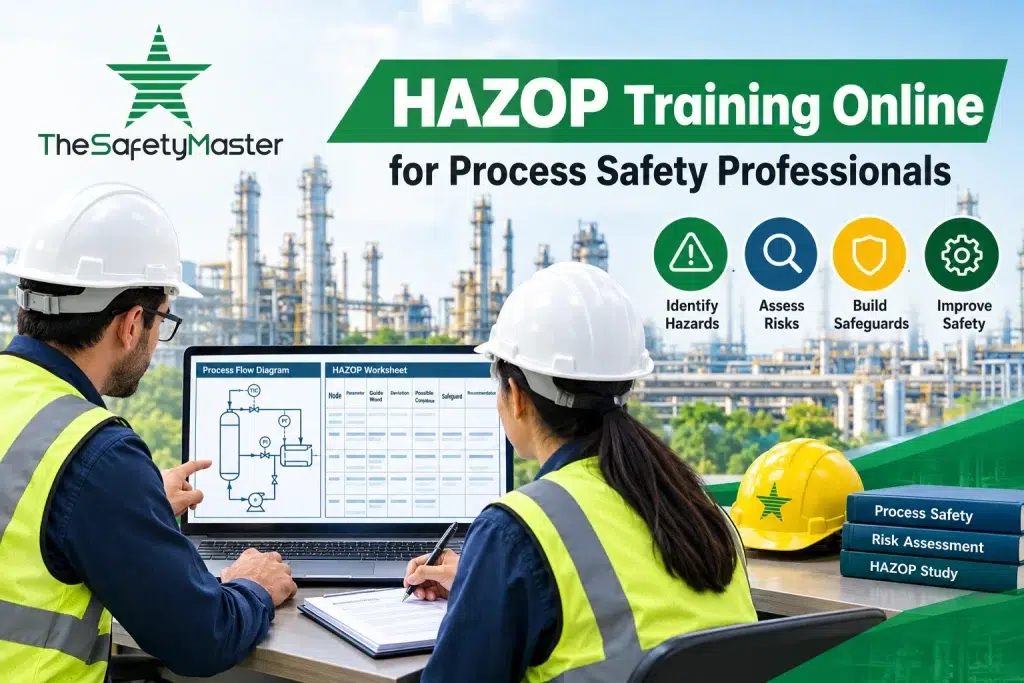
Process safety professionals need practical knowledge to identify hazards, understand process deviations, and reduce the risk of major accidents. HAZOP Training Online is a convenient way to learn the principles and techniques used in Hazard and Operability Studies.
HAZOP training helps safety professionals understand how process parameters can deviate from normal operating conditions and how these deviations may lead to hazardous events. The Safety Master provides safety training and professional learning resources that can help learners develop their understanding of HAZOP and process safety.
What Is HAZOP Training Online?
HAZOP Training Online is a structured learning program that teaches professionals how to conduct and participate in a HAZOP study. HAZOP stands for Hazard and Operability Study.
The training generally covers:
- Basic HAZOP concepts
- HAZOP terminology
- Guide words
- Process deviations
- Causes and consequences
- Existing safeguards
- Risk evaluation
- Recommendations
- HAZOP documentation
- HAZOP team roles
- HAZOP study methodology
Online learning allows professionals to study these concepts from their workplace or home and revise important topics when required.
Why Is HAZOP Important in Process Safety?
HAZOP is widely used to identify potential hazards in process industries. It is particularly useful for chemical, petrochemical, oil and gas, pharmaceutical, power, and other industries where process failures can create serious safety risks.
A properly conducted HAZOP study can help organizations identify:
- Fire and explosion hazards
- Toxic gas release
- High or low pressure
- High or low temperature
- Equipment failure
- Flow deviations
- Human errors
- Control system problems
- Loss of containment
- Unsafe operating conditions
HAZOP in industrial safety supports a proactive approach because potential problems can be identified before they result in an incident.
What Do You Learn During a HAZOP Study?
A HAZOP study is normally conducted by a multidisciplinary team. The team reviews a process systematically and examines possible deviations from the intended design or operating conditions.
HAZOP Guide Words
Common guide words include:
- No or Not
- More
- Less
- As Well As
- Part Of
- Reverse
- Other Than
These guide words are combined with process parameters such as flow, pressure, temperature, level, composition, and reaction.
Causes and Consequences
The team identifies possible causes of each deviation and considers what could happen if the deviation occurs.
For example:
Deviation: More Flow
Possible Cause: Control valve failure
Possible Consequence: Equipment overloading or unsafe operating conditions
Safeguard: Alarm, interlock, or shutdown system
Recommendation: Improve control or protection measures where required
This systematic process makes HAZOP study in safety an important part of process hazard analysis.
HAZOP Study in a Chemical Plant
Chemical plants often handle flammable, toxic, corrosive, or reactive substances. A HAZOP study can help identify hazards associated with process equipment and operating conditions.
A chemical plant HAZOP may review:
- Reactors
- Storage tanks
- Pumps
- Compressors
- Heat exchangers
- Distillation columns
- Pipelines
- Pressure vessels
- Instrumentation
- Safety systems
Professionals may also search for a HAZOP study in chemical plant PDF to understand typical study formats and documentation. However, sample PDFs should be used for learning purposes and not treated as a substitute for a project-specific HAZOP study.
HAZOP Certification Course
A HAZOP certification course can help safety professionals build structured knowledge of HAZOP methodology. Depending on the course provider, the program may include theory, practical examples, case studies, exercises, and assessments.
Before choosing a course, professionals should check:
- Course syllabus
- Trainer experience
- Practical HAZOP exercises
- Industry examples
- Assessment method
- Certificate details
- Online learning format
- Course duration
- Support provided after training
A certificate can demonstrate completion of training, but practical understanding and the ability to participate effectively in a HAZOP team are equally important.
IChemE HAZOP Training
IChemE HAZOP training is another area that process safety professionals may consider when comparing HAZOP learning options. IChemE is widely recognized within the chemical engineering and process safety community.
When selecting any HAZOP program, learners should compare the course content, practical learning, trainer expertise, learning objectives, and certification requirements rather than choosing a course only because of its name.
Is HAZOP Certification Online Free Available?
Many learners search for HAZOP Certification online free because they want to understand HAZOP before paying for professional training.
Free resources can be useful for learning basic concepts such as:
- What is HAZOP?
- HAZOP guide words
- HAZOP terminology
- Basic deviations
- Causes and consequences
- Safeguards
- HAZOP examples
However, a free online resource may not provide the same depth as a structured professional certification course. Learners should also verify whether a certificate offered for free is an actual professional certification or simply a certificate of participation or course completion.
How to Learn HAZOP Training Online Effectively
To get better results from HAZOP Training Online, follow a step-by-step learning approach.
Start With Process Safety Fundamentals
First understand basic process safety concepts, including hazards, risk, process equipment, control systems, and safety barriers.
Learn HAZOP Terminology
Understand terms such as:
- Node
- Design intent
- Deviation
- Cause
- Consequence
- Safeguard
- Recommendation
- Guide word
Practice With Process Examples
Study simple process diagrams and identify possible deviations. Practical exercises make HAZOP concepts easier to understand.
Learn HAZOP Documentation
Understand how findings are recorded in a HAZOP worksheet. A typical worksheet can include the node, parameter, guide word, deviation, causes, consequences, safeguards, recommendations, and actions.
Study Realistic Case Studies
Case studies help learners understand how HAZOP is applied in chemical plants and other process industries.
HAZOP and Industrial Safety
HAZOP in industrial safety helps organizations identify process-related hazards before they develop into serious incidents. It can support safer design, commissioning, operation, modification, and maintenance activities.
HAZOP may be applied during:
- New plant design
- Process modifications
- Expansion projects
- Pre-commissioning
- Existing plant reviews
- Major process changes
- Periodic safety reviews
The exact timing and methodology should be selected according to the project, process, applicable standards, and organizational requirements.
Benefits of HAZOP Training for Safety Professionals
Learning HAZOP can provide several professional benefits.
Better Hazard Identification
Professionals learn how to systematically identify potential process deviations and their consequences.
Improved Risk Awareness
HAZOP training helps learners understand how process deviations can contribute to hazardous events.
Better Team Participation
A trained professional can contribute more effectively during multidisciplinary HAZOP meetings.
Stronger Process Safety Knowledge
HAZOP connects process design, instrumentation, operations, safeguards, and safety management.
Professional Development
A recognized HAZOP certification course can complement the experience of safety engineers, process engineers, operations professionals, and other process safety personnel.
HAZOP Study in Safety: Common Mistakes to Avoid
A HAZOP study should be systematic and properly documented. Common mistakes include:
- Poorly defined study scope
- Incomplete process information
- Insufficiently experienced team members
- Ignoring human factors
- Weak consequence analysis
- Not reviewing existing safeguards
- Poorly written recommendations
- Failing to close recommendations
- Treating HAZOP as only a documentation exercise
Good preparation and experienced facilitation are important for an effective HAZOP study.
Who Should Take HAZOP Training Online?
HAZOP Training Online can be useful for:
- Process safety engineers
- Safety professionals
- Chemical engineers
- Process engineers
- Operations engineers
- Plant managers
- EHS professionals
- Instrumentation engineers
- Maintenance professionals
- Project engineers
- HAZOP team members
The appropriate training level depends on the learner’s education, industry experience, job responsibilities, and previous process safety knowledge.
Conclusion
Learning HAZOP Training Online can help process safety professionals understand hazard identification, process deviations, safeguards, consequences, and HAZOP study methodology. From basic HAZOP concepts to chemical plant applications and professional certification, structured learning can improve practical process safety knowledge.
Free resources can provide a useful introduction, while a structured HAZOP certification course can offer deeper learning, practical exercises, and formal course completion. Professionals can also explore options such as IChemE HAZOP training when comparing recognized learning pathways.
The Safety Master supports professionals who want to strengthen their knowledge of HAZOP, industrial safety, and process safety practices through relevant training and safety resources.