What to Include in a Professional Fire Safety Audit Report for Hospital Compliance

A Complete Guide to Learning HAZOP Training Online for Process Safety Professionals
October 6, 2026
What to Include in a Professional Fire Safety Audit Report for Hospital Compliance
October 7, 2026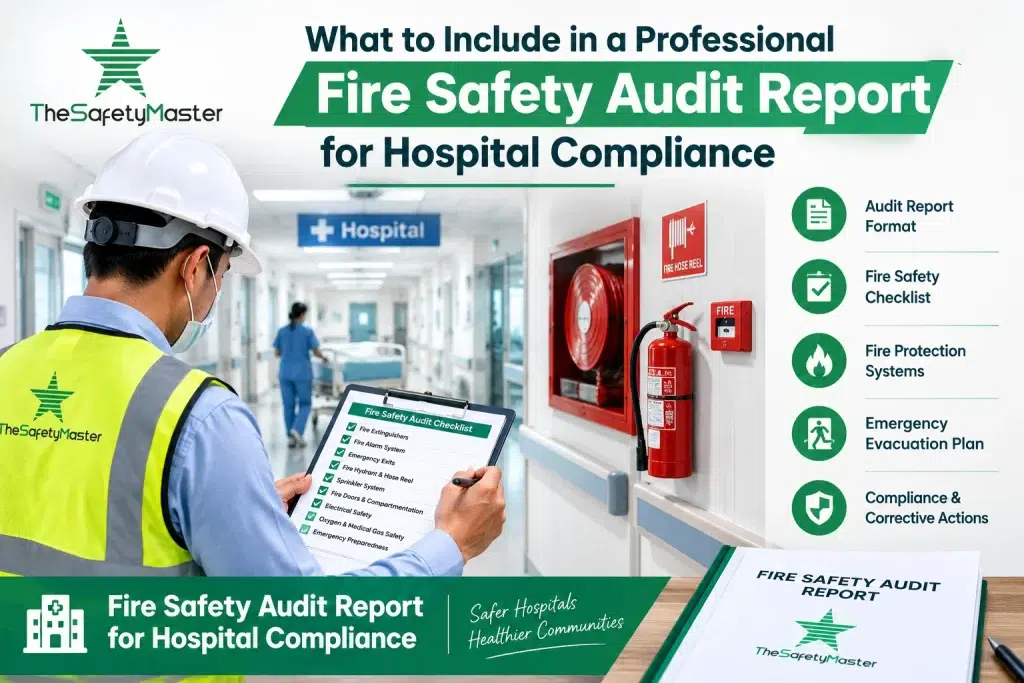
Hospitals need strong fire safety systems because they have patients, visitors, medical staff, electrical equipment, oxygen systems, chemicals, and other potential fire hazards. Some patients may also have limited mobility and may not be able to evacuate quickly during an emergency.
A professional fire safety audit report for hospital should clearly show the condition of fire protection systems, identify unsafe conditions, record non-compliances, and provide practical corrective actions.
The Safety Master helps organizations understand fire safety requirements and improve workplace and building safety through professional safety services and training.
What Is a Fire Safety Audit Report for Hospital?
A fire safety audit report is a formal document prepared after inspecting the fire safety arrangements of a hospital.
The report normally records:
- Areas inspected
- Fire hazards identified
- Fire protection systems available
- Emergency arrangements
- Compliance observations
- Non-compliances
- Risk levels
- Photographic evidence
- Corrective actions
- Responsible persons
- Recommended completion dates
The report should be clear enough for hospital management to understand the current fire safety condition and take corrective action.
Why Is a Fire Safety Audit Important for Hospitals?
A hospital fire can create serious risks because patients may need assistance during evacuation. Fire and smoke can also affect critical areas such as operating rooms, intensive care units, laboratories, pharmacies, electrical rooms, and oxygen storage areas.
A fire safety audit helps identify problems before an emergency occurs.
Important objectives include:
- Identifying fire hazards
- Checking fire protection systems
- Reviewing emergency exits
- Checking fire extinguishers
- Reviewing fire alarm systems
- Checking emergency lighting
- Reviewing evacuation arrangements
- Identifying blocked escape routes
- Checking emergency preparedness
- Recording corrective actions
Fire Safety Audit Checklist for Hospitals
A fire safety audit checklist for hospitals should cover both active and passive fire protection systems.
Fire Extinguishers
Check:
- Correct extinguisher type
- Location and accessibility
- Identification signage
- Pressure condition
- Inspection status
- Service records
- Physical damage
- Obstruction around extinguishers
Fire extinguishers should be suitable for the hazards present in the particular area.
Fire Alarm and Detection System
The audit should review:
- Smoke detectors
- Heat detectors
- Manual call points
- Fire alarm panels
- Alarm sounders
- Visual alarm indicators where applicable
- Detector condition
- Testing records
- Fault indications
The auditor should also verify whether the system is maintained and tested according to applicable requirements.
Fire Hydrant and Hose Reel System
Where provided, inspect:
- Fire hydrant points
- Hose reels
- Fire pumps
- Jockey pump
- Main pump
- Pump room
- Valves
- Pressure indicators
- Fire water storage
- Accessibility
- Maintenance records
Sprinkler System
For hospitals with sprinkler protection, the audit can cover:
- Sprinkler heads
- Control valves
- Water supply
- Alarm arrangements
- Pipe condition
- Obstructions
- Maintenance records
- Pump and pressure arrangements
Emergency Exit and Evacuation Arrangements
Emergency exits are one of the most important parts of a hospital fire safety audit.
The auditor should check whether:
- Exit routes are clearly identified
- Emergency exits are accessible
- Corridors are free from obstruction
- Exit doors can be opened as required
- Exit signage is visible
- Emergency lighting is available
- Staircases are accessible
- Fire doors are in suitable condition
- Evacuation routes are displayed
- Assembly areas are identified
Hospitals should also consider the evacuation needs of patients who cannot walk independently.
Fire Doors and Compartmentation
Passive fire protection helps prevent fire and smoke from spreading between areas.
The audit should examine:
- Fire-rated doors
- Door closers
- Door condition
- Door gaps and damage
- Fire stopping
- Service penetrations
- Fire-rated walls
- Fire-rated shafts
- Staircase protection
- Smoke control arrangements where applicable
Damaged fire doors or unprotected service openings can reduce the effectiveness of fire compartments.
Electrical Fire Safety
Electrical faults are an important area to review during a hospital fire safety audit.
The audit may include:
- Electrical panels
- Wiring condition
- Overloaded sockets
- Extension boards
- Cable management
- Earthing
- Electrical room housekeeping
- Panel accessibility
- Preventive maintenance
- Thermographic inspection records where applicable
Special attention should be given to critical electrical installations and areas containing sensitive medical equipment.
Oxygen and Medical Gas Safety
Hospitals use oxygen and other medical gases, making gas safety an important part of fire prevention.
The audit should review:
- Medical gas storage
- Oxygen cylinders
- Cylinder segregation
- Cylinder identification
- Storage arrangements
- Gas pipeline areas
- Leakage controls
- Warning signs
- Ignition source control
- Emergency procedures
Oxygen-rich environments can increase the severity of a fire, so appropriate controls are important.
Fire Safety in Critical Hospital Areas
A professional audit should not inspect every area in exactly the same way. Critical areas require additional attention.
These may include:
- ICU
- Operation theatres
- Emergency department
- Laboratories
- Pharmacy
- Kitchen
- Laundry
- Electrical rooms
- Generator rooms
- Medical gas areas
- Oxygen storage areas
- Boiler or utility areas
- Parking areas
The auditor should consider the specific hazards and evacuation challenges of each area.
Fire Safety Audit Report PDF Free Download
People often search for a fire safety audit report PDF free download to understand the format of a professional report.
A sample PDF can be useful for learning how an audit report is structured. However, a downloaded template should not be treated as proof of compliance. Every hospital has different building layouts, occupancy conditions, fire systems, hazards, and operational requirements.
A professional report should be based on actual site observations and applicable requirements.
Fire Safety Audit Checklist Excel
A fire safety audit checklist Excel file can help auditors organize inspection observations and track corrective actions.
Typical columns can include:
| Item | Area | Observation | Risk Level | Recommendation | Responsible Person | Target Date | Status |
|---|---|---|---|---|---|---|---|
| Fire Extinguisher | ICU | Access obstructed | High | Remove obstruction | Facility Team | Date | Open |
| Exit Signage | Floor 2 | Sign not visible | Medium | Replace/improve signage | Maintenance | Date | Open |
| Fire Door | Ward | Door closer damaged | High | Repair closer | Engineering | Date | Open |
| Emergency Light | Corridor | Not functioning | Medium | Repair/replace | Electrical Team | Date | Open |
This format makes it easier for management to monitor the closure of audit findings.
Fire Safety Audit Checklist PDF
A fire safety audit checklist PDF can provide a convenient inspection format. However, the checklist should be customized according to the hospital’s:
- Building type
- Number of floors
- Occupancy
- Patient capacity
- Fire protection systems
- Medical facilities
- Emergency arrangements
- Applicable local requirements
A checklist should support the audit rather than replace professional judgment.
Fire Safety Checklist for Buildings in India
A fire safety checklist for buildings India should consider the applicable national, state, local, and fire authority requirements relevant to the building.
Important areas generally include:
- Fire exits
- Staircases
- Fire doors
- Fire extinguishers
- Fire alarm systems
- Fire hydrants
- Sprinklers
- Fire pumps
- Emergency lighting
- Exit signage
- Fire water storage
- Smoke control
- Emergency evacuation
- Fire safety training
- Mock drills
- Maintenance records
The exact requirements can vary according to building type, occupancy, height, location, and applicable regulations.
Fire Safety Audit Checklist for Industry
Although hospitals require special attention, the basic principles of fire auditing can also be applied to industrial facilities.
A fire safety audit checklist for industry may cover:
- Fire load
- Flammable materials
- Electrical systems
- Fire extinguishers
- Hydrant systems
- Sprinklers
- Emergency exits
- Fire alarm systems
- Hot work
- Chemical storage
- Emergency response
- Training and mock drills
The checklist should always be adapted to the hazards of the particular industry.
Fire Audit Checklist
A basic fire audit checklist can be divided into several sections:
Building and Layout
- Access roads
- Emergency exits
- Staircases
- Fire doors
- Fire compartments
- Exit signage
Fire Protection
- Extinguishers
- Fire alarm
- Detection system
- Hydrant system
- Sprinkler system
- Fire pumps
Emergency Preparedness
- Emergency response plan
- Evacuation plan
- Assembly point
- Emergency contact list
- Mock drills
- Staff training
Documentation
- Fire equipment inspection records
- Maintenance certificates
- Testing records
- Training records
- Mock drill records
- Previous audit reports
- Corrective action records
How to Write a Professional Fire Safety Audit Report
A professional report should be simple, factual, and easy to understand.
1. Add Audit Information
Start with:
- Hospital name
- Location
- Audit date
- Audit team
- Scope of audit
- Areas inspected
2. Provide an Executive Summary
Briefly explain the overall fire safety condition of the hospital.
The summary can mention major strengths, important deficiencies, and high-priority actions.
3. Record Detailed Observations
Each observation should explain:
What was found → Where it was found → Why it is important → What should be done.
Photographs can be added where they help explain the finding.
4. Assign Risk Priority
Findings can be categorized according to the organization’s approved risk-rating system, such as:
- Critical
- High
- Medium
- Low
The report should clearly explain the basis for the selected risk level.
5. Provide Corrective Actions
Every significant finding should have a practical recommendation.
For example:
Observation: Emergency exit corridor is partially blocked.
Risk: Obstructed evacuation route may delay evacuation during an emergency.
Recommendation: Remove stored materials and maintain the exit route free from obstruction.
What Are the 5 C’s of Audit?
The 5 C’s of audit are commonly explained as:
- Criteria – What requirement or standard should be followed?
- Condition – What was actually observed?
- Cause – Why did the problem occur?
- Consequence – What could happen because of the problem?
- Corrective Action – What should be done to address it?
Using these five points can make audit observations clearer and more useful for management.
Common Mistakes in Hospital Fire Safety Audits
Some common problems include:
- Using a generic checklist without site-specific review
- Not checking critical hospital areas
- Ignoring patient evacuation challenges
- Not recording photographic evidence
- Writing unclear observations
- Not assigning responsibility for corrective actions
- Not tracking closure of findings
- Focusing only on fire extinguishers
- Ignoring passive fire protection
- Not reviewing emergency drills and training
A good audit should look at the complete fire safety system rather than one individual component.
Conclusion
A professional fire safety audit report for hospital should provide a clear picture of the hospital’s fire hazards, fire protection systems, emergency arrangements, compliance gaps, and corrective actions. It should cover active fire protection, passive fire protection, electrical safety, medical gas safety, evacuation arrangements, documentation, training, and emergency preparedness.
Checklists in PDF or Excel format can make inspections easier, but the final report should be based on actual site conditions and applicable requirements. A properly prepared report helps hospital management prioritize risks and improve fire safety.
The Safety Master provides safety-focused knowledge, training, and professional services to help organizations strengthen fire safety and workplace risk management.