HAZOP Training in India: Complete Guide to Certification, Course Benefits & Career Opportunities

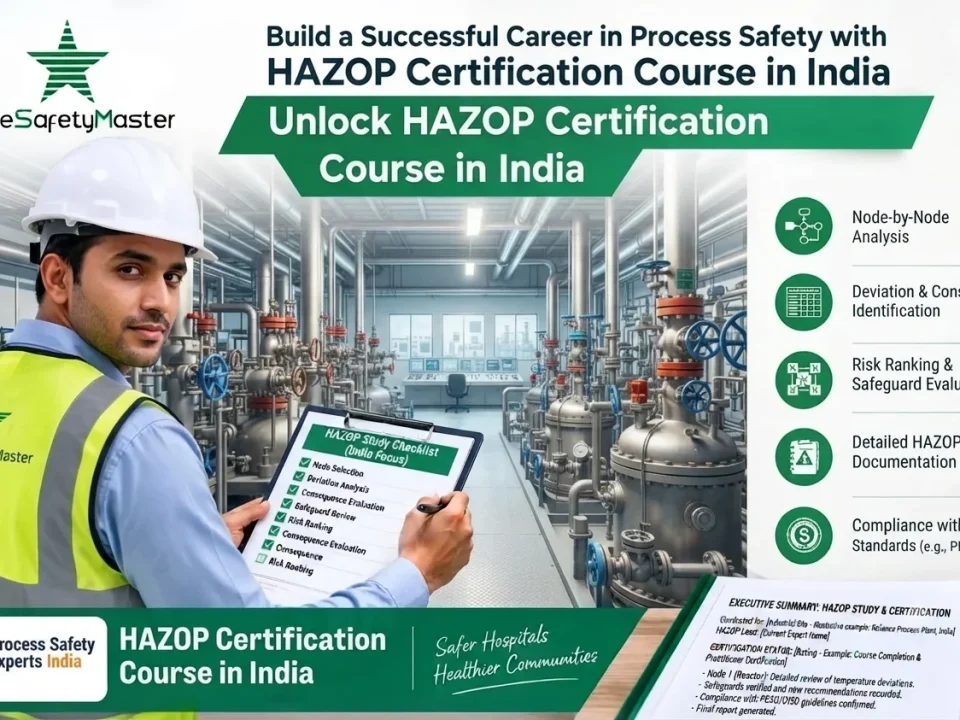
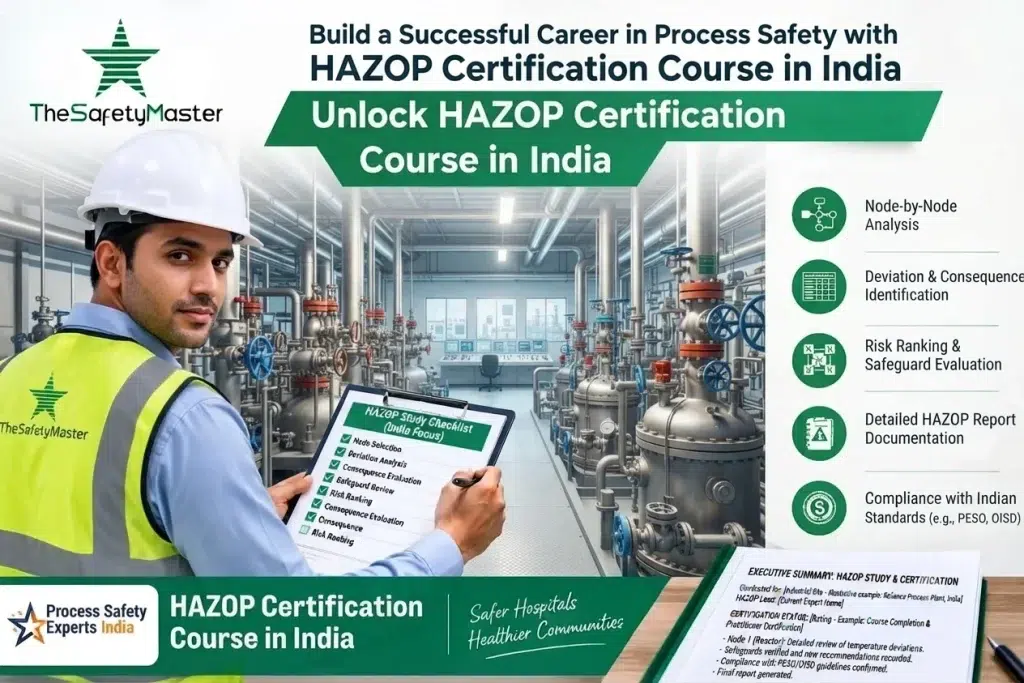
Build a Successful Career in Process Safety with HAZOP Certification Course in India
October 7, 2026
HAZOP Training Course Online: Certification, Cost, HAZID & Free Training Guide | The Safety Master
October 8, 2026
HAZOP is an important process safety technique used to identify hazards, understand possible deviations, and reduce risks in industrial processes. Industries such as oil and gas, chemicals, petrochemicals, pharmaceuticals, power, manufacturing, and other process industries use HAZOP studies to improve safety and prevent unwanted incidents.
HAZOP Training in India helps safety professionals, process engineers, plant personnel, and other technical professionals understand how to conduct a structured HAZOP study. The training provides knowledge of HAZOP methodology, guide words, nodes, deviations, causes, consequences, safeguards, and recommendations.
The Safety Master provides professional safety training designed to develop practical knowledge and improve the skills required for effective process hazard identification and risk management.
What Is HAZOP?
HAZOP stands for Hazard and Operability Study. It is a systematic method used to identify potential hazards and operating problems in a process or system.
During a HAZOP study, a process is divided into manageable sections called nodes. A team then uses guide words to identify possible deviations from the intended design or operating conditions.
Common HAZOP guide words include:
- No
- More
- Less
- As well as
- Part of
- Reverse
- Other than
- Early
- Late
The team examines the causes and consequences of each deviation and identifies existing safeguards. Where additional controls are required, recommendations are developed.
Why Is HAZOP Training Important?
Process industries can involve flammable materials, toxic substances, high pressure, high temperature, hazardous chemicals, and complex operating systems. A small process deviation can sometimes create a serious safety event.
HAZOP training helps professionals understand how to identify these deviations before they result in an incident.
A good training program can help participants:
- Understand HAZOP principles
- Identify process hazards
- Understand HAZOP guide words
- Develop HAZOP nodes
- Identify causes and consequences
- Review existing safeguards
- Develop suitable recommendations
- Participate effectively in HAZOP meetings
- Improve process safety knowledge
- Understand the role of a HAZOP team
- Support better risk management
HAZOP Training in India – What Does the Course Cover?
A professional HAZOP Training in India course should cover both basic concepts and practical application.
Important topics generally include:
Introduction to Process Safety
Participants learn the basic principles of process safety and how process hazards can affect people, equipment, the environment, and business operations.
HAZOP Methodology
The course explains the complete HAZOP process, including preparation, team formation, node selection, guide words, deviations, causes, consequences, safeguards, recommendations, and documentation.
HAZOP Guide Words
Guide words are an important part of HAZOP. Participants learn how guide words are applied to process parameters to identify possible deviations.
HAZOP Nodes
A process is divided into suitable sections or nodes for detailed examination. Participants learn how nodes are selected and reviewed during a study.
Causes and Consequences
A HAZOP team identifies what could cause a deviation and what could happen if the deviation occurs.
Existing Safeguards
Safeguards such as alarms, trips, interlocks, relief systems, procedures, and other controls are reviewed to understand how risks are currently controlled.
Recommendations
When existing safeguards are not sufficient, the team may develop recommendations for additional risk reduction.
HAZOP Documentation
Proper documentation is important for tracking findings, recommendations, responsibilities, and actions from a HAZOP study.
Who Should Attend HAZOP Training?
HAZOP training can be useful for professionals who work with process safety, plant operations, engineering, maintenance, risk management, and EHS.
The course can be suitable for:
- Process safety professionals
- Safety engineers
- Process engineers
- Chemical engineers
- Mechanical engineers
- Plant engineers
- Operations engineers
- Maintenance professionals
- EHS professionals
- Project engineers
- Process design professionals
- Plant managers
- Safety managers
- Consultants
- Professionals involved in risk assessment
Students and professionals who want to develop a career in process safety can also benefit from learning HAZOP methodology.
What Skills Can You Develop Through HAZOP Training?
HAZOP training is not only about understanding definitions. Practical training can help participants develop skills that can be applied in real industrial situations.
Key skills include:
- Hazard identification
- Process risk assessment
- Deviation analysis
- Cause and consequence analysis
- Safeguard identification
- Risk reduction thinking
- HAZOP team participation
- Technical discussion
- HAZOP worksheet preparation
- Recommendation development
- Process safety communication
These skills can be useful when working with process safety studies and other risk assessment activities.
HAZOP Training and Certification
A HAZOP certification can demonstrate that a professional has completed structured training in HAZOP methodology.
However, certification should be considered together with practical knowledge and industrial experience. Employers may look at a combination of technical education, process knowledge, safety experience, risk assessment skills, and training.
When selecting a HAZOP course, professionals should check:
- Course syllabus
- Trainer experience
- Practical exercises
- Certification details
- Training duration
- Learning methodology
- Industrial case studies
- HAZOP study examples
- Applicability to their industry
A well-structured HAZOP Training in India program can provide a strong foundation for professionals who want to improve their process safety knowledge.
Practical HAZOP Training
Practical learning is an important part of HAZOP training.
Instead of only studying theory, participants should understand how a HAZOP team works with process information such as:
- Process Flow Diagrams
- Piping and Instrumentation Diagrams
- Process descriptions
- Equipment information
- Operating procedures
- Process parameters
- Safety systems
Participants can learn how to apply guide words and identify deviations using realistic process scenarios.
Practical exercises can also help participants understand how to record causes, consequences, safeguards, and recommendations in a HAZOP worksheet.
HAZOP Study Example
Consider a process line where a liquid is transferred through a pipeline.
The intended condition may be a specific flow rate. During the HAZOP study, the team can apply the guide word “More” to identify the deviation “More Flow.”
The team may then examine:
Deviation: More Flow
Possible Causes:
- Control valve failure
- Incorrect valve position
- Instrument failure
Possible Consequences:
- Overloading of downstream equipment
- Increased pressure
- Process instability
Existing Safeguards:
- Flow alarm
- Control system
- High-pressure protection
Recommendation:
Additional control may be considered if the existing safeguards do not adequately control the risk.
This simple example shows how HAZOP provides a structured approach to identifying process problems.
HAZOP vs Other Risk Assessment Methods
HAZOP is one of several process safety and risk assessment methodologies.
Depending on the facility and purpose, professionals may also use:
- HAZID
- What-If Analysis
- FMEA
- LOPA
- SIL Assessment
- Bow-Tie Analysis
- Fault Tree Analysis
- Event Tree Analysis
- Risk Assessment
Understanding the differences between these methods can help professionals select the appropriate technique for a particular application.
HAZOP is especially useful for systematic examination of process deviations and their potential causes and consequences.
Career Opportunities After HAZOP Training
Process safety is important across many industries, creating opportunities for professionals with relevant technical and safety skills.
After completing HAZOP training, professionals may strengthen their knowledge for roles such as:
- Process Safety Engineer
- Safety Engineer
- EHS Engineer
- Process Engineer
- Risk Assessment Professional
- HAZOP Study Team Member
- Process Safety Consultant
- Plant Safety Professional
- Operations Safety Professional
- Process Risk Management Professional
HAZOP training alone does not guarantee a particular job role. Career opportunities depend on qualifications, experience, industry knowledge, technical skills, and other professional certifications.
Industries That Use HAZOP
HAZOP studies are widely associated with process industries where process deviations can create significant safety or operational risks.
These include:
- Oil and gas
- Petrochemical
- Chemical
- Pharmaceutical
- Power generation
- Refinery
- Fertilizer
- Manufacturing
- Food processing
- Water and wastewater
- Energy
- Process plants
Professionals working in these industries can benefit from understanding HAZOP principles.
How to Choose the Right HAZOP Training in India
There are many training options available, so professionals should select a course based on their career goals and learning requirements.
Before enrolling, consider the following:
Check the Course Content
Make sure the syllabus covers HAZOP methodology, guide words, nodes, causes, consequences, safeguards, recommendations, and documentation.
Look for Practical Exercises
Practical exercises can help you understand how HAZOP is applied to real process situations.
Consider Trainer Experience
Experienced trainers with practical process safety knowledge can provide better industry-focused learning.
Review Certification
Check what type of certificate is provided after successful completion of the training.
Check Industry Relevance
Select a course that matches your professional background and the industries in which you want to work.
Why Choose The Safety Master for HAZOP Training?
The Safety Master focuses on professional safety training and process safety knowledge. Its training approach can help participants understand important concepts through structured learning and practical application.
The course is designed for professionals who want to improve their understanding of HAZOP studies, hazard identification, process safety, and risk management.
For professionals looking to develop their knowledge through HAZOP Training in India, The Safety Master can be considered as a training option for building relevant process safety skills.
Conclusion
HAZOP is an important methodology for identifying process hazards and improving operational safety. It provides a structured way to examine deviations, identify causes and consequences, review safeguards, and develop recommendations.
HAZOP Training in India can help safety professionals, engineers, plant personnel, and other technical professionals develop practical knowledge of HAZOP methodology and process safety.
For professionals planning to build or strengthen a career in process safety, HAZOP training can be a valuable addition to their technical and safety knowledge. The Safety Master provides professional safety training designed to help learners understand HAZOP concepts and their practical application in industrial environments.