How to Perform Hazardous Area Classification for Oil and Gas Facilities: A Step-by-Step Process

Top Safety Consultants Thailand: The Ultimate Guide to EHS & Compliance
November 5, 2026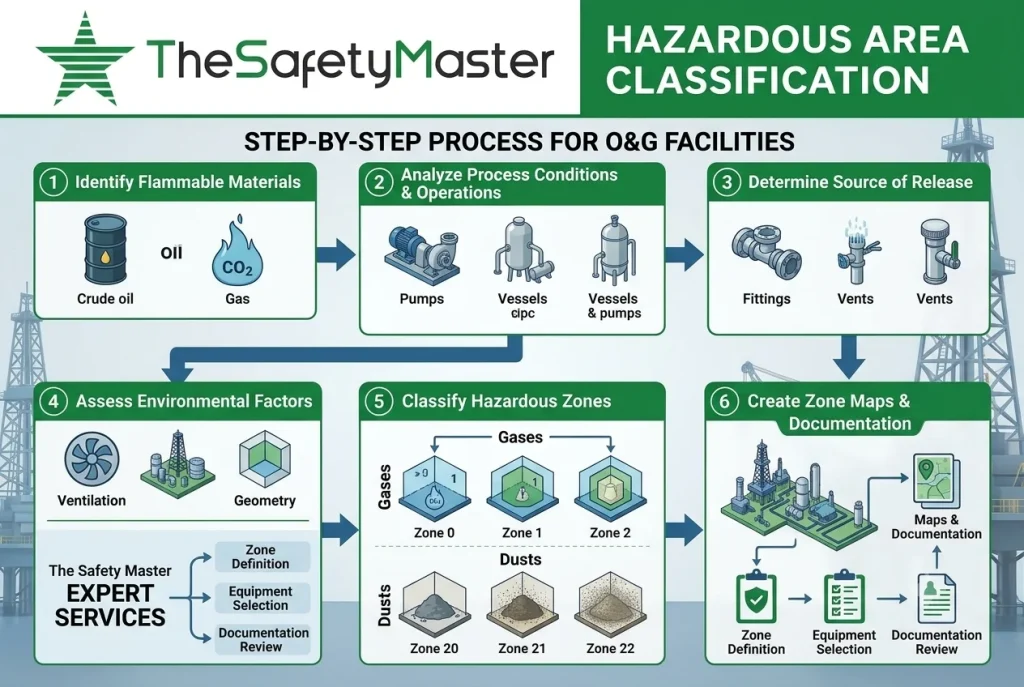
Hazardous Area Classification is an important safety process for oil and gas facilities. These industries handle flammable gases, vapours, liquids and other dangerous materials that can create fire and explosion risks. A small gas leak or accidental release can create a dangerous atmosphere when it mixes with air and comes into contact with an ignition source.
A proper Hazardous Area Classification study helps identify locations where explosive gas or vapour atmospheres may occur. It also helps companies select suitable electrical and mechanical equipment to reduce the possibility of fire and explosions.
Oil refineries, offshore platforms, gas processing plants, petrochemical industries and storage terminals need proper hazardous area assessment to maintain workplace safety. The Safety Master provides safety consulting and risk assessment support to help industries improve their process safety systems and manage workplace hazards.
This blog explains the step-by-step process of performing Hazardous Area Classification for oil and gas facilities.
What Is Hazardous Area Classification?
Hazardous Area Classification is a systematic method used to identify and classify areas where flammable gases, vapours or combustible materials may create an explosive atmosphere.
The main purpose is to understand where hazardous substances can be released, how often they may occur and how long they can remain in the surrounding environment.
The classification helps safety professionals and engineers select appropriate equipment that can operate safely in potentially explosive atmospheres.
Why Is Hazardous Area Classification Important?
Hazardous Area Classification is important for several reasons:
- Helps prevent fire and explosion incidents.
- Identifies areas with flammable gas and vapour risks.
- Supports the selection of explosion-protected equipment.
- Improves electrical and mechanical safety.
- Helps meet applicable safety standards and regulations.
- Protects workers, equipment and industrial facilities.
- Reduces operational risks and unexpected shutdowns.
Industries That Require Hazardous Area Classification
Several industries require hazardous area assessment because they handle flammable materials.
- Oil and gas production facilities.
- Petroleum refineries.
- Natural gas processing plants.
- Chemical and petrochemical industries.
- Offshore oil and gas platforms.
- LNG and LPG storage facilities.
- Fuel storage terminals.
- Pipeline pumping and compressor stations.
Step-by-Step Process for Hazardous Area Classification
A proper Hazardous Area Classification study requires technical information, engineering knowledge and a detailed understanding of the facility’s operations.
The following steps explain how to perform the classification process.
Step 1: Collect Facility Information
The first step is to collect all important technical documents related to the oil and gas facility.
These documents help engineers understand the plant layout, operating conditions and possible sources of flammable material release.
Important documents include:
- Plant layout drawings.
- Process Flow Diagrams (PFDs).
- Piping and Instrumentation Diagrams (P&IDs).
- Equipment layout drawings.
- Safety data sheets (SDS).
- Process operating conditions.
- Equipment specifications.
- Ventilation system details.
- Gas detection system layouts.
Importance of Proper Documentation
Correct documentation helps engineers identify possible leakage points and understand how flammable substances move through the facility.
Incomplete or outdated drawings can lead to incorrect hazardous area boundaries.
Step 2: Identify Flammable Materials
The next step is to identify all flammable gases, vapours and liquids used or stored in the facility.
Different materials have different physical and chemical properties. These properties affect the possibility of forming an explosive atmosphere.
Important information includes:
- Flash point.
- Auto-ignition temperature.
- Lower Explosive Limit (LEL).
- Upper Explosive Limit (UEL).
- Vapour density.
- Gas group.
- Temperature class.
- Operating pressure and temperature.
Understanding Gas and Vapour Properties
For example, methane, hydrogen, propane and hydrogen sulphide require careful consideration based on their properties and the process conditions.
Engineers must review material safety information before deciding the appropriate hazardous area classification.
Step 3: Identify Sources of Release
A source of release is a point where flammable gas, vapour or liquid can escape into the surrounding atmosphere.
Identifying these sources is one of the most important parts of a Hazardous Area Classification study.
Common sources of release in oil and gas facilities include:
- Pumps and compressors.
- Valves and flanges.
- Gas pipelines.
- Storage tanks.
- Pressure relief valves.
- Sampling points.
- Loading and unloading connections.
- Drains and vents.
- Equipment maintenance points.
Types of Sources of Release
Continuous Grade of Release: A release that occurs continuously or frequently for long periods.
Primary Grade of Release: A release that is expected to occur occasionally during normal plant operations.
Secondary Grade of Release: A release that is not expected during normal operations but may occur for a short period due to equipment failure or abnormal conditions.
Correct identification helps engineers determine the appropriate hazardous zone.
Step 4: Evaluate Ventilation Conditions
Ventilation plays an important role in controlling the concentration of flammable gases and vapours.
Proper ventilation can help reduce gas accumulation and limit the size or persistence of a hazardous atmosphere.
Engineers should evaluate:
- Natural ventilation.
- Mechanical ventilation.
- Air movement patterns.
- Ventilation openings.
- Potential gas accumulation areas.
- Indoor and outdoor conditions.
- Ventilation reliability.
Natural and Mechanical Ventilation
Natural ventilation uses wind and air movement to remove gases from an area.
Mechanical ventilation uses fans and other equipment to move air and reduce gas accumulation.
Poor ventilation can increase the possibility of an explosive atmosphere, especially in enclosed spaces.
Step 5: Determine Hazardous Area Zones
After identifying release sources and evaluating ventilation, engineers classify the hazardous areas into suitable zones.
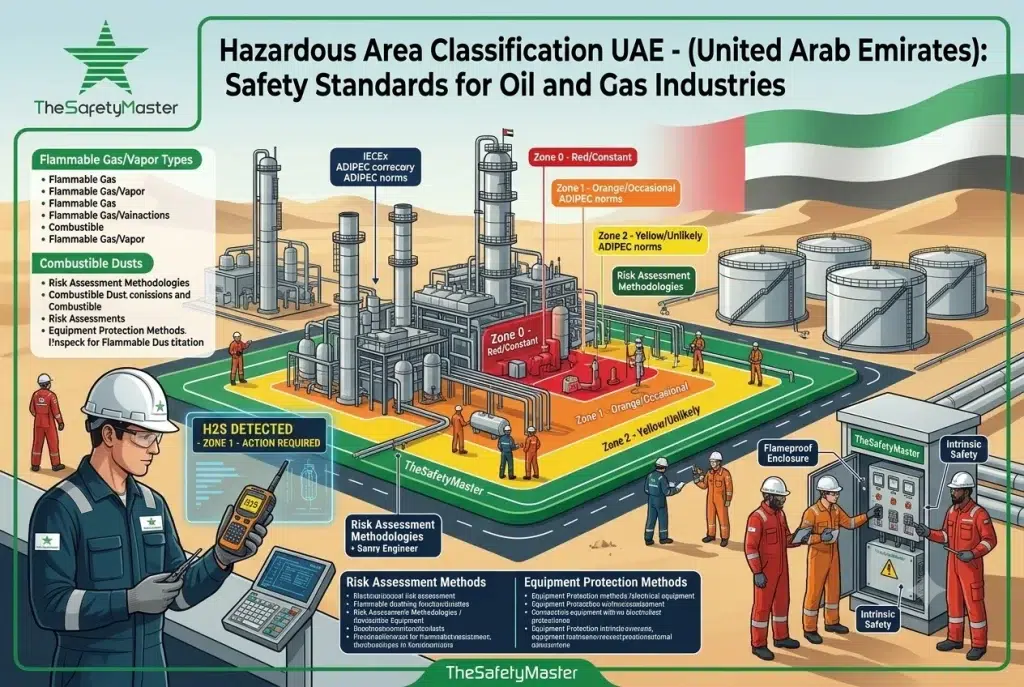
The IEC hazardous area classification system commonly uses three zones for gases and vapours.
Zone 0
Zone 0 is an area where an explosive gas atmosphere is present continuously, for long periods or frequently.
Examples:
- Certain internal spaces of equipment containing flammable gases.
- Some enclosed process equipment environments.
Zone 1
Zone 1 is an area where an explosive gas atmosphere is likely to occur occasionally during normal operations.
Examples:
- Certain pump sealing areas.
- Gas sampling locations.
- Some process equipment connection points.
Zone 2
Zone 2 is an area where an explosive gas atmosphere is not likely to occur during normal operations. If it occurs, it will normally exist for a short period.
Examples:
- Areas around certain flanged connections.
- Locations near equipment with infrequent leakage possibilities.
Important: Zone classification must be based on actual release characteristics, ventilation and applicable standards. These examples are not automatic classifications for every installation.
Step 6: Determine Gas Groups and Temperature Classes
After identifying hazardous zones, engineers must determine the appropriate gas group and temperature class for equipment selection.
These classifications help ensure that electrical equipment is suitable for the surrounding hazardous atmosphere.
Gas Groups
Common IEC gas groups include:
- Group IIA: Includes gases such as propane.
- Group IIB: Includes gases such as ethylene.
- Group IIC: Includes gases such as hydrogen and acetylene.
Group IIC equipment is suitable for the more demanding gas group requirements, subject to its certification and equipment marking.
Temperature Classes
Temperature classes define the maximum surface temperature of equipment.
Temperature Class
Maximum Surface Temperature
T1
450°C
T2
300°C
T3
200°C
T4
135°C
T5
100°C
T6
85°C
Equipment must have a temperature rating suitable for the ignition characteristics of the hazardous material.
Step 7: Select Suitable Electrical Equipment
Selecting suitable equipment is an important part of hazardous area safety.
Electrical equipment used in classified locations must have appropriate explosion protection and certification.
Common equipment includes:
- Explosion-protected motors.
- Lighting systems.
- Junction boxes.
- Electrical control panels.
- Cable glands.
- Switches and sockets.
- Instrumentation systems.
- Gas detection equipment.
Common Explosion Protection Methods
- Ex d – Flameproof enclosure.
- Ex e – Increased safety.
- Ex i – Intrinsic safety.
- Ex p – Pressurisation.
- Ex m – Encapsulation.
The selection must consider zone, equipment protection level, gas group, temperature class, environmental conditions and applicable certification requirements.
Step 8: Prepare Hazardous Area Classification Drawings
After completing the technical assessment, engineers prepare hazardous area classification drawings.
These drawings show the classified locations and their boundaries within the facility.
Important information includes:
- Zone 0, Zone 1 and Zone 2 locations.
- Sources of release.
- Hazardous area boundaries.
- Equipment locations.
- Gas groups.
- Temperature classes.
- Relevant design assumptions.
Importance of Classification Drawings
These drawings help electrical engineers, instrumentation teams, maintenance personnel and safety professionals understand hazardous locations.
They also support safe equipment installation, inspection and maintenance.
Step 9: Review and Verify the Classification
The final step is to review and verify the completed Hazardous Area Classification study.
The engineering and safety teams should check whether all release sources, operating conditions and ventilation details have been considered correctly.
The review should include:
- Verification of process documents.
- Confirmation of release sources.
- Review of zone boundaries.
- Equipment certification checks.
- Compliance with applicable standards.
- Review of ventilation conditions.
- Approval by competent personnel.
The classification should also be reviewed whenever there are significant changes in plant design, process conditions, equipment or operating procedures.
Important Standards for Hazardous Area Classification
Oil and gas facilities should follow applicable national and international standards when performing hazardous area classification.
Important standards include:
1. IEC 60079-10-1
This standard provides guidance for the classification of areas where explosive gas atmospheres may occur.
It explains the principles used to identify hazardous locations and determine zone classifications.
2. IEC 60079 Series
The IEC 60079 series covers different requirements for equipment and installations in explosive atmospheres, including equipment protection and inspection.
3. API RP 500
API RP 500 provides guidance for classifying locations for electrical installations at petroleum facilities using the Division system.
4. API RP 505
API RP 505 provides guidance for classifying locations at petroleum facilities using the Zone system.
5. NFPA 70
The National Electrical Code (NEC) includes requirements for electrical installations in hazardous locations.
The correct standards depend on the country, project requirements and regulatory framework.
Common Mistakes in Hazardous Area Classification
Incorrect hazardous area classification can create serious safety risks. Companies should avoid the following mistakes:
- Using outdated plant drawings.
- Missing important sources of gas release.
- Ignoring ventilation conditions.
- Incorrectly identifying hazardous zones.
- Selecting unsuitable electrical equipment.
- Ignoring gas groups and temperature classes.
- Not updating classification drawings after plant modifications.
- Failing to conduct periodic inspections.
- Using assumptions without proper technical justification.
A detailed engineering review can help reduce these mistakes and improve plant safety.
Benefits of Professional Hazardous Area Classification Services
Professional Hazardous Area Classification services help oil and gas companies identify hazardous locations and implement suitable protection measures.
The major benefits include:
- Better control of fire and explosion risks.
- Improved workplace safety.
- Correct selection of electrical equipment.
- Better compliance with industry standards.
- Improved maintenance planning.
- Reduced equipment damage.
- Better protection of employees and assets.
- Improved process safety management.
The Safety Master supports industries with safety consulting, risk assessment and process safety solutions to help identify workplace hazards and improve operational safety.
Why Choose The Safety Master for Hazardous Area Classification?
Choosing the right safety consultant is important for conducting a proper hazardous area assessment.
The Safety Master focuses on helping industries identify potential hazards, understand operational risks and improve workplace safety.
Our safety consulting approach supports:
- Hazard identification and risk assessment.
- Process safety management support.
- Industrial safety consulting.
- Fire and explosion risk assessment.
- Safety audits and compliance support.
- Technical safety documentation.
- Risk control recommendations.
A systematic safety assessment helps companies improve their safety practices and reduce the possibility of industrial incidents.
For professional safety consulting and risk assessment support, visit The Safety Master at https://www.thesafetymaster.com/.
Conclusion
Hazardous Area Classification is an essential safety activity for oil and gas facilities. It helps identify locations where flammable gases and vapours may create explosive atmospheres. A proper study includes collecting facility information, identifying flammable materials, locating release sources, evaluating ventilation, determining hazardous zones and selecting suitable explosion-protected equipment.
Following standards such as IEC 60079-10-1, API RP 500 and API RP 505 helps companies develop a systematic approach to hazardous area safety.
Regular reviews and updated classification drawings are also important for maintaining safe operations. With professional safety consulting and risk assessment support from The Safety Master, industries can improve hazardous area management and build safer working environments.
Frequently Asked Questions (FAQs)
Hazardous Area Classification is a process used to identify locations where flammable gases or vapours may create an explosive atmosphere. It helps companies determine hazardous zones and select suitable explosion-protected equipment.
The three gas hazardous area zones are:
Zone 0: Explosive gas atmosphere is present continuously, frequently or for long periods.
Zone 1: Explosive gas atmosphere is likely to occur occasionally during normal operations.
Zone 2: Explosive gas atmosphere is not likely during normal operations and, if it occurs, exists only for a short period.
Common standards include IEC 60079-10-1, IEC 60079, API RP 500 and API RP 505. The applicable standard depends on the facility, country and project requirements.
Ventilation helps remove flammable gases and vapours from an area. Proper ventilation can reduce gas accumulation and influence the extent and persistence of hazardous zones.
A competent engineer or qualified hazardous area classification specialist with relevant process safety, electrical engineering and hazardous area knowledge can perform the study. The work should follow applicable standards and project requirements.