Comprehensive Electric Vehicle Manufacturing Facilities Safety Auditing

A Cultural Shift towards Safety Excellence: How BBS Implementation Programs Drive Organizational Success
October 16, 2023
Strengthening Safety Measures: Understanding the Importance of Following BIS14489 Safety Audit Guidelines in Indian Industries
October 17, 2023
Electric vehicle manufacturing is growing rapidly, and modern EV plants use advanced batteries, electrical systems, automated machinery, chemicals, robotics, and high-energy equipment. These operations create specific safety risks that require systematic identification and control. Electric Vehicle Manufacturing Facilities Safety Auditing helps manufacturers identify hazards, check safety controls, improve compliance, and create safer working conditions.
The Safety Master provides safety auditing and risk management solutions that can help organizations evaluate workplace hazards and develop practical corrective actions.
Why Safety Auditing Is Important in EV Manufacturing
An EV manufacturing facility includes several processes such as battery manufacturing, battery charging, welding, painting, vehicle assembly, electrical testing, material handling, and warehouse operations. Each process can create different safety risks.
A structured safety audit helps identify unsafe conditions before they result in incidents. It also helps management review whether existing safety procedures, emergency systems, training programs, PPE, and engineering controls are working effectively.
A good audit should look beyond documentation. Auditors should inspect actual workplace conditions, observe operations, speak with employees, review records, and identify gaps between written procedures and actual practices.
Major Safety Risks in Electric Vehicle Manufacturing Facilities
Battery and Thermal Runaway Hazards
Lithium-ion battery manufacturing and handling require careful risk management. Battery cells and modules can present risks associated with electrical energy, overheating, short circuits, damage, and thermal events.
A safety audit should review battery storage, charging areas, handling procedures, temperature monitoring, damaged-battery controls, emergency response arrangements, and fire protection systems.
Electrical Safety Hazards
EV production involves high-voltage systems, electrical testing equipment, battery packs, charging systems, motors, control panels, and automated machinery.
An audit should evaluate:
- Electrical panels and installations
- High-voltage work procedures
- Lockout/Tagout practices
- Earthing and bonding
- Electrical isolation
- Insulation and cable condition
- Electrical testing areas
- PPE and insulated tools
- Authorized-person controls
- Emergency response procedures
Electrical safety should be integrated into routine inspections and employee training.
Fire and Explosion Risks
Fire safety is an important part of EV manufacturing safety. Potential sources can include battery-related incidents, flammable materials, electrical faults, hot work, combustible packaging, chemicals, and charging operations.
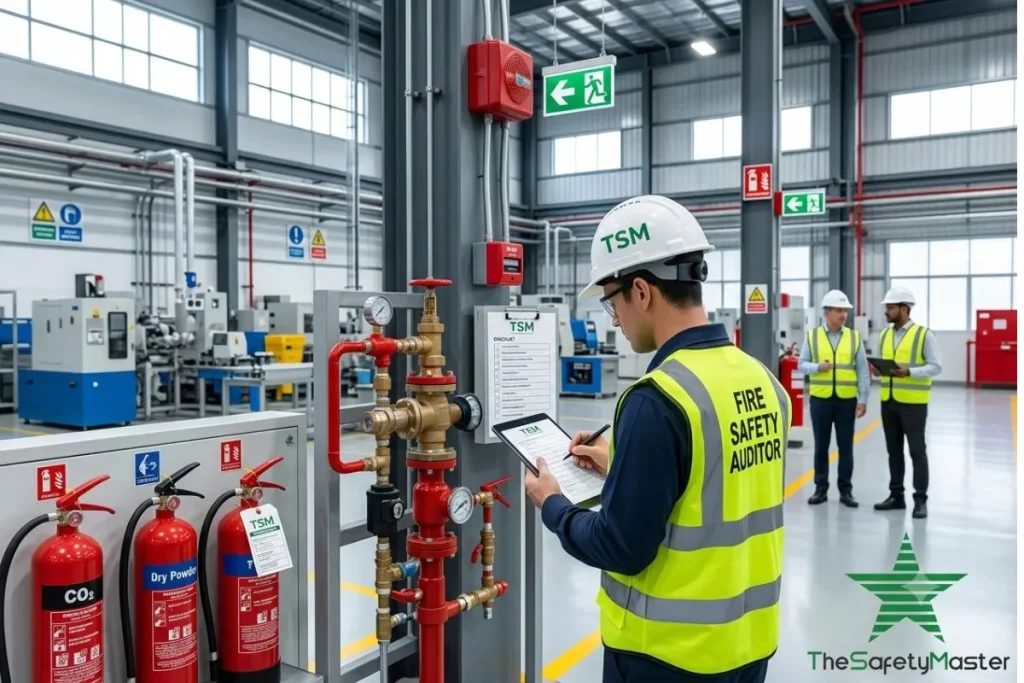
The audit should check fire detection and alarm systems, extinguishing systems, emergency exits, fire pumps, hydrants, extinguishers, emergency lighting, evacuation routes, hot-work controls, and emergency response plans.
Chemical Exposure
Battery production and other manufacturing activities may involve chemicals, solvents, coatings, adhesives, cleaning agents, and other hazardous substances.
The audit should review chemical storage, labeling, Safety Data Sheets, ventilation, exposure controls, PPE, spill response, waste handling, and employee training.
Machinery and Automation Hazards
Modern EV plants often use automated production lines, robots, conveyors, presses, welding equipment, and other machinery.
Auditors should verify machine guarding, emergency stops, interlocks, preventive maintenance, access controls, energy isolation, operator training, and safe maintenance procedures.
Key Areas Covered in an EV Manufacturing Safety Audit
A comprehensive audit should cover the complete facility rather than focusing on only one department.
Workplace Safety
The audit can review:
- Housekeeping
- Workplace access
- Walkways and aisles
- Material storage
- PPE
- Manual handling
- Ergonomics
- Safety signage
- Emergency exits
Electrical Safety
Electrical systems should be inspected for unsafe conditions, damaged equipment, improper isolation, inadequate protection, and gaps in electrical work procedures.
Fire Safety
Fire prevention and emergency preparedness should be reviewed across production, battery areas, warehouses, charging areas, utilities, and other critical locations.
Occupational Health
The audit should consider worker exposure to chemicals, noise, heat, dust, fumes, vibration, repetitive work, and other occupational health hazards.
Contractor Safety
Contractors may perform maintenance, construction, electrical work, equipment installation, or other activities inside the facility. Their competency, permits, PPE, induction, supervision, and emergency arrangements should be reviewed.
How to Conduct Electric Vehicle Manufacturing Facilities Safety Auditing
Step 1: Understand the Facility
Before the physical audit, auditors should understand the facility layout, production processes, equipment, materials, utilities, workforce, and previous incident history.
Step 2: Identify Hazards
Identify hazards associated with each activity and area. This may include electrical, chemical, mechanical, fire, ergonomic, environmental, and emergency risks.
Step 3: Review Existing Controls
Check whether identified hazards are controlled through engineering controls, administrative controls, procedures, training, PPE, inspection programs, and maintenance systems.
Step 4: Conduct a Physical Inspection
The audit team should inspect production areas, battery areas, warehouses, charging stations, electrical rooms, maintenance areas, emergency exits, chemical storage areas, and other relevant locations.
Step 5: Interview Employees
Employees often understand operational risks that may not be visible during a short inspection. Interviews can help identify unsafe practices, procedural gaps, recurring problems, and improvement opportunities.
Step 6: Document Findings
Each finding should be recorded clearly. A useful audit report can include the observation, location, risk, existing control, recommended corrective action, responsible person, priority, and target completion date.
Step 7: Develop a Corrective Action Plan
High-risk findings should receive appropriate priority. Management should assign responsibility and establish realistic completion dates.
Step 8: Verify Corrective Actions
An audit should not end when the report is issued. Follow-up inspections should confirm whether corrective actions have actually been implemented and whether they are effective.
EV Battery Safety Audit Checklist
A battery-area audit can include checks for:
- Battery storage conditions
- Charging arrangements
- Damaged battery identification
- Temperature monitoring
- Electrical isolation
- Short-circuit prevention
- Battery handling procedures
- Emergency response
- Fire detection
- Ventilation
- Chemical controls
- PPE
- Employee training
- Waste battery management
- Emergency access
The checklist should be customized according to the battery technology, process design, facility layout, and applicable requirements.
Emergency Preparedness for EV Manufacturing Plants
Emergency preparedness is a major part of a safety audit. The facility should have suitable procedures for foreseeable emergencies.
The audit can review emergency response plans for fire, battery incidents, chemical spills, electrical emergencies, injuries, evacuation, and other site-specific scenarios.
Emergency drills should be conducted periodically, and lessons from drills should be used to improve emergency procedures.
Benefits of Regular EV Manufacturing Safety Audits
Regular auditing can help organizations:
- Identify hazards early
- Improve workplace safety
- Strengthen risk controls
- Improve emergency preparedness
- Reduce unsafe conditions
- Improve employee awareness
- Support regulatory compliance
- Improve safety documentation
- Track corrective actions
- Promote continuous safety improvement
Safety auditing should be treated as an ongoing improvement process rather than a one-time compliance activity.
Role of The Safety Master in EV Manufacturing Safety
The Safety Master supports organizations with safety audits, risk assessment, electrical safety, fire safety, HIRA studies, process safety, training, and other safety management services.
For EV manufacturing facilities, a customized audit can focus on the risks associated with battery operations, electrical systems, production machinery, chemical handling, fire protection, emergency preparedness, contractor activities, and workplace safety.
A practical audit approach combines document review, site inspection, employee interaction, hazard identification, risk evaluation, and corrective-action tracking.
Conclusion
Electric Vehicle Manufacturing Facilities Safety Auditing is an important part of managing the complex risks associated with modern EV production. Battery systems, high-voltage electrical equipment, chemicals, machinery, automation, and fire hazards require effective safety controls and regular review.
A comprehensive audit can help manufacturers identify gaps, strengthen existing controls, improve emergency preparedness, and support continuous workplace safety improvement. With systematic inspections and corrective actions, organizations can build a stronger safety management system across their EV manufacturing operations.
The Safety Master can support organizations with customized safety auditing and risk management solutions designed around their specific processes and workplace hazards.
Frequently Asked Questions
1. What is an electric vehicle manufacturing safety audit?
An electric vehicle manufacturing safety audit is a systematic review of workplace conditions, processes, equipment, safety procedures, emergency systems, and risk controls within an EV manufacturing facility.
2. What are the main hazards in EV manufacturing?
Common hazards can include electrical hazards, battery-related risks, fire hazards, chemical exposure, machinery hazards, ergonomic risks, material-handling risks, and emergency-response challenges.
3. Why is battery safety important in EV manufacturing?
Battery systems can involve electrical energy and thermal hazards. Proper storage, charging, handling, monitoring, isolation, emergency response, and employee training are therefore important parts of battery safety management.
4. What does an EV manufacturing safety audit checklist include?
An audit checklist may cover electrical safety, battery handling, fire protection, chemical management, machinery safety, PPE, housekeeping, emergency preparedness, contractor safety, occupational health, and corrective-action management.
5. How can The Safety Master help EV manufacturing facilities?
The Safety Master can support organizations through safety audits, HIRA studies, electrical safety audits, fire safety audits, process safety services, training, and customized risk-management solutions for industrial facilities.