Electrical Safety Audit, Thermography Assessment, and Arc Flash Assessment

How Behavior-Based Safety Training Works – The Safety Master
September 16, 2023
Contractor Safety Management Implementation by TheSafetyMaster
September 18, 2023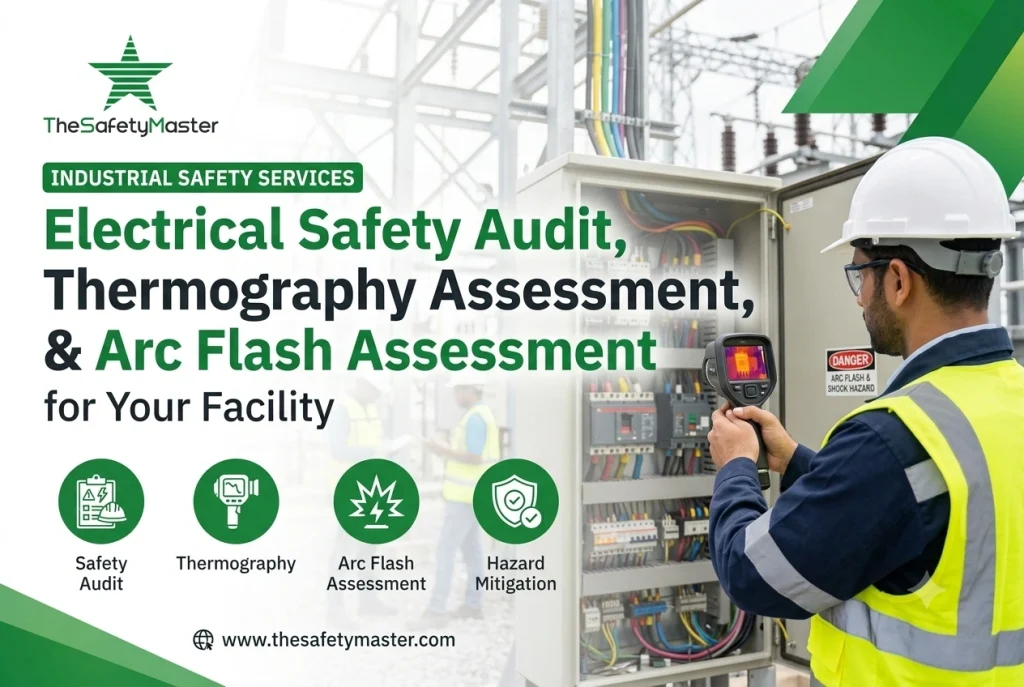
Electrical systems are an important part of every industrial plant, commercial building, manufacturing facility, office, hotel, hospital, and other workplace. However, electrical faults can lead to electric shock, equipment damage, electrical fires, production losses, and serious injuries.
An Electrical Safety Audit helps organizations identify electrical hazards, unsafe conditions, equipment problems, and gaps in safety practices. Along with an electrical audit, Thermography Assessment and Arc Flash Assessment provide additional information about hidden electrical risks.
The Safety Master provides safety consultancy and assessment services to help organizations identify electrical hazards, understand risks, and develop suitable corrective actions. The existing service portfolio of The Safety Master includes Electrical Safety Audit, Thermography Study, and Arc Flash Assessment.
What Is an Electrical Safety Audit?
An Electrical Safety Audit is a systematic examination of an organization’s electrical installation, equipment, systems, procedures, and safety practices.
The main purpose is to identify unsafe conditions before they result in an accident, fire, equipment failure, or production interruption.
An Electrical Safety Audit may review:
- Electrical panels and distribution boards
- Cables and wiring systems
- Circuit breakers and protective devices
- Earthing and grounding systems
- Electrical equipment
- Switchgear and control panels
- Electrical rooms
- Isolation and lockout procedures
- Maintenance practices
- Electrical safety documentation
- Personal protective equipment
- Emergency response arrangements
- Electrical safety training
A detailed audit helps the organization understand existing electrical risks and develop an action plan for improvement.
Why Is Electrical Safety Audit Important?
Electrical hazards are sometimes difficult to identify during normal operations. A connection may become loose, equipment may become overloaded, insulation may deteriorate, or an electrical component may develop excessive heat.
A regular Electrical Safety Audit can help identify these conditions at an early stage.
Key benefits include:
- Identification of electrical hazards
- Reduction of electrical accident risks
- Identification of fire hazards
- Improvement of equipment safety
- Review of electrical protection systems
- Better maintenance planning
- Identification of unsafe work practices
- Improved employee awareness
- Support for electrical safety compliance
- Reduction of unplanned equipment failures
The existing The Safety Master page also describes electrical audits as a systematic process for examining electrical systems and identifying hazards involving wiring, equipment, grounding, protection devices, and emergency arrangements.
What Does an Electrical Safety Audit Cover?
A professional audit should be suitable for the electrical installation and operating conditions of the facility.
Electrical Panels and Switchboards
The auditor can inspect panels, switchboards, distribution boards, connections, breakers, busbars, and other accessible components for visible defects and unsafe conditions.
Cables and Wiring
The condition, routing, insulation, termination, protection, and identification of cables can be reviewed.
Earthing and Grounding
The audit can review the condition and effectiveness of the grounding arrangement and identify potential gaps requiring further testing or corrective action.
Protective Devices
Circuit breakers, fuses, residual-current protection, overload protection, and other protective devices can be reviewed for suitability and condition.
Electrical Work Practices
Safe operating procedures, isolation practices, work permits, lockout/tagout arrangements, and maintenance procedures can be examined.
Electrical Safety Documentation
Relevant drawings, inspection records, maintenance records, test reports, procedures, and training records can also be reviewed.
What Is Electrical Thermography Assessment?
Thermography Assessment uses infrared thermal imaging to identify temperature differences in electrical equipment.
An infrared camera can detect abnormal heating that may not be visible during a normal visual inspection.
Thermography can help identify conditions such as:
- Loose electrical connections
- Overloaded circuits
- Unbalanced loads
- Abnormal heating
- Poor connections
- Potential component problems
- Hotspots in electrical equipment
The Safety Master’s existing page explains that thermal imaging can identify hotspots, overloaded circuits, loose connections, and other abnormalities without physically touching the equipment.
How Does Electrical Thermography Work?
Step 1: Prepare for the Assessment
Relevant electrical drawings, equipment information, load conditions, previous maintenance records, and other available information are reviewed.
Step 2: Capture Thermal Images
A suitable infrared camera is used to inspect electrical equipment under appropriate operating conditions.
Step 3: Identify Abnormal Temperature Patterns
Thermal images are reviewed to identify areas showing unusual temperature differences.
Step 4: Analyze the Findings
The thermal findings should be considered together with equipment condition, electrical loading, operating conditions, and other available information.
Step 5: Recommend Corrective Actions
Where abnormal conditions are identified, suitable corrective actions can be recommended based on the finding and its severity.
Benefits of Electrical Thermography Assessment
Electrical thermography can provide several practical benefits:
- Non-contact inspection
- Early identification of abnormal heating
- Support for preventive maintenance
- Identification of potential connection problems
- Reduced risk of unexpected equipment failure
- Better maintenance prioritization
- Visual documentation through thermal images
Thermography should complement, rather than replace, other electrical inspection and testing activities.
What Is an Arc Flash Assessment?
An Arc Flash Assessment is an engineering-based assessment used to understand the potential hazards associated with an arc-flash event within an electrical system.
An arc flash can release intense thermal energy and may also create pressure, sound, light, and molten-metal hazards. The potential severity depends on factors such as the electrical system configuration, available fault current, protective-device operation, equipment characteristics, and other system parameters.
An Arc Flash Assessment can help organizations understand potential incident-energy exposure and determine appropriate safety measures.
The Safety Master’s current page describes arc-flash assessment as involving evaluation of electrical-system details, potential fault conditions, protective measures, PPE, and personnel training.
Why Is Arc Flash Assessment Important?
Arc-flash hazards require careful engineering and operational controls.
An assessment can support:
- Identification of arc-flash hazards
- Evaluation of electrical-system conditions
- Review of protective-device coordination
- Determination of appropriate protective measures
- Electrical safety procedures
- PPE selection based on the assessment
- Arc-flash warning labels where applicable
- Employee awareness and training
- Safer electrical maintenance practices
The assessment should be performed by competent professionals using suitable electrical-system data and an appropriate engineering methodology.
Key Steps in an Arc Flash Assessment
Collect Electrical System Data
Information about transformers, cables, switchgear, motors, protective devices, generators, and other relevant electrical equipment is collected.
Develop or Review the Electrical Model
Available electrical-system information is organized to represent the system for engineering analysis.
Analyze Fault Conditions
Potential fault conditions are evaluated using appropriate engineering calculations and assumptions.
Review Protective Devices
Protective-device settings and operating characteristics are reviewed as part of the assessment.
Evaluate Arc Flash Hazard
Potential arc-flash exposure is evaluated for applicable equipment and operating conditions.
Develop Safety Recommendations
The findings can be used to support appropriate engineering, administrative, PPE, labeling, and training measures.
Electrical Safety Audit vs Thermography vs Arc Flash Assessment
These three activities address different aspects of electrical safety.
| Assessment | Main Purpose |
|---|---|
| Electrical Safety Audit | Identifies electrical safety hazards, unsafe conditions, and gaps |
| Thermography Assessment | Identifies abnormal thermal conditions in operating electrical equipment |
| Arc Flash Assessment | Evaluates potential arc-flash hazards and supports protective measures |
Using the appropriate combination of these assessments can provide a broader understanding of electrical safety risks.
Common Electrical Hazards Identified During Assessments
Some common hazards include:
- Loose electrical connections
- Damaged cables
- Exposed conductors
- Overloaded circuits
- Poor earthing
- Inadequate electrical protection
- Improper cable routing
- Defective electrical equipment
- Abnormal heating
- Inadequate electrical room controls
- Unsafe maintenance practices
- Lack of appropriate PPE
- Inadequate electrical safety training
Early identification allows organizations to prioritize corrective actions before an electrical problem develops into a serious incident.
Corrective Actions After an Electrical Safety Audit
Finding a hazard is only the first step. The organization should also develop and track corrective actions.
Depending on the findings, corrective measures may include:
- Repairing or replacing damaged components
- Tightening or correcting connections
- Addressing overloaded circuits
- Improving cable protection
- Correcting grounding issues
- Reviewing protective-device settings
- Improving electrical-room housekeeping
- Updating procedures
- Providing appropriate PPE
- Conducting employee training
- Improving preventive maintenance
- Updating electrical drawings and records
Corrective actions should be assigned to responsible persons and monitored until closure.
Electrical Safety Training for Employees
Technical assessments are important, but people also need the right knowledge to work safely around electrical systems.
Training can cover:
- Basic electrical hazards
- Electric shock prevention
- Arc-flash awareness
- Electrical PPE
- Safe work procedures
- Lockout/tagout
- Electrical emergency response
- Inspection and reporting
- Safe use of electrical equipment
- Incident prevention
The Safety Master also lists Electrical Safety Training among its in-company training offerings.
Who Needs Electrical Safety Assessment Services?
Electrical safety assessments can be useful for:
- Manufacturing plants
- Chemical and process industries
- Oil and gas facilities
- Warehouses
- Commercial buildings
- Hotels
- Hospitals
- Offices
- Data centers
- Power-related facilities
- Construction sites
- Large residential and commercial projects
- Other facilities with significant electrical installations
The scope should be customized according to the facility, electrical system, equipment, operations, and applicable requirements.
Electrical Safety Audit Services by The Safety Master
The Safety Master provides electrical safety-related consultancy and assessment services, including Electrical Safety Audit, Thermography Study, and Arc Flash Assessment.
A structured assessment can help an organization:
- Identify electrical hazards
- Understand existing risks
- Prioritize corrective actions
- Improve electrical safety practices
- Support preventive maintenance
- Improve employee awareness
- Strengthen workplace safety
For organizations managing complex electrical installations, combining electrical inspection with thermography and arc-flash assessment can provide useful technical information for safety improvement.
Conclusion
Electrical hazards can affect people, equipment, production, and business continuity. An Electrical Safety Audit helps identify unsafe conditions and electrical safety gaps, while Thermography Assessment can identify abnormal heating and Arc Flash Assessment can help evaluate potential arc-flash hazards.
Regular assessment, corrective action, preventive maintenance, appropriate PPE, safe work procedures, and employee training are important parts of an effective electrical safety program.
The Safety Master can support organizations with Electrical Safety Audit, Thermography Assessment, Arc Flash Assessment, and related safety consultancy services to help identify and manage electrical risks.
FAQs
Q-What is an Electrical Safety Audit?
An Electrical Safety Audit is a systematic review of electrical installations, equipment, protection systems, maintenance practices, procedures, and workplace conditions to identify hazards and safety gaps.
Q-Why is an Electrical Safety Audit important?
It helps organizations identify electrical hazards, unsafe conditions, equipment problems, and gaps in safety practices so that suitable corrective actions can be planned.
Q-What is a Thermography Assessment?
A Thermography Assessment uses infrared thermal imaging to identify abnormal temperature patterns in operating electrical equipment. It can help identify potential hotspots, overloaded circuits, and connection problems.
Q-What is an Arc Flash Assessment?
An Arc Flash Assessment evaluates potential arc-flash hazards in an electrical system and supports the development of appropriate engineering, administrative, PPE, labeling, and training measures.
Q-Can thermography detect electrical problems?
Thermography can help identify abnormal heating associated with certain electrical problems. However, thermal findings should be evaluated by competent professionals and considered along with other inspection and testing information.
Q-What equipment can be inspected during an Electrical Safety Audit?
Depending on the scope, an audit may include electrical panels, switchboards, cables, circuit breakers, switchgear, distribution systems, grounding arrangements, and other electrical equipment.
Q-How often should an Electrical Safety Audit be conducted?
The frequency should be based on the facility’s risk profile, electrical system, operating conditions, maintenance program, applicable requirements, and previous findings.
Q-Who should conduct an Electrical Safety Audit?
The assessment should be conducted by competent and appropriately qualified electrical safety professionals with relevant experience in electrical systems and safety assessment.
Q-Does an Electrical Safety Audit replace electrical testing?
No. An audit and technical testing serve different purposes. The required testing should be determined according to the electrical system, equipment, risk, and applicable requirements.
Q-How can The Safety Master help with electrical safety?
The Safety Master offers electrical safety-related services including Electrical Safety Audit, Thermography Study, and Arc Flash Assessment, along with electrical safety training and other safety consultancy services.