Process Safety Management Implementation: Crucial Steps for Safer Industrial Operations

The Importance of Fire Load Calculation and Adequacy Study in Indian Industries: Ensuring Workplace Safety
May 28, 2024
Understanding Behavior Safety Audits (BSA)
June 5, 2024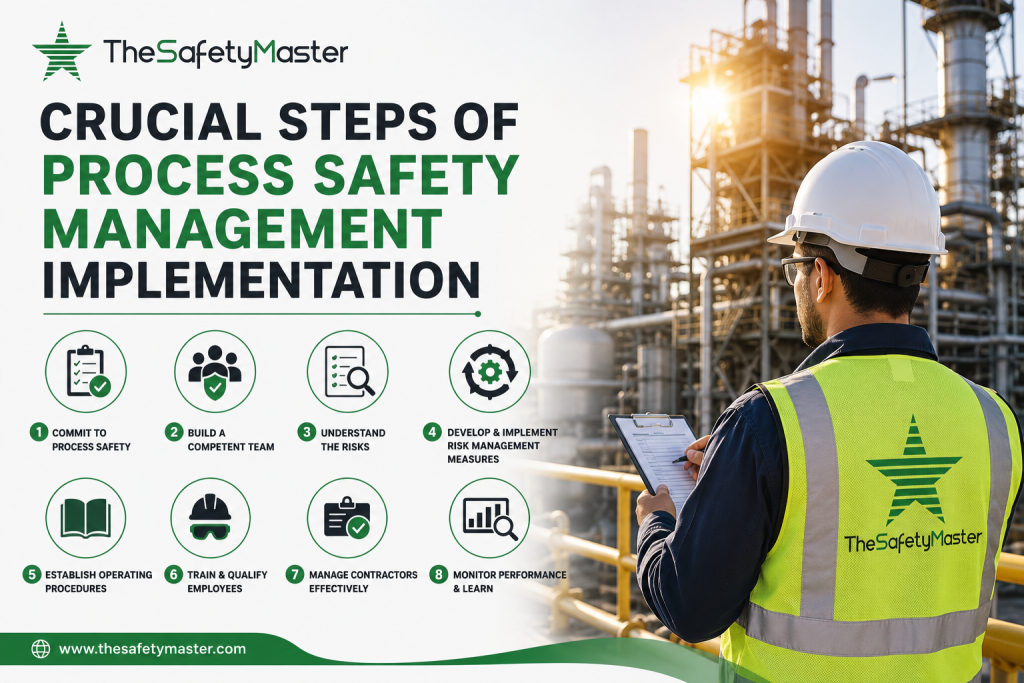
Process Safety Management Implementation is a systematic approach to identifying, evaluating, and controlling hazards associated with highly hazardous chemicals and industrial processes. A properly implemented PSM program helps organizations prevent catastrophic releases, fires, explosions, toxic exposures, equipment failures, and other major process-related incidents.
OSHA’s Process Safety Management standard, 29 CFR 1910.119, establishes requirements for managing hazards associated with processes involving highly hazardous chemicals. The framework integrates process information, hazard analysis, operating procedures, employee training, mechanical integrity, management of change, emergency planning, audits, and other controls.
For organizations operating chemical plants, refineries, petrochemical facilities, pharmaceutical plants, oil and gas facilities, and other high-risk operations, PSM should be treated as an ongoing management system rather than a one-time compliance activity.
What Is Process Safety Management?
Process Safety Management is a structured system for preventing or minimizing the consequences of accidental releases of toxic, reactive, flammable, or explosive chemicals. It focuses on understanding process hazards and establishing multiple layers of protection to prevent incidents.
Unlike a basic workplace safety program that may focus primarily on individual worker behavior, PSM examines the complete process, including:
- Process design and technology
- Hazardous chemicals
- Equipment and instrumentation
- Operating and maintenance procedures
- Human factors
- Training and competency
- Emergency response
- Process modifications
- Equipment inspection and testing
- Incident investigation
OSHA describes PSM as a comprehensive program that integrates technologies, procedures, and management practices to control hazards associated with highly hazardous chemicals.
Why Is Process Safety Management Implementation Important?
Effective PSM implementation can help organizations identify hazards before they result in serious incidents. It also provides a structured method for controlling risks throughout the lifecycle of a process.
Key benefits include:
Prevention of Major Industrial Incidents
A well-designed PSM system helps identify scenarios that could lead to fires, explosions, toxic releases, or other catastrophic events.
Better Hazard Identification
Process Hazard Analysis provides a systematic method for examining process hazards, deviations, safeguards, and potential consequences.
Improved Equipment Reliability
Mechanical integrity programs help ensure that critical equipment is inspected, tested, maintained, and suitable for its intended service.
Safer Changes
Management of Change ensures that modifications to chemicals, equipment, technology, procedures, or facilities are reviewed before implementation.
Stronger Emergency Preparedness
Emergency planning helps organizations establish appropriate actions for responding to hazardous releases and other process emergencies.
Regulatory Compliance
A structured PSM program supports compliance with applicable requirements. Organizations should always evaluate the regulations and standards applicable to their specific location, process, chemicals, and industry.
Process Safety Management Implementation: Crucial Steps
Successful implementation requires coordination between management, engineering, operations, maintenance, safety professionals, contractors, and employees.
Step 1: Establish Management Commitment
Senior management should establish process safety as a core organizational priority.
Management commitment should include:
- Defining clear process safety objectives
- Providing adequate resources
- Assigning responsibilities
- Supporting employee participation
- Reviewing process safety performance
- Following up on corrective actions
- Encouraging reporting of hazards and near misses
Employees are more likely to participate actively in process safety when management demonstrates visible and consistent commitment.
Step 2: Develop Process Safety Information
Accurate Process Safety Information (PSI) is the foundation for understanding hazards.
The information should cover relevant chemical hazards, process technology, and equipment. OSHA’s standard includes requirements concerning chemical properties, process chemistry, operating limits, process flow information, P&IDs, equipment design, relief systems, electrical classification, safety systems, and related information.
Important Process Safety Information
Organizations should maintain appropriate documentation such as:
- Chemical hazard information
- Safety Data Sheets
- Process flow diagrams
- Piping and instrumentation diagrams
- Equipment specifications
- Design information
- Operating limits
- Relief system information
- Safety system details
- Applicable engineering standards
Step 3: Conduct Process Hazard Analysis
Process Hazard Analysis (PHA) is one of the most important components of PSM.
A PHA systematically identifies hazards, evaluates potential consequences, and determines whether existing safeguards are adequate.
Common methodologies include:
- HAZOP
- What-If Analysis
- Checklist Analysis
- What-If/Checklist
- Failure Mode and Effects Analysis
- Fault Tree Analysis
OSHA requires covered processes to have an appropriate PHA methodology and specifies requirements concerning team expertise, recommendations, documentation, and periodic revalidation.
Address PHA Recommendations
Identifying hazards is not enough. Organizations should establish a system to:
- Document recommendations.
- Assign responsibility.
- Establish target completion dates.
- Implement corrective measures.
- Verify completion.
- Communicate relevant actions to affected personnel.
Step 4: Develop and Maintain Operating Procedures
Written operating procedures should explain how covered processes are operated safely.
Procedures should address relevant operating phases, including:
- Initial startup
- Normal operations
- Temporary operations
- Emergency shutdown
- Emergency operations
- Normal shutdown
- Startup following turnaround
- Startup following emergency shutdown
They should also identify operating limits, consequences of deviations, corrective actions, safety precautions, and safety-system functions.
Step 5: Provide Training and Competency Assurance
Employees who operate or maintain covered processes need appropriate knowledge and skills.
Training should address:
- Process hazards
- Operating procedures
- Emergency operations
- Shutdown procedures
- Safe work practices
- Hazardous chemical risks
- Applicable control measures
Training effectiveness should also be verified and documented.
Step 6: Manage Contractors
Contractors can work in areas containing significant process hazards, so contractor management should be integrated into the PSM system.
Organizations should evaluate contractor qualifications, communicate known process hazards, provide applicable site information, establish safe work requirements, and monitor contractor performance.
Contractors should also understand the facility’s emergency procedures and applicable safety rules.
Step 7: Conduct a Pre-Startup Safety Review
A Pre-Startup Safety Review (PSSR) should verify that important safety requirements have been addressed before hazardous chemicals are introduced into a new or significantly modified process.
A PSSR should verify, as applicable:
- Construction meets design specifications
- Safety procedures are available
- Operating procedures are adequate
- Maintenance procedures are established
- Emergency procedures are available
- Required PHA recommendations are addressed
- Employee training is completed
OSHA specifically requires PSSR for new facilities and certain significant modifications.
Step 8: Establish Mechanical Integrity
Mechanical integrity focuses on keeping critical process equipment safe and reliable throughout its operating life.
Equipment may include:
- Pressure vessels
- Storage tanks
- Piping systems
- Valves
- Relief devices
- Emergency shutdown systems
- Sensors
- Alarms
- Interlocks
- Pumps
Inspection and testing programs should be based on the equipment, service conditions, applicable requirements, and recognized good engineering practices.
Step 9: Control Hot Work
Hot work such as welding, cutting, brazing, or other spark- or flame-producing activities can introduce an ignition source into hazardous areas.
A controlled hot-work system should include:
- Work authorization
- Hazard assessment
- Fire prevention measures
- Gas testing where appropriate
- Removal or protection of combustible materials
- Fire protection equipment
- Defined permit duration
- Post-work verification
OSHA’s PSM standard requires a hot-work permit for hot work conducted on or near a covered process.
Step 10: Implement Management of Change
Management of Change (MOC) ensures that changes are evaluated before they are introduced into a covered process.
Changes may involve:
- Process chemicals
- Equipment
- Technology
- Procedures
- Facilities
- Operating conditions
Key MOC Questions
Before approving a change, organizations should consider:
- What is changing?
- Why is the change necessary?
- What hazards could the change introduce?
- Does the change affect existing safeguards?
- Are procedures required to be updated?
- Is additional training necessary?
- Does the change require a PHA or PSSR?
- Who needs to be informed?
Effective MOC prevents seemingly minor modifications from introducing uncontrolled hazards.
Step 11: Investigate Process Safety Incidents
Incident investigation should focus on understanding what happened and why.
Investigators should identify:
- Immediate causes
- Underlying causes
- Management-system weaknesses
- Equipment failures
- Procedural deficiencies
- Human factors
- Training gaps
- Corrective actions
The objective should be learning and prevention rather than simply assigning blame.
Step 12: Establish Emergency Planning and Response
Organizations handling highly hazardous chemicals need effective emergency planning.
Plans should consider scenarios such as:
- Chemical releases
- Fires
- Explosions
- Toxic exposures
- Equipment failures
- Loss of containment
- Utility failures
Emergency plans should define responsibilities, communication methods, evacuation or shelter procedures, response resources, and coordination with relevant emergency organizations.
Step 13: Conduct Compliance Audits
Regular audits help determine whether the PSM program is actually being implemented.
An effective audit can examine:
- Written procedures
- Training records
- PHA documentation
- MOC records
- Mechanical integrity records
- Incident investigations
- Emergency plans
- Contractor management
- Hot-work permits
- Corrective actions
OSHA requires covered employers to certify that they have evaluated compliance with the PSM standard at least every three years.
Step 14: Control and Protect Process Safety Information
Trade-secret considerations should not prevent authorized personnel from obtaining information necessary to perform PSM activities safely.
Organizations should establish appropriate controls for confidential information while ensuring that people responsible for PSM activities can access the information they need.
14 Elements of Process Safety Management
The 14 elements of Process Safety Management under OSHA’s PSM framework are:
- Employee Participation
- Process Safety Information
- Process Hazard Analysis
- Operating Procedures
- Training
- Contractors
- Pre-Startup Safety Review
- Mechanical Integrity
- Hot Work Permit
- Management of Change
- Incident Investigation
- Emergency Planning and Response
- Compliance Audits
- Trade Secrets
These elements work together rather than functioning as independent activities. Weakness in one area can affect the performance of the overall process safety system.
Process Safety Management Principles
The major Process Safety Management principles focus on proactive hazard identification, risk reduction, operational discipline, equipment reliability, employee involvement, and continuous improvement.
Important principles include:
Hazard Identification
Understand what can go wrong before an incident occurs.
Risk Control
Apply appropriate engineering, administrative, and operational controls to reduce risk.
Operational Discipline
Ensure that operations are performed according to approved procedures and defined operating limits.
Competency
Make sure employees and contractors have the knowledge, skills, and training needed for their responsibilities.
Mechanical Reliability
Maintain critical equipment and protective systems in a condition suitable for safe operation.
Management of Change
Evaluate safety implications before making changes.
Learning From Incidents
Investigate incidents and near misses to identify underlying weaknesses and prevent recurrence.
Continuous Improvement
Use audits, inspections, performance indicators, investigations, and lessons learned to strengthen the PSM system.
Process Safety Management Implementation Example
Consider a chemical manufacturing facility that stores and processes a highly hazardous and flammable chemical.
The company begins its PSM implementation by compiling chemical and process safety information. A multidisciplinary team then conducts a HAZOP to identify deviations such as high pressure, high temperature, loss of cooling, and incorrect chemical addition.
The team identifies a scenario in which loss of cooling could increase process temperature beyond the safe operating limit.
The organization then evaluates existing safeguards and identifies additional controls, such as improved alarms, automatic shutdown functions, revised operating procedures, equipment inspection requirements, and operator training.
Before a later equipment modification, the company uses its MOC process to evaluate the change. Relevant procedures are updated, affected employees are trained, and a PSSR is completed before restarting the modified process.
This example demonstrates how PSM elements operate as an interconnected system rather than isolated compliance activities.
Process Safety Management Implementation Notes
When developing Process safety management implementation notes, organizations should focus on practical application rather than simply creating documentation.
Important notes include:
- Keep process safety information current.
- Involve experienced process personnel in PHA activities.
- Track every PHA recommendation to closure.
- Review operating procedures regularly.
- Verify employee competency after training.
- Control contractor activities.
- Complete PSSR before applicable startups.
- Maintain critical equipment according to established requirements.
- Use MOC for applicable process changes.
- Investigate serious incidents and near misses appropriately.
- Conduct periodic compliance audits.
- Track corrective actions until verified closure.
- Review process safety performance indicators regularly.
Process Safety Management 14 Elements PPT
A Process Safety Management 14 elements PPT can be useful for employee awareness sessions, management presentations, contractor orientation, and process safety training.
A useful presentation structure can include:
Slide 1: Introduction to PSM
Definition, objectives, and importance.
Slide 2: Employee Participation
Roles and responsibilities of employees.
Slide 3: Process Safety Information
Chemical, process, and equipment information.
Slide 4: Process Hazard Analysis
HAZOP, What-If, FMEA, and other methodologies.
Slide 5: Operating Procedures
Safe operating and emergency procedures.
Slide 6: Training
Training, competency, and documentation.
Slide 7: Contractors
Contractor qualification and safety management.
Slide 8: PSSR
Safety verification before startup.
Slide 9: Mechanical Integrity
Inspection, testing, and maintenance.
Slide 10: Hot Work Permit
Control of ignition sources.
Slide 11: Management of Change
Safe evaluation and implementation of changes.
Slide 12: Incident Investigation
Root causes, corrective actions, and learning.
Slide 13: Emergency Planning and Response
Emergency preparedness and response.
Slide 14: Compliance Audits and Trade Secrets
Auditing, corrective actions, and information management.
Process Safety Management PDF: What Should It Include?
A Process safety Management PDF can serve as a reference document for employees, safety professionals, engineers, and managers.
A useful PSM document may contain:
- PSM policy
- Scope and applicability
- Roles and responsibilities
- The 14 PSM elements
- Process Safety Information
- PHA methodology
- Operating procedures
- Training requirements
- Contractor controls
- PSSR procedure
- Mechanical integrity program
- Hot-work procedure
- MOC procedure
- Incident investigation procedure
- Emergency response requirements
- Audit procedure
- Corrective action tracking
The document should be customized to the organization’s processes, hazards, applicable regulations, and operational requirements.
Guidelines for Implementing Process Safety Management
The Guidelines for implementing process safety management PDF should be treated as a practical reference rather than a substitute for applicable regulations, engineering standards, or site-specific risk assessments.
A strong implementation framework should:
- Define the scope of the PSM program.
- Identify covered processes and hazards.
- Establish management responsibilities.
- Develop complete process safety information.
- Conduct appropriate PHAs.
- Implement operating procedures.
- Train employees and verify competency.
- Control contractor activities.
- Conduct PSSR where required.
- Maintain critical equipment.
- Control hot work.
- Manage changes systematically.
- Investigate qualifying incidents.
- Maintain emergency preparedness.
- Conduct periodic audits.
- Track corrective actions to completion.
OSHA’s Appendix C provides additional nonmandatory compliance guidelines and recommendations that can help employers understand and implement the PSM requirements.
How to Improve PSM Performance
Implementing PSM is not the end of the process. Organizations should continuously evaluate whether the system is working effectively.
Useful improvement activities include:
Track Leading Indicators
Monitor activities such as overdue inspections, open PHA recommendations, overdue MOC actions, training completion, and audit findings.
Review Process Safety Events
Analyze incidents, near misses, unsafe conditions, and loss-of-containment events for recurring patterns.
Strengthen Employee Participation
Encourage employees to report hazards and participate in PHA, procedure reviews, investigations, and improvement activities.
Verify Corrective Actions
Do not consider an action complete until implementation and effectiveness have been verified.
Maintain Accurate Documentation
Outdated procedures, drawings, equipment records, and process information can undermine the effectiveness of the entire PSM program.
Frequently Asked Questions
What is Process Safety Management implementation?
Process Safety Management implementation is the process of establishing and maintaining a structured system for identifying, evaluating, and controlling hazards associated with highly hazardous chemical processes.
What are the 14 elements of Process Safety Management?
The 14 elements are Employee Participation, Process Safety Information, Process Hazard Analysis, Operating Procedures, Training, Contractors, Pre-Startup Safety Review, Mechanical Integrity, Hot Work Permit, Management of Change, Incident Investigation, Emergency Planning and Response, Compliance Audits, and Trade Secrets.
Why is PHA important in PSM?
PHA helps organizations systematically identify process hazards, evaluate potential consequences, review safeguards, and develop recommendations for risk reduction. OSHA identifies PHA as a central component of its PSM requirements.
How often should a PHA be revalidated?
For processes covered by OSHA’s PSM standard, the PHA must be updated and revalidated by a qualified team at least every five years.
What is Management of Change in PSM?
Management of Change is a formal process for evaluating applicable changes to process chemicals, technology, equipment, procedures, or facilities before implementation so that new hazards and required safeguards can be identified.
What is a Pre-Startup Safety Review?
A PSSR is a structured safety review performed before introducing highly hazardous chemicals into a new facility or certain modified facilities. It verifies that required design, procedures, training, and other safety requirements have been addressed.
Is Process Safety Management only about chemical safety?
No. PSM addresses the broader management of hazards associated with processes involving highly hazardous chemicals. It integrates technical information, engineering controls, procedures, equipment integrity, training, management systems, emergency planning, and organizational practices.
Who should be involved in PSM implementation?
Management, process engineers, safety professionals, operators, maintenance personnel, technical specialists, and contractors where applicable should have defined roles in the PSM program.
Can PSM documentation be provided as a PDF or PPT?
Yes. Organizations commonly use structured documents, presentations, procedures, checklists, training materials, and audit records to support their PSM systems. However, documents should be customized to the specific facility and applicable requirements rather than copied without review.
Conclusion
Effective Process Safety Management Implementation requires more than creating policies or completing a compliance checklist. It requires organizations to understand their process hazards, maintain accurate information, operate within safe limits, protect critical equipment, manage changes, train personnel, investigate incidents, and continuously verify that safeguards remain effective.
The 14 PSM elements provide an integrated framework for managing major process hazards. When these elements are implemented consistently and supported by strong leadership and employee participation, organizations can strengthen process safety performance and reduce the likelihood and potential consequences of catastrophic incidents. OSHA’s PSM standard and associated guidance provide an important regulatory reference, while site-specific engineering evaluation and applicable local requirements remain essential.