Risk Control Measures Commonly Recommended After HIRA

How to Choose the Right HIRA Consultant for Your Industry
May 13, 2026
Signs Your Workplace Needs an Updated Risk Assessment
May 18, 2026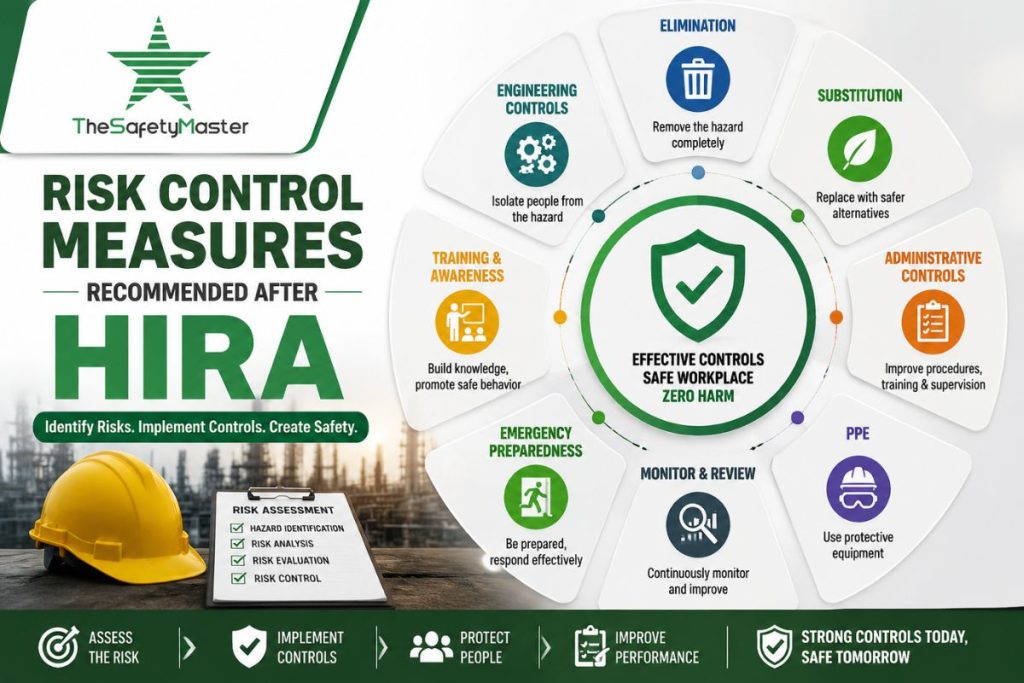
Conducting a Hazard Identification and Risk Assessment (HIRA) is a crucial first step toward ensuring workplace health and safety. However, identifying hazards and assessing their potential severity is only half the battle. The real value lies in what follows—selecting and implementing robust, sustainable, and reliable risk controls to manage residual risks effectively.
Choosing the right intervention strategy can mean the difference between proactive risk prevention and reactive crisis management. At The Safety Master, safety consultants and technical experts guide organizations through structured HIRA processes to establish tailored risk control measures that satisfy regulatory standards, protect workforce well-being, and drive operational excellence.
What are Risk Control Measures in HIRA?
In the context of HIRA, risk control measures are systematic actions, engineering modifications, or administrative rules introduced to reduce the probability or severity of workplace hazards.Once potential hazards—such as working at height, chemical handling, or equipment maintenance—are rated on a risk matrix, appropriate controls must be assigned based on the Hierarchy of Controls.
5 Primary Levels of Risk Control (Hierarchy of Controls)
To ensure maximum safety and reliability, control measures should be prioritized from the highest level of protection to the lowest:
1. Elimination
Elimination involves completely removing the hazard or hazardous activity from the work process.Because it permanently eradicates the risk, it stands as the most effective control measure.
- Example: Discontinuing the use of a redundant high-risk machine or removing manual handling in favor of fully automated conveyor systems.
2. Substitution
When complete elimination is not feasible, substitution replaces high-risk processes, equipment, or materials with safer alternatives.
- Example:Replacing toxic or flammable chemical solvents with water-based, non-hazardous cleaning agents.
3. Engineering Controls
Engineering controls physically isolate workers from hazardous exposures or create barriers between the hazard and employee. These systems operate independently of human behavior, making them reliable and long-lasting.
- Example: Installing machine guards, safety interlocks, local exhaust ventilation systems, or acoustic sound barriers.
4. Administrative Controls
Administrative controls modify how, when, and by whom work is executed. While vital, they rely heavily on human compliance and ongoing oversight.
- Example: Implementing Permit-to-Work (PTW) systems, rotating shifts to minimize worker exposure, and establishing Standard Operating Procedures (SOPs).
5. Personal Protective Equipment (PPE)
PPE serves as the final barrier of protection. It is deployed when other measures cannot entirely eliminate the risk or acts as supplementary protection.
- Example: Safety helmets, flame-resistant clothing, respiratory protection, and safety harnesses.
Specialized Risk Control Measures Recommended After HIRA
When performing comprehensive risk assessments, The Safety Master frequently recommends tailored operational controls beyond basic procedural controls:
Engineering & Physical Safeguards
- Safety Interlocks & E-Stops: Automated shutdown systems that cut power instantly in emergency situations.
- Containment & Machine Guarding: Physical barriers preventing direct contact with dangerous moving parts or toxic chemical splashes.
Competency & Training Programs
- Technical skill development ensures employees understand risk matrix findings, correct safety procedures, and emergency response plans.
- Regular toolbox talks reinforce daily hazard awareness prior to shift execution.
Preventive Maintenance & Inspection Schedules
- Routine equipment servicing, vibration monitoring, and thermal inspections catch operational failures before catastrophic accidents occur.
Emergency Preparedness & Incident Planning
- Establishing clear evacuation protocols, spill response kits, fire suppression systems, and designated safety wardens mitigates damage if an incident arises.
How to Implement Risk Control Measures Effectively
Selecting a risk control is only the first step; execution determines its real-world success. Organizations should follow structured steps after a HIRA study:
Step 1: Assign Ownership and Timelines
Clearly define who is responsible for installing engineering controls, drafting procedures, or procuring equipment within set deadlines.
Step 2: Communicate and Train Workforce
Inform workers about new procedures and physical modifications, ensuring they understand why changes were introduced and how to follow them.
Step 3: Re-evaluate Residual Risk
Assess the risk score after applying controls to confirm that the residual risk falls within an acceptable tolerance limit.
Step 4: Continuous Review and Auditing
Periodically audit control measures to verify they remain functional and relevant, updating the HIRA whenever processes change or incidents occur.
Partnering with The Safety Master for Effective HIRA Management
Selecting the optimal mix of controls requires technical insight and industrial experience. The Safety Master helps organizations carry out rigorous HIRA studies, systematically design hierarchy-driven controls, and establish safety management systems that safeguard lives and boost productivity.
Frequently Asked Questions (FAQs)
What are the 5 control measures to reduce risk?
The 5 control measures to reduce risk in order of effectiveness are:
- Elimination:Completely removing the hazard.
- Substitution:Replacing the hazard with a safer alternative.
- Engineering Controls:Isolating workers from the hazard physically.
- Administrative Controls: Changing procedures, schedules, or rules.
- Personal Protective Equipment (PPE):Providing protective gear to individual workers.
What are the control measures in Hira?
Control measures in HIRA are specific safeguards selected to minimize risks identified during hazard assessment. They include physical safeguards (machine guards, ventilation), organizational systems (permits-to-work, safety training, shift rotations), and individual protective equipment (gloves, helmets, respirators).
What are 5 control measures?
The 5 standard risk control measures constitute the Hierarchy of Controls: Elimination, Substitution, Engineering Controls, Administrative Controls, and Personal Protective Equipment (PPE).
What are some risk control measures?
Common risk control measures include:
- Installing ventilation systems and machine guards.
- Replacing toxic solvents with non-toxic solutions.
- Conducting regular preventive maintenance and safety inspections.
- Issuing Permit-to-Work approvals for hot work or confined spaces.
- Providing specialized safety training and PPE like fall protection harnesses.
What are three types of control measures?
Control measures are often categorized functionally into three distinct types:
- Preventive Controls:Prevent an incident from occurring (e.g., equipment maintenance, standard operating procedures).
- Detective Controls: Detect abnormal conditions or early failures (e.g., safety alarms, gas detectors, routine safety inspections).
- Corrective/Mitigation Controls:Reduce impact after an incident begins (e.g., emergency stops, fire suppression systems, emergency spill response).
What is the most effective risk control measure?
Elimination is the most effective risk control measure.By physically removing the hazard entirely from the workplace or process, the associated risk is completely removed without relying on human compliance or mechanical maintenance.