Risk-Based Inspection (RBI) Implementation: A Complete Guide

How Behavior-Based Safety Programs Improve Safety Culture and Reduce Workplace Incidents
June 22, 2026
What Makes the Top Safety Consultants Stand Out in Industrial Safety?
June 26, 2026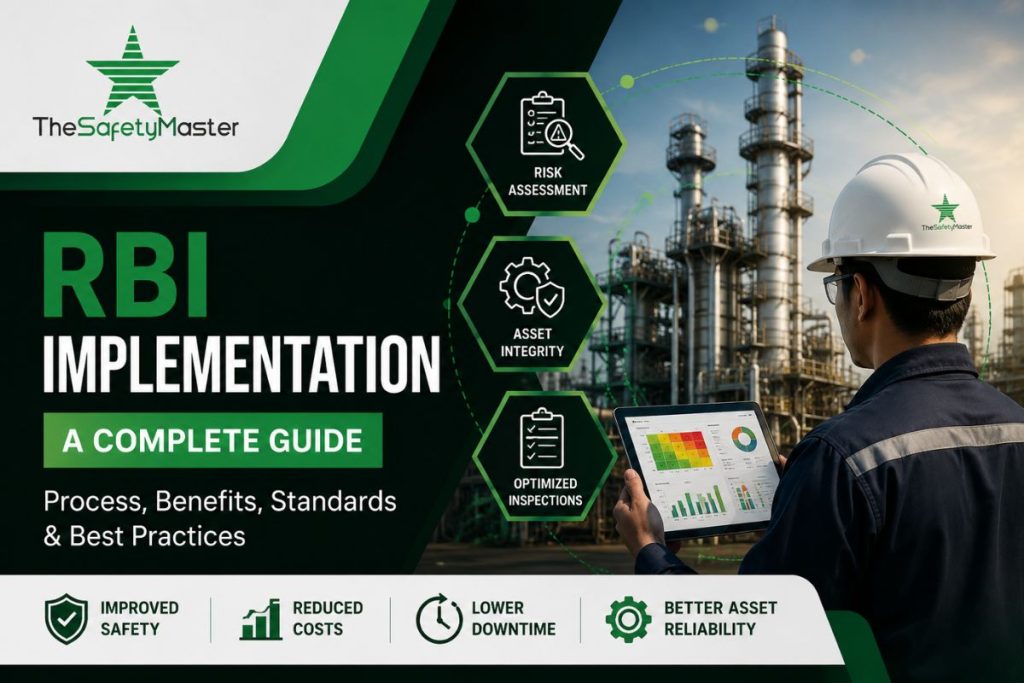
Risk-Based Inspection (RBI) is a structured approach that helps organizations prioritize inspections based on the likelihood and consequences of equipment failure. Unlike traditional time-based inspections, RBI focuses resources on high-risk assets, improving safety, reliability, and operational efficiency. Widely used in oil & gas, chemical, petrochemical, power, pharmaceutical, and manufacturing industries, RBI supports effective asset integrity management while reducing unnecessary inspection costs. Standards such as API 580 and API 581 provide the framework for implementing RBI programs and making informed risk-based decisions that enhance workplace safety and business performance.
What Is Risk-Based Inspection (RBI)?
Risk-Based Inspection (RBI) is a systematic approach used to prioritize inspection activities based on the likelihood and consequences of equipment failure. The primary objective of RBI is to improve safety, optimize inspection resources, reduce maintenance costs, and enhance asset reliability. Unlike traditional inspections that follow fixed schedules, RBI focuses on high-risk equipment requiring greater attention. It plays a critical role in Asset Integrity Management by helping organizations identify potential threats, manage risks effectively, and ensure the safe and reliable operation of critical assets throughout their lifecycle.
Traditional Inspection vs Risk-Based Inspection
| Traditional Inspection | Risk-Based Inspection (RBI) |
|---|---|
| Fixed inspection intervals | Risk-based inspection intervals |
| Equal focus on all assets | Focus on high-risk assets |
| Higher inspection costs | Optimized inspection costs |
| Time-based approach | Risk-driven approach |
| Limited risk prioritization | Improved risk management |
Why Is RBI Important for Modern Industries?
Modern industries rely on critical equipment that operates under demanding conditions. Over time, asset aging, corrosion, and equipment degradation can increase the risk of unexpected failures.
RBI helps organizations focus on the equipment that poses the highest risk, ensuring resources are used effectively.
Why RBI Matters
- Identifies potential failures before they occur
- Reduces costly downtime and production losses
- Manages corrosion and equipment deterioration
- Supports regulatory and safety compliance
- Protects employees, assets, and the environment
- Improves reliability and operational efficiency
By prioritizing inspections based on risk, RBI enables organizations to make smarter maintenance decisions while enhancing safety and business performance.
Key Components of Risk-Based Inspection
Risk-Based Inspection (RBI) evaluates equipment risk by analyzing two critical factors: Probability of Failure (PoF) and Consequence of Failure (CoF). Together, these factors help organizations prioritize inspections and maintenance activities.
Probability of Failure (PoF)
PoF measures the likelihood of equipment failure due to factors such as:
- Corrosion and erosion
- Fatigue and cracking
- Material degradation
- Operating and process conditions
Consequence of Failure (CoF)
CoF evaluates the potential impact if a failure occurs, including:
- Personnel injury or safety risks
- Environmental damage
- Production downtime and financial losses
- Reputational impact on the organization
Risk Ranking
RBI combines PoF and CoF using a Risk Matrix to classify assets as:
- High Risk
- Medium Risk
- Low Risk
This risk-based approach helps organizations focus inspection efforts on the most critical equipment, improving safety, reliability, and maintenance efficiency.
RBI Implementation Process Step by Step
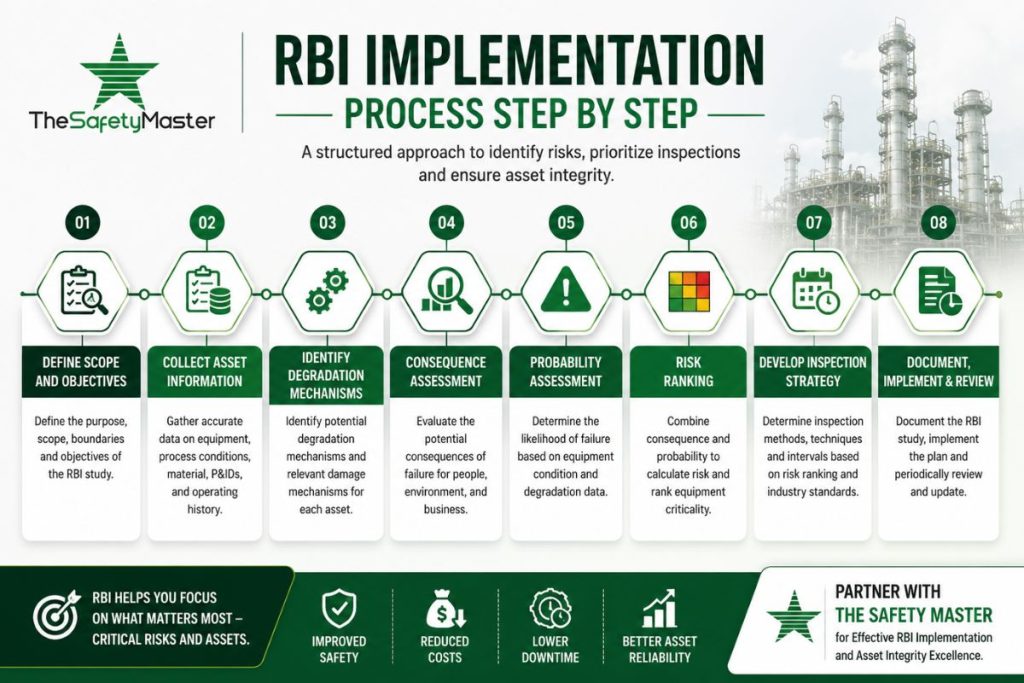
A successful Risk-Based Inspection (RBI) program follows a structured process to identify risks and optimize inspection activities.
Step 1: Asset Data Collection
Gather critical information such as equipment inventory, design documents, inspection records, and operating conditions to establish a reliable foundation for the RBI study.
Step 2: Damage Mechanism Review
Identify potential damage mechanisms that may affect equipment integrity, including corrosion, stress corrosion cracking, fatigue, and erosion.
Step 3: Risk Assessment
Evaluate risk using qualitative, semi-quantitative, or quantitative RBI methodologies based on available data and operational requirements.
Step 4: Risk Ranking
Prioritize assets according to their risk levels and identify equipment requiring immediate attention.
Step 5: Inspection Planning
Develop inspection strategies, intervals, and techniques based on risk rankings.
Step 6: Inspection Execution
Conduct inspections and collect data to verify asset condition.
Step 7: RBI Reassessment and Continuous Improvement
Regularly update the RBI study using new inspection findings and operational data to ensure continuous risk reduction and asset reliability.
Industries That Benefit Most from RBI
Risk-Based Inspection (RBI) is widely used in industries where equipment reliability, safety, and regulatory compliance are critical. It helps organizations prioritize inspections, reduce operational risks, and improve asset performance.
Industries Commonly Using RBI
- Oil & Gas – Pipelines, pressure vessels, and processing equipment.
- Petrochemical Plants – Managing corrosion and process-related risks.
- Chemical Manufacturing – Protecting critical assets handling hazardous chemicals.
- Refineries – Optimizing inspection intervals for high-value equipment.
- LNG Plants – Ensuring safe operation of storage and processing facilities.
- Power Plants – Improving reliability of boilers, turbines, and pressure systems.
- Pharmaceutical Facilities – Supporting equipment integrity and regulatory compliance.
- Fertilizer Plants – Managing corrosion, pressure systems, and operational risks.
RBI helps these industries improve safety, reduce maintenance costs, and extend the life of critical assets while ensuring reliable and efficient operations.
RBI Standards and Guidelines
Several internationally recognized standards provide the framework for implementing effective Risk-Based Inspection (RBI) programs. These guidelines help organizations assess risks, prioritize inspections, and maintain asset integrity.
Key RBI Standards
- API 580 – Provides the fundamental principles and requirements for Risk-Based Inspection programs.
- API 581 – Offers quantitative and qualitative methodologies for calculating equipment risk.
- ASME PCC-3 – Supports inspection planning and asset integrity management using risk-based approaches.
- DNV-RP-G101 – Widely used for offshore and process industries to manage inspection strategies based on risk.
- EN 16991 – European standard that provides guidance for implementing RBI in industrial facilities.
Following these standards helps organizations improve safety, optimize inspection resources, ensure regulatory compliance, and make informed decisions regarding critical asset management.
Common Challenges During RBI Implementation
While Risk-Based Inspection offers significant benefits, organizations often face several challenges during implementation. Incomplete asset information, missing inspection records, and inaccurate operating data can affect the quality of risk assessments. Limited technical expertise and resistance to adopting new methodologies may also slow the RBI process.
Common challenges include:
- Poor asset and equipment data
- Lack of historical inspection records
- Inadequate risk assessment practices
- Limited RBI expertise and resources
- Resistance to organizational change
- Software integration and data management issues
Regular evaluations through a safety audit program can help identify gaps in inspection and maintenance practices. Similarly, a comprehensive fire risk audit can support broader asset integrity and risk management objectives, ensuring critical hazards are effectively controlled.
Benefits of Risk-Based Inspection Implementation
Risk-Based Inspection (RBI) helps organizations allocate inspection resources where they are needed most. By focusing on critical equipment, companies can improve safety, optimize maintenance activities, and reduce operational risks.
Key Benefits
- Reduced inspection and maintenance costs
- Improved workplace safety
- Enhanced asset reliability and performance
- Lower unplanned downtime
- More effective maintenance planning
- Better regulatory compliance
- Extended equipment service life
RBI becomes even more effective when combined with structured hazard identification techniques such as Hazard Identification and Risk Assessment (HIRA). It also supports broader operational risk reduction initiatives that form part of a comprehensive process safety management framework. Together, these approaches help organizations improve asset integrity, strengthen safety performance, and achieve long-term operational excellence.
RBI and Asset Integrity Management
Asset Integrity Management focuses on ensuring that equipment and systems perform safely, reliably, and efficiently throughout their lifecycle. Risk-Based Inspection (RBI) plays a critical role by helping organizations identify high-risk assets, prioritize inspections, and prevent unexpected failures before they occur.
RBI works closely with several key integrity and safety programs, including:
- Mechanical Integrity Programs to maintain the reliability of critical equipment.
- Process Safety Management (PSM) initiatives to identify and control process-related hazards.
- Corrosion Management Programs to monitor degradation mechanisms and extend asset life.
- Risk assessment and inspection planning activities to support informed maintenance decisions.
At The Safety Master, we help organizations integrate RBI with broader asset integrity and process safety initiatives, enabling improved reliability, enhanced safety performance, reduced downtime, and better regulatory compliance.
How The Safety Master Supports RBI Implementation
Successful RBI implementation requires technical expertise, accurate risk assessment, and a structured approach to asset integrity management. At The Safety Master, we help organizations develop and implement RBI programs that improve safety, reliability, and operational efficiency.
Our RBI Support Services
- RBI Study and Risk Prioritization
- HAZOP Study and Process Hazard Analysis
- Mechanical Integrity Assessment
- Process Safety Management (PSM)
- Asset Integrity Assessment
- Hazard and Risk Assessment
- Safety Audits and Compliance Reviews
Our team works closely with organizations to identify critical risks, optimize inspection intervals, and develop practical strategies for maintaining asset integrity. Whether you operate in oil & gas, chemical, manufacturing, power, or pharmaceutical industries, we provide customized solutions tailored to your operational needs.
Ready to Optimize Your Inspection Strategy?
Partner with The Safety Master to implement an effective RBI program that reduces risk, improves asset reliability, and supports long-term operational excellence. Contact our experts today to discuss your RBI implementation requirements.
How The Safety Master Supports RBI Implementation
Successful RBI implementation requires technical expertise, accurate risk assessment, and a structured approach to asset integrity management. At The Safety Master, we help organizations develop and implement RBI programs that improve safety, reliability, and operational efficiency.
Our RBI Support Services
- RBI Study and Risk Prioritization
- HAZOP Study and Process Hazard Analysis
- Mechanical Integrity Assessment
- Process Safety Management (PSM)
- Asset Integrity Assessment
- Hazard and Risk Assessment
- Safety Audits and Compliance Reviews
Our team works closely with organizations to identify critical risks, optimize inspection intervals, and develop practical strategies for maintaining asset integrity. Whether you operate in oil & gas, chemical, manufacturing, power, or pharmaceutical industries, we provide customized solutions tailored to your operational needs.
Ready to Optimize Your Inspection Strategy?
Partner with The Safety Master to implement an effective RBI program that reduces risk, improves asset reliability, and supports long-term operational excellence. Contact our experts today to discuss your RBI implementation requirements.
Frequently Asked Questions
What is RBI implementation?
RBI implementation is the process of assessing equipment risk based on the probability and consequence of failure to develop optimized inspection and maintenance plans.
What is the difference between API 580 and API 581?
API 580 provides the principles and requirements for RBI programs, while API 581 offers detailed methodologies and calculations for performing risk assessments.
How long does an RBI study take?
The duration depends on the number of assets, data availability, and facility complexity. Most RBI studies can take anywhere from a few weeks to several months.
Which industries need RBI?
RBI is commonly used in oil & gas, petrochemical, chemical manufacturing, refineries, power plants, LNG facilities, pharmaceutical plants, and other asset-intensive industries.
What are the benefits of RBI?
RBI helps reduce inspection costs, improve safety, increase asset reliability, minimize downtime, and optimize maintenance planning.
Is RBI mandatory?
RBI is not always a regulatory requirement, but many organizations adopt it to improve risk management, asset integrity, and compliance with industry standards.
How often should RBI be updated?
An RBI study should be reviewed and updated periodically, especially after major process changes, inspection findings, equipment modifications, or operational incidents.