How to Choose the Best Safety Training Company in India?

What Is Workplace Ergonomics and Why Is It Important?
May 16, 2023
Why Is a Contractor Safety Audit Important for Workplace Safety?
May 17, 2023
Workplace safety training is an important part of building a safe, productive, and responsible organization. Employees need the right knowledge and skills to identify hazards, assess risks, follow safe work procedures, and respond correctly during emergencies.
With many organizations offering safety courses and professional training programs, choosing the Best Safety Training Company in India can be difficult. A good training provider should offer more than theoretical information. The training should be practical, easy to understand, relevant to industry requirements, and delivered by competent trainers.
Safety training can benefit safety professionals, engineers, supervisors, managers, operators, contractors, and other employees depending on their responsibilities.
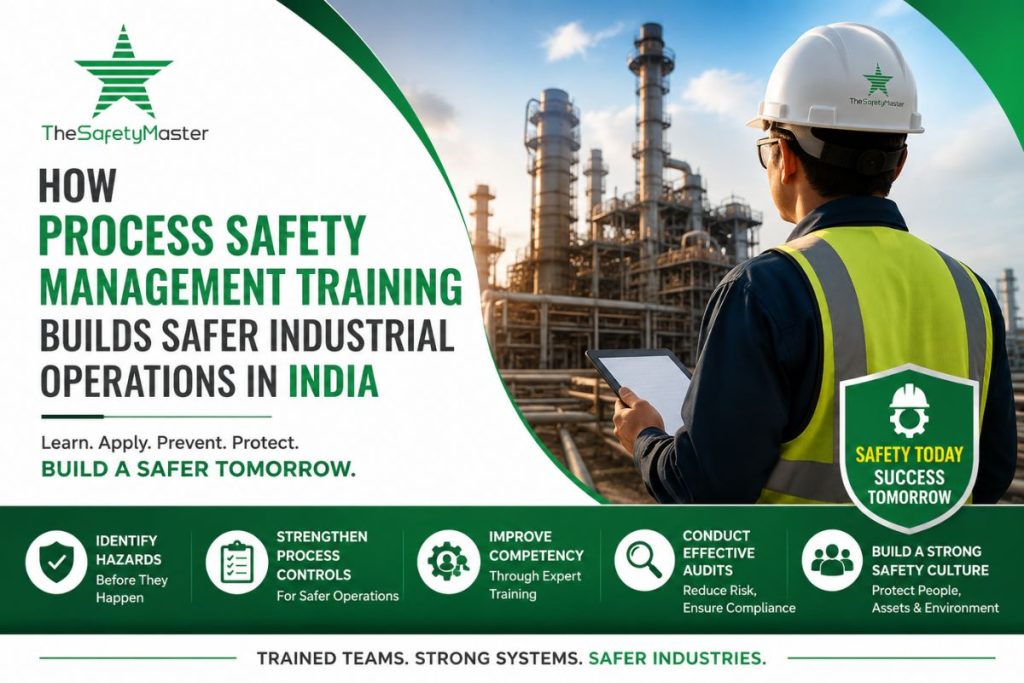
The Safety Master provides professional safety training and consulting services designed to help individuals and organizations improve their understanding of workplace safety, risk management, process safety, and emergency preparedness.
What Is Safety Training?
Safety training is a structured learning process that helps employees and professionals understand workplace hazards and the controls required to manage them.
Training may focus on general workplace safety or specialized subjects.
Common safety training topics include:
- Industrial safety
- Fire safety
- HIRA
- HAZOP
- LOPA and SIL
- Process safety
- Risk assessment
- Electrical safety
- Construction safety
- Work at height
- Confined space safety
- Permit to work
- Emergency response
- Incident investigation
- PPE
- Contractor safety
- Safety management systems
The right training depends on the industry, job role, workplace hazards, and learning objectives.
Why Is Safety Training Important?
Employees may face different hazards depending on their job. A production operator may work around machinery, while a maintenance worker may face electrical or mechanical hazards. A process engineer may need knowledge of process hazards, while a construction worker may need training in work at height and lifting safety.
Training helps employees understand these risks before they perform the work.
Improves Hazard Awareness
Employees who understand workplace hazards are better positioned to recognize unsafe conditions.
Improves Safe Work Practices
Training explains how tasks should be performed safely and what controls should be followed.
Supports Emergency Preparedness
Employees can learn what to do during fire, chemical release, equipment failure, injury, or evacuation situations.
Builds Safety Culture
Regular and relevant training demonstrates that safety is an important part of workplace operations.
Supports Professional Development
Specialized courses can help safety professionals and technical employees develop additional knowledge in risk management and safety engineering.
What Makes the Best Safety Training Company in India?
The phrase Best Safety Training Company in India should not be judged only by course price or certificate availability. Several factors should be considered before selecting a training provider.
Experienced Trainers
Trainers should have suitable technical knowledge and practical industry experience.
A trainer who understands real workplace situations can explain how safety concepts are applied in actual operations.
Industry-Relevant Course Content
Training should reflect the hazards and requirements of the target industry.
For example, process safety training may be more relevant to chemical and petrochemical industries, while construction safety training may focus on scaffolding, excavation, lifting, work at height, and site hazards.
Practical Learning
Good safety training should connect theory with practical workplace situations.
Practical learning may include:
- Case studies
- Workplace examples
- Risk assessment exercises
- Group discussions
- Hazard identification exercises
- Incident scenarios
- Practical demonstrations
- Simulated situations
Clear Training Material
Course material should be structured and easy to understand.
Complex technical subjects should be explained using practical examples rather than unnecessary technical language.
Assessment
An assessment can help determine whether participants have understood the course material.
Depending on the program, assessment may include written tests, practical exercises, case studies, assignments, or participation.
Appropriate Certification
Participants may require a certificate to demonstrate completion of training. However, the value of a training program should be assessed based on the quality and relevance of the learning rather than the certificate alone.
Popular Safety Training Courses in India
Organizations and professionals can choose from many different safety training subjects.
HIRA Training
HIRA stands for Hazard Identification and Risk Assessment.
HIRA training helps participants understand how to identify workplace hazards, evaluate risks, determine risk ratings, and select appropriate control measures.
It can be useful for safety professionals, engineers, supervisors, and managers.
HAZOP Training
HAZOP stands for Hazard and Operability Study.
HAZOP training introduces participants to a structured approach for identifying process hazards and operational deviations.
It is particularly relevant to process industries where complex systems and hazardous materials are involved.
Fire Safety Training
Fire safety training helps employees understand fire prevention, fire hazards, emergency response, evacuation, firefighting equipment, and workplace fire safety practices.
Industrial Safety Training
Industrial safety training covers common workplace hazards and safe work practices.
Topics can include machinery safety, electrical safety, PPE, material handling, housekeeping, chemical safety, emergency preparedness, and accident prevention.
Process Safety Training
Process safety training focuses on preventing major incidents associated with hazardous processes.
It can include topics such as process hazard analysis, management of change, operating procedures, mechanical integrity, emergency planning, and process safety management.
Electrical Safety Training
Electrical safety training helps workers understand electrical hazards, safe working practices, electrical equipment, isolation, PPE, and emergency response.
Construction Safety Training
Construction safety training can cover:
- Work at height
- Scaffolding
- Excavation
- Lifting
- Electrical safety
- Construction equipment
- PPE
- Housekeeping
- Traffic management
- Emergency response
How to Choose the Right Safety Training Course?
Choosing the right course requires understanding the participant’s job and the organization’s safety requirements.
Identify the Training Objective
First determine why training is required.
Is the objective:
- Employee awareness?
- Legal or organizational compliance?
- Professional development?
- Risk assessment competency?
- Technical knowledge?
- Leadership development?
- Specialized certification?
The answer will help identify the most suitable course.
Consider the Participant’s Role
Training should match the participant’s responsibilities.
A plant manager may need safety leadership and process safety awareness, while a safety officer may need detailed risk assessment and auditing skills.
Review the Course Syllabus
The syllabus should clearly explain what participants will learn.
Check whether the topics are relevant to the actual workplace.
Check Trainer Experience
Trainer experience can significantly influence the quality of learning.
Ask whether trainers have practical industry experience related to the subject.
Consider Practical Exercises
A course that includes practical activities may provide better understanding than a program based only on lectures.
Evaluate Training Duration
The course duration should provide sufficient time to cover the subject properly.
Very short training may be suitable for awareness, while advanced technical subjects may require more time.
Online vs Classroom Safety Training
Both online and classroom training can be useful depending on the topic and participant requirements.
Online Training
Online training provides flexibility and can be useful for:
- Safety awareness
- Theoretical concepts
- Refresher training
- Introductory courses
- Employees working from different locations
Participants can often access the course without traveling to a training center.
Classroom Training
Classroom training can provide greater interaction between trainers and participants.
It can be particularly useful when the course requires:
- Group exercises
- Case studies
- Practical demonstrations
- Discussions
- Simulations
- Team-based risk assessment
Which One Should You Choose?
The best format depends on the course objectives, participant requirements, location, schedule, and subject complexity.
For specialized safety topics, a blended approach combining theory with practical exercises can be useful.
Benefits of Professional Safety Training
Professional training can provide benefits for both employees and organizations.
Improved Employee Awareness
Employees learn to recognize workplace hazards and understand appropriate safety controls.
Better Risk Identification
Safety professionals can improve their ability to identify hazards and evaluate workplace risks.
Improved Safety Performance
Well-trained employees are more likely to understand and follow established safety procedures.
Stronger Emergency Preparedness
Training helps employees understand their responsibilities during emergencies.
Improved Safety Culture
Training encourages employees to view safety as part of everyday work rather than as a separate activity.
Professional Development
Specialized training can help safety professionals expand their technical knowledge.
Safety Training for Different Industries
Different industries require different training approaches.
Manufacturing
Manufacturing organizations may require training in machinery safety, electrical safety, fire safety, material handling, risk assessment, and contractor safety.
Chemical Industry
Chemical industries may require HAZOP, process safety, chemical safety, emergency response, HIRA, LOPA, and hazardous substance training.
Construction
Construction companies may require training in scaffolding, work at height, excavation, lifting, electrical safety, PPE, and construction risk management.
Oil and Gas
Oil and gas organizations may require process safety, HAZOP, emergency response, permit to work, confined space, fire safety, and hazardous area awareness.
Hospitality
Hotels and hospitality businesses may require fire safety, emergency response, electrical safety, kitchen safety, occupational safety, and evacuation training.
Role of The Safety Master
The Safety Master provides safety training and professional consulting support for organizations and professionals seeking to strengthen their safety knowledge.
Training programs can be selected according to workplace hazards, professional responsibilities, and organizational requirements.
The objective of effective training should be to help participants understand safety concepts and apply them in real workplace situations.
The Safety Master focuses on practical safety knowledge that can support organizations in hazard identification, risk management, compliance, emergency preparedness, and continuous improvement.
How Organizations Can Make Safety Training More Effective
Training should not end when the course finishes. Organizations should connect training with workplace activities.
Conduct Training Needs Analysis
Identify which employees require which type of training.
Use Real Workplace Examples
Examples from the organization’s actual activities can make learning easier to understand.
Conduct Refresher Training
Important safety topics should be reviewed periodically.
Evaluate Learning
Assessments, quizzes, observations, and discussions can help determine whether employees understood the training.
Monitor Workplace Application
Supervisors should observe whether employees apply the knowledge gained during training.
Keep Training Records
Organizations should maintain appropriate records of participation, course completion, assessment, and refresher training.
What Should You Ask a Safety Training Company Before Enrolling?
Before selecting a training provider, ask:
- Who will conduct the training?
- What is the trainer’s experience?
- What topics are included?
- Is practical learning included?
- Is the course relevant to the industry?
- What is the course duration?
- How are participants assessed?
- What type of certificate is provided?
- Is online or classroom training available?
- Is post-training support available?
These questions can help organizations compare providers more effectively.
Common Mistakes When Choosing Safety Training
Some organizations select training based only on price. This may not provide the desired learning outcome.
Other common mistakes include:
- Choosing an unrelated course
- Ignoring trainer experience
- Focusing only on certificates
- Selecting very short courses for complex subjects
- Not checking the syllabus
- Ignoring practical learning
- Not evaluating participants
- Not following up after training
A good training decision should focus on learning quality, relevance, practical application, and participant needs.
Why The Safety Master Can Be a Safety Training Partner
The Safety Master combines safety training with professional safety consulting and risk management knowledge.
This approach can help participants understand not only safety theory but also how safety principles can be applied to workplace activities.
Training can be particularly valuable when organizations connect it with safety audits, risk assessments, incident investigation, emergency planning, and continuous improvement programs.
Conclusion
Choosing the Best Safety Training Company in India requires careful consideration of trainer expertise, course content, practical learning, industry relevance, assessment, certification, and organizational requirements.
Safety training should not be viewed simply as a certificate program. Its real value comes from improving knowledge, developing competency, strengthening hazard awareness, and helping employees apply safe work practices.
Whether an organization needs HIRA, HAZOP, fire safety, industrial safety, process safety, electrical safety, construction safety, or another specialized program, the training should match the actual risks and responsibilities of the participants.
The Safety Master provides professional safety training and consulting support to help organizations and safety professionals build stronger knowledge and improve workplace safety performance.