HAZOP Certification Course in India: Complete Guide to Training, Eligibility and Career Opportunities

Fire Risk Assessment: Complete Guide for Workplace Safety & Compliance
August 21, 2026
PSM Implementation: A Complete Roadmap for High-Hazard Chemical & Process Industries
September 2, 2026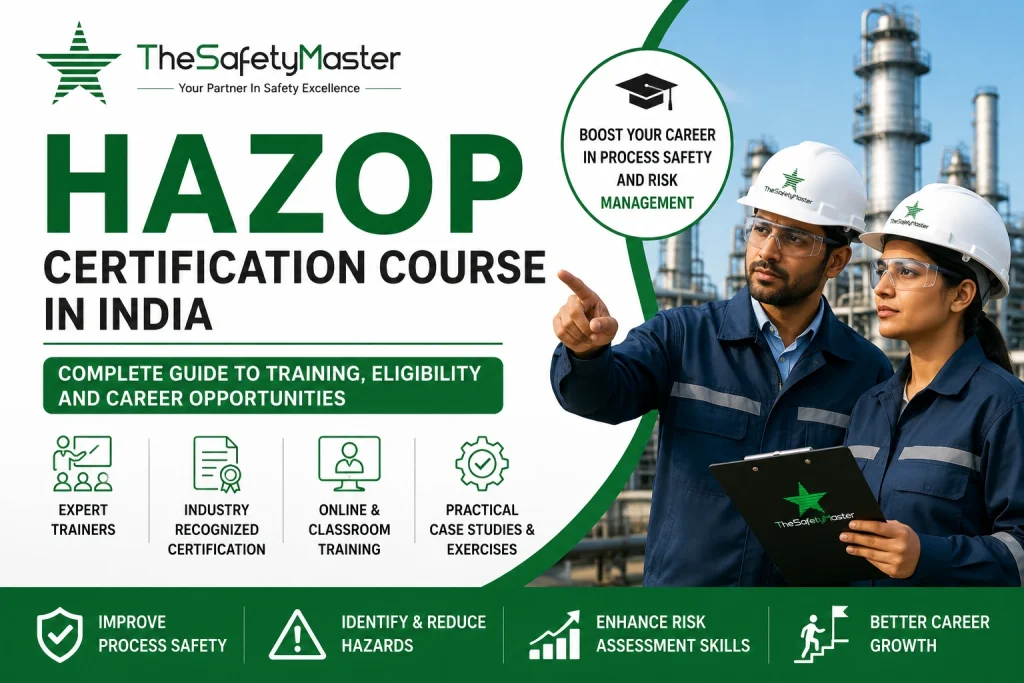
A HAZOP Certification course in India helps safety professionals, process engineers, chemical engineers, operations teams, and other industry professionals understand how to identify process hazards and reduce operational risks. Hazard and Operability Study (HAZOP) is a structured technique used to identify deviations from the intended design or operating conditions of a process and evaluate their possible causes and consequences.
Industries such as oil and gas, petrochemicals, chemicals, pharmaceuticals, power generation, manufacturing, and other process industries use HAZOP studies as part of their process safety management activities. A well-designed HAZOP training program can help professionals participate effectively in HAZOP teams and improve their understanding of process safety.
This guide explains HAZOP certification, eligibility, training, course content, certification costs, career opportunities, online learning options, and how to choose the right course in India.
What Is HAZOP?
HAZOP stands for Hazard and Operability Study. It is a systematic and team-based risk assessment technique used to identify potential hazards, operational problems, and deviations in a process.
A HAZOP team reviews a process systematically using guide words such as:
- No
- More
- Less
- As well as
- Part of
- Reverse
- Other than
The team applies these guide words to process parameters such as flow, pressure, temperature, level, composition, and other relevant variables.
Why Is HAZOP Important?
HAZOP helps organizations:
- Identify process hazards.
- Find potential causes of abnormal operating conditions.
- Understand possible consequences.
- Evaluate existing safeguards.
- Recommend additional risk-reduction measures.
- Improve process and operational safety.
- Support compliance with internal safety requirements.
- Reduce the likelihood of major incidents.
Where Is HAZOP Used?
HAZOP is commonly applied in:
- Oil and gas
- Petrochemical plants
- Chemical industries
- Pharmaceutical manufacturing
- Refineries
- Power plants
- Fertilizer plants
- Manufacturing facilities
- Water and wastewater treatment
- Food processing
- Mining and minerals processing
What Is a HAZOP Certification Course in India?
A HAZOP Certification course in India is a professional training program that teaches participants the principles, methodology, terminology, team roles, documentation, and practical application of HAZOP studies.
Depending on the training provider, a course may include classroom training, live online sessions, case studies, practical exercises, examination, and a certificate of completion.
A good course should not focus only on theory. Participants should learn how a real HAZOP workshop is planned, conducted, documented, and followed up.
HAZOP Certification Course Eligibility
One of the common questions is whether a specific degree or qualification is required for HAZOP certification.
In general, HAZOP training is suitable for professionals and students with backgrounds related to engineering, safety, operations, maintenance, process design, or technical management.
Who Can Take HAZOP Training?
The course can be useful for:
- Chemical engineers
- Process engineers
- Mechanical engineers
- Electrical engineers
- Safety professionals
- EHS professionals
- Production engineers
- Operations professionals
- Maintenance professionals
- Project engineers
- Process safety engineers
- Consultants
- Plant managers
- Safety managers
- Engineering students and graduates
Is Prior HAZOP Experience Required?
Basic courses generally do not require previous HAZOP experience. However, practical industry experience can make it easier to understand process diagrams, operating conditions, safeguards, and real-world scenarios.
Professionals who already participate in risk assessments may benefit particularly from advanced or leader-level HAZOP training.
What Does HAZOP Training Cover?
A comprehensive HAZOP course normally introduces participants to both the concepts and practical application of the technique.
Key Topics in HAZOP Training
Typical topics include:
- Introduction to process safety
- HAZOP principles
- HAZOP terminology
- HAZOP methodology
- HAZOP team composition
- Roles and responsibilities
- Guide words and parameters
- Deviation identification
- Causes and consequences
- Existing safeguards
- Recommendations
- Risk ranking
- HAZOP worksheets
- P&ID interpretation
- HAZOP documentation
- HAZOP report preparation
- Follow-up and action tracking
- Practical HAZOP case studies
HAZOP Guide Words and Deviations
Guide words are an important part of the HAZOP methodology.
For example:
Parameter: Flow
Guide word: No
Deviation: No Flow
The team then discusses:
- What could cause no flow?
- What could happen if no flow occurs?
- What safeguards are available?
- Is the existing protection sufficient?
- What recommendations are required?
This structured approach allows the team to examine potential problems systematically.
HAZID, HAZOP Training Courses: What Is the Difference?
HAZID, HAZOP training courses may cover two important process safety techniques: Hazard Identification (HAZID) and Hazard and Operability Study (HAZOP).
HAZID is generally used for broader and earlier hazard identification, while HAZOP provides a structured examination of process deviations.
HAZID vs HAZOP
| HAZID | HAZOP |
|---|---|
| Hazard Identification | Hazard and Operability Study |
| Broad hazard identification | Detailed process deviation analysis |
| Often used early in projects | Commonly applied to process design and operations |
| Identifies major hazards | Examines causes, consequences and safeguards |
| Can cover an entire facility | Often performed node-by-node |
Both techniques can complement each other within a broader process safety strategy.
HAZOP and SIL Training: How Are They Connected?
HAZOP and SIL training are often considered together because HAZOP can identify hazardous scenarios for which safety instrumented functions may be required.
SIL stands for Safety Integrity Level. SIL analysis helps determine the required level of risk reduction for applicable safety instrumented functions.
HAZOP vs SIL Study
HAZOP primarily identifies deviations, causes, consequences, and safeguards.
A SIL assessment focuses on determining the required integrity level for a safety instrumented function based on the risk associated with a hazardous scenario.
Therefore, HAZOP and SIL are different activities, but their findings can be closely connected in process safety engineering.
HAZOP Certification Cost in India
The HAZOP certification cost varies considerably depending on the training provider, course duration, delivery method, certification, instructor experience, practical exercises, and whether the program is basic or advanced.
Before selecting a course based only on price, compare:
- Course duration
- Training syllabus
- Instructor qualifications
- Practical HAZOP exercises
- Case studies
- Examination method
- Certificate provided
- Online or classroom format
- Post-training support
- Industry relevance
A low-cost course may provide only introductory knowledge, while a more comprehensive program may include practical workshop exercises and detailed case studies.
How Much Does HAZOP Certification Cost?
There is no single fixed price for every HAZOP course in India. Training providers set their own fees according to the course structure and certification model.
For the most accurate current fee, candidates should check the training provider’s latest course information before registration.
HAZOP Certification Online Free: Is It Available?
People frequently search for HAZOP Certification online free or free HAZOP certification course in India.
Free online resources can be useful for learning the fundamentals of HAZOP, including terminology, guide words, methodology, and basic examples. However, free learning material should not automatically be considered equivalent to a professional certification program.
Free HAZOP Certification Course in India
A search for a Free hazop certification course in india complete guide to training eligibility and career opportunities may return free videos, articles, webinars, introductory courses, or learning resources.
Before considering a free certificate, check:
- Who issues the certificate?
- Is there an assessment?
- Is the course industry-oriented?
- Does it include practical HAZOP exercises?
- Is the certificate recognized by employers or clients?
- Does it teach complete HAZOP methodology?
For professionals seeking career development, the quality and practical value of training are generally more important than whether the course is free.
Best HAZOP Certification Course in India: How to Choose
Searching for the Best hazop certification course in india complete guide to training eligibility and career opportunities can produce many options. The best course depends on your professional background and career objective.
What Should You Look for in a HAZOP Course?
Choose a program that provides:
1. Practical Learning
Look for real-world examples and workshop-based exercises rather than theory alone.
2. Experienced Trainers
The instructor should have practical knowledge of process safety, HAZOP studies, and industrial risk assessment.
3. Relevant Course Content
The syllabus should cover HAZOP methodology, guide words, deviations, causes, consequences, safeguards, recommendations, and reporting.
4. Case Studies
Case studies help learners understand how HAZOP is applied to actual process scenarios.
5. Assessment
An assessment or practical evaluation can help confirm that participants understand the methodology.
6. Industry Relevance
The training should be useful for the sectors and roles in which you plan to work.
TÜV HAZOP Leader Course: What Is It?
The TÜV HAZOP Leader course is a leader-focused training option associated with TÜV organizations. Such programs are intended for professionals who want to develop skills related to leading or facilitating HAZOP studies.
HAZOP leadership requires more than understanding guide words. A leader needs to manage the study process, encourage effective team participation, maintain a systematic discussion, control the scope, and ensure that findings are properly recorded.
Professionals considering a TÜV HAZOP Leader course should verify the specific provider, certification scheme, prerequisites, examination requirements, and current course structure before enrolling.
HAZOP Study Process: Step-by-Step
A typical HAZOP study follows a structured process.
Step 1: Define the Scope
The study team establishes the boundaries, objectives, systems, and documents to be reviewed.
Step 2: Form the HAZOP Team
A multidisciplinary team may include process engineering, operations, instrumentation, maintenance, safety, and other relevant specialists.
Step 3: Collect Required Documents
Documents can include:
- P&IDs
- Process descriptions
- Process flow diagrams
- Operating procedures
- Equipment information
- Control philosophy
- Instrumentation information
Step 4: Divide the Process Into Nodes
The process is divided into manageable sections or nodes for systematic review.
Step 5: Apply Guide Words
Guide words are applied to process parameters to identify deviations.
Step 6: Identify Causes
The team determines potential causes for each deviation.
Step 7: Evaluate Consequences
The possible consequences of each deviation are discussed.
Step 8: Identify Safeguards
Existing preventive and mitigative safeguards are documented.
Step 9: Develop Recommendations
Where additional controls are needed, the team records recommendations.
Step 10: Document and Close Actions
The HAZOP results are documented and recommendations are assigned for follow-up and closure.
Career Opportunities After HAZOP Training
HAZOP training can support professionals working in process safety and risk management.
Potential roles include:
- Process Safety Engineer
- HSE Engineer
- Process Engineer
- Safety Engineer
- Risk Assessment Professional
- Operations Engineer
- Process Safety Consultant
- HAZOP Facilitator
- HAZOP Leader
- EHS Manager
- Safety Consultant
HAZOP certification can be particularly valuable when combined with relevant engineering qualifications and practical industry experience.
Benefits of HAZOP Certification
Improve Process Safety Knowledge
The training helps professionals understand systematic process hazard identification.
Develop Risk Assessment Skills
Participants learn how to evaluate causes, consequences, safeguards, and recommendations.
Improve HAZOP Participation
Professionals can contribute more effectively during HAZOP workshops.
Support Career Growth
HAZOP knowledge can strengthen a professional profile for process safety and EHS-related roles.
Understand Industry Practices
Practical case studies can help connect theoretical concepts with industrial applications.
HAZOP Certification vs HAZOP Training
HAZOP training refers to the learning process, while certification generally indicates that a participant has completed a defined training or assessment program.
Not every certificate has the same value.
Therefore, professionals should evaluate the training provider, curriculum, assessment, instructor expertise, practical exposure, and recognition rather than choosing a course solely because it provides a certificate.
Why Choose The Safety Master for HAZOP Training?
The Safety Master focuses on professional safety and process safety training and consulting. A well-structured HAZOP program should help learners move beyond definitions and understand how HAZOP is actually conducted.
When evaluating The Safety Master or any other training provider, candidates should review the latest syllabus, course duration, trainer profile, practical exercises, certification process, and applicable industry sectors before enrollment.
The objective should be to gain practical knowledge that can be applied during real-world process safety and risk assessment activities.
Who Should Enroll in HAZOP Training?
HAZOP training can be considered by professionals who:
- Work in process industries.
- Participate in risk assessments.
- Work with P&IDs and process documentation.
- Want to enter process safety.
- Work in HSE or EHS.
- Want to improve their process hazard analysis skills.
- Plan to become HAZOP facilitators or leaders.
- Want to strengthen their professional safety credentials.
How to Prepare for a HAZOP Certification Course
Before starting your course, become familiar with basic process safety concepts and engineering terminology.
Recommended Preparation
- Understand basic process flow diagrams.
- Learn the purpose of P&IDs.
- Review common process parameters.
- Understand basic risk assessment concepts.
- Learn common process equipment terminology.
- Read about process safety management.
- Practice identifying simple process deviations.
This preparation can make the practical parts of the training easier to understand.
Frequently Asked Questions About HAZOP Certification
Q-What is the full form of HAZOP?
HAZOP full form is Hazard and Operability Study. It is a systematic technique used to identify potential hazards and operability problems by examining deviations from the intended process design or operating conditions.
Q-Is HAZOP certification useful for a safety professional?
Yes. HAZOP knowledge can be useful for safety professionals working with process industries, risk assessments, process safety, EHS, and operational safety.
Q-Can I take HAZOP certification online?
Yes. Many training providers offer online HAZOP training. Before enrolling, check whether the program includes live instruction, practical exercises, assessment, and a verifiable certificate.
Q-Is HAZOP Certification online free available?
Free HAZOP learning resources may be available online, but a free resource is not necessarily equivalent to a professional certification. Always verify the certificate issuer, assessment, syllabus, and industry recognition.
Q-What is the HAZOP certification cost in India?
The cost varies by provider, course duration, delivery format, certification type, trainer expertise, and practical components. Candidates should compare current fees and course inclusions before registering.
Q-What is the difference between HAZID and HAZOP?
HAZID is generally a broader hazard identification technique, while HAZOP systematically examines process deviations and their causes, consequences, and safeguards.
Q-What is HAZOP and SIL training?
HAZOP and SIL training combines learning about process deviation analysis with Safety Integrity Level concepts. HAZOP may identify scenarios that subsequently require SIL assessment.
Q-What is a TÜV HAZOP Leader course?
A TÜV HAZOP Leader course is a specialized program designed to develop skills for professionals who want to lead or facilitate HAZOP studies. Exact prerequisites, examination arrangements, and certification requirements depend on the specific TÜV program.
Q-Can freshers take HAZOP training?
Yes. Beginners can take introductory HAZOP training, although engineering, safety, or process-industry knowledge can make the subject easier to understand.
Q-Does HAZOP certification guarantee a job?
No certification can guarantee employment. HAZOP certification can strengthen your knowledge and professional profile, but career opportunities also depend on education, industry experience, technical skills, communication ability, and relevant job requirements.
Q-Which industries use HAZOP?
HAZOP is widely used in process-intensive industries such as oil and gas, petrochemicals, chemicals, pharmaceuticals, power generation, refineries, fertilizer, and manufacturing.
Conclusion
A HAZOP Certification course in India can be a valuable learning opportunity for engineers, safety professionals, process professionals, and others working in industries where process hazards and operational risks need systematic evaluation. A strong course should cover HAZOP methodology, guide words, deviations, causes, consequences, safeguards, recommendations, documentation, and practical case studies.
When comparing options such as online programs, free learning resources, professional certification courses, HAZID and HAZOP training, HAZOP and SIL training, or a TÜV HAZOP Leader course, focus on practical value, trainer expertise, assessment, course content, and industry relevance rather than certificate availability alone.
For professionals looking to build stronger process safety capabilities, selecting the right training provider is an important step toward developing practical HAZOP knowledge and advancing a career in process safety and risk management.