HAZOP vs. What-If Analysis Study

The Safety Master: Pioneering Behavior-Based Safety Training
October 16, 2025
Scaffolding Safety Training: How We Can Help
October 17, 2025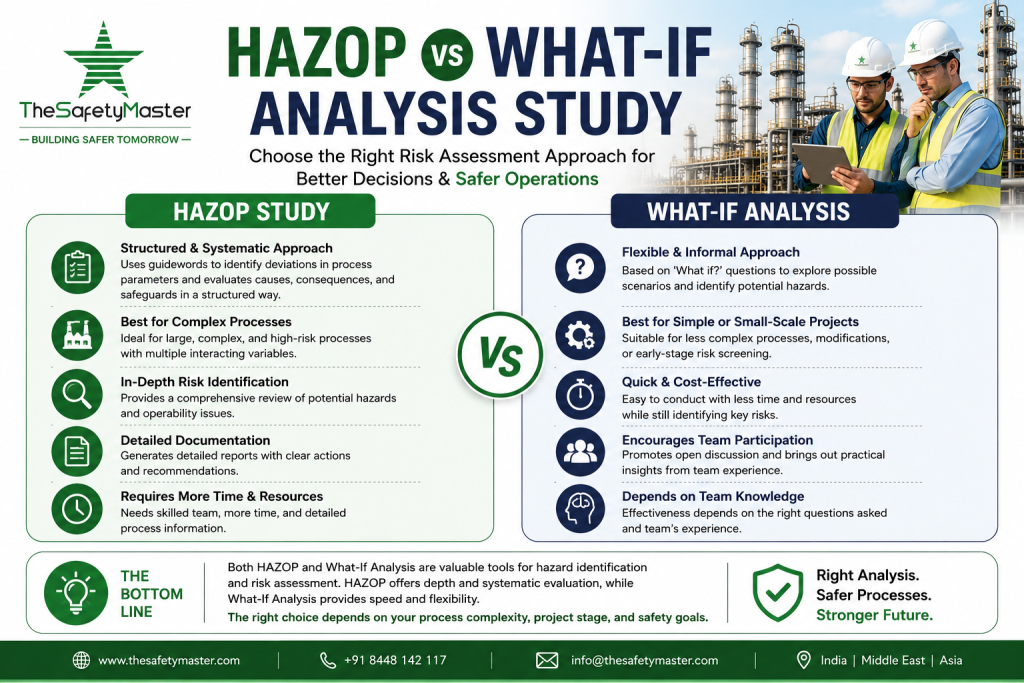
HAZOP and What-If Analysis are two important process hazard analysis (PHA) techniques used to identify hazards, understand potential consequences, and improve process safety. While both methods aim to reduce risk, they differ in structure, depth, application, and the type of process they are best suited for.
For complex industrial processes, HAZOP provides a systematic, guideword-based examination of deviations. What-If Analysis is generally more flexible and relies on structured brainstorming around hypothetical scenarios. Choosing the right method depends on the complexity of the process, project stage, available information, and safety objectives.
What Is HAZOP Analysis?
HAZOP stands for Hazard and Operability Study. It is a structured, team-based methodology used to identify deviations from the intended design or operating conditions of a process.
A HAZOP team divides a process into manageable sections called nodes and examines parameters such as flow, pressure, temperature, level, composition, and time. Guidewords such as No, More, Less, Reverse, Part Of, Other Than, and As Well As are applied to identify possible deviations.
Main Objectives of HAZOP
The key objectives of a HAZOP study include:
- Identifying process hazards and operability problems.
- Finding causes of abnormal process conditions.
- Understanding possible consequences.
- Reviewing existing safeguards.
- Recommending additional risk-reduction measures.
- Improving process design and operational safety.
- Supporting informed safety-related decision-making.
HAZOP is particularly valuable where process interactions are complex and a detailed, systematic review is required.
How HAZOP Is Conducted
A typical HAZOP study involves:
- Defining the study scope and objectives.
- Selecting a multidisciplinary team.
- Reviewing relevant P&IDs and process information.
- Dividing the process into nodes.
- Defining the design intention for each node.
- Applying guidewords to process parameters.
- Identifying causes and consequences.
- Reviewing existing safeguards.
- Making recommendations.
- Recording actions and closing them through follow-up.
What Is What-If Analysis?
What-If Analysis is a qualitative risk assessment technique based on asking hypothetical questions about what could go wrong in a process or operation.
For example:
- What if the cooling system fails?
- What if the pump stops unexpectedly?
- What if pressure becomes too high?
- What if an operator opens the wrong valve?
- What if power is lost during operation?
- What if a safety alarm fails?
The team discusses the possible causes, consequences, safeguards, and recommendations associated with each question.
Objectives of What-If Analysis
What-If Analysis can help organizations:
- Identify foreseeable hazards.
- Explore abnormal operating scenarios.
- Review existing controls.
- Identify weaknesses in procedures.
- Generate practical recommendations.
- Support early-stage risk screening.
- Examine simpler or less complex systems efficiently.
Its flexibility makes it useful across different types of processes and operational situations. However, its effectiveness depends strongly on the experience and knowledge of the review team.
How What-If Analysis Is Conducted
A typical study includes:
- Define the scope.
- Assemble knowledgeable team members.
- Review process and operational information.
- Identify important scenarios.
- Develop relevant “What-If” questions.
- Discuss causes and consequences.
- Identify existing safeguards.
- Recommend additional controls.
- Document findings.
- Assign and track actions.
HAZOP vs What-If Analysis: Key Differences
Although both techniques identify hazards, their approaches are different. HAZOP is systematic and guideword-driven, whereas What-If Analysis uses hypothetical questions and expert brainstorming.
| Factor | HAZOP | What-If Analysis |
|---|---|---|
| Approach | Structured and systematic | Flexible and brainstorming-based |
| Main technique | Guidewords and deviations | “What if?” questions |
| Detail | Generally more detailed | Generally moderate |
| Process complexity | Best for complex processes | Useful for simpler or varied systems |
| Team expertise | Multidisciplinary team | Experienced subject-matter team |
| Time requirement | Usually higher | Usually lower |
| Flexibility | More structured | Highly flexible |
| Hazard coverage | Systematic coverage | Depends on questions asked |
| Documentation | Detailed | Comparatively simple |
| Typical use | Detailed process safety review | Screening, early review, or simpler processes |
HAZOP vs What-If Analysis: Which Is Better?
There is no universal answer that one technique is always better. The appropriate method depends on the process and the purpose of the study.
When HAZOP Is the Better Choice
HAZOP is generally preferable when:
- The process is complex.
- Detailed P&IDs are available.
- Multiple process variables interact.
- The consequences of deviations can be significant.
- A systematic review is required.
- The project requires detailed process hazard identification.
HAZOP’s structured methodology helps reduce dependence on individual brainstorming because the team systematically examines process deviations.
When What-If Analysis Is the Better Choice
What-If Analysis can be appropriate when:
- The process is relatively simple.
- A rapid qualitative assessment is needed.
- The project is at an early stage.
- The operation involves specific or unusual scenarios.
- The team wants to explore hypothetical events.
- Flexibility is more important than a highly structured review.
Research has also highlighted What-If Analysis as flexible and adaptable to specific operations, while noting that it can be more dependent on the expertise of the people conducting the study.
Can HAZOP and What-If Analysis Be Used Together?
Yes. In some risk assessment programs, organizations can use multiple PHA techniques to provide broader coverage.
For example, What-If Analysis can be used for an initial screening or to explore specific operational scenarios, while HAZOP can provide a more systematic examination of a complex process.
Benefits of Combining the Two Methods
Using complementary techniques can help:
- Identify different categories of hazards.
- Examine both routine and abnormal scenarios.
- Improve the quality of risk discussions.
- Provide additional perspectives.
- Strengthen the overall process safety review.
The important point is to select methods according to the project’s objectives rather than using a technique simply because it is familiar.
Advantages of HAZOP Analysis
1. Systematic Hazard Identification
HAZOP provides a structured framework for reviewing process deviations.
2. Detailed Process Review
It allows teams to examine process parameters, causes, consequences, and safeguards in depth.
3. Multidisciplinary Decision-Making
Participation from operations, engineering, instrumentation, process safety, and other disciplines brings different perspectives to the study.
4. Better Action Tracking
HAZOP documentation can provide clear recommendations that can be assigned and followed through to completion.
Limitations of HAZOP Analysis
1. Time-Consuming
A detailed HAZOP can require considerable time, particularly for large and complex facilities.
2. Requires Experienced Participants
The quality of the study depends heavily on team knowledge, preparation, facilitation, and the quality of available process information.
3. Resource Intensive
Large studies may require participation from multiple technical disciplines.
Advantages of What-If Analysis
1. Flexible Method
Questions can be customized to the process, operation, or scenario being examined.
2. Faster Assessment
Compared with a highly detailed node-by-node HAZOP, a What-If review can often be completed more quickly.
3. Easy to Understand
The question-and-answer format is relatively straightforward for participants.
4. Useful for Different Operations
What-If Analysis can be adapted to different process and operational situations.
Limitations of What-If Analysis
1. Dependent on Team Experience
Important hazards can be missed if the team does not ask the right questions.
2. Less Structured Than HAZOP
There is no equivalent guideword sequence forcing the team to examine each process parameter systematically.
3. Potential for Incomplete Coverage
Because the results depend on the questions generated, the study may not identify every possible deviation.
HAZOP vs What-If Analysis for Process Safety Management
Both techniques can support a broader Process Safety Management (PSM) program. They can help organizations identify hazards before incidents occur and develop appropriate safeguards.
For high-risk industries such as oil and gas, petrochemical, chemical manufacturing, pharmaceuticals, and other process industries, selecting an appropriate PHA method is an important part of effective risk management.
The key is not simply to complete a study, but to ensure that the study is appropriate for the process, technically sound, properly documented, and followed by effective action closure.
How to Choose the Right Analysis Method
Before selecting HAZOP or What-If Analysis, consider:
Process Complexity
Complex interconnected systems generally benefit from a more systematic technique.
Project Stage
The amount and quality of engineering information available can influence which method is practical.
Risk Level
Higher-risk processes may require a more detailed and structured assessment.
Available Expertise
The competence and experience of the study team directly affect the quality of the findings.
Study Objective
Define whether the goal is preliminary screening, detailed hazard identification, operational review, or assessment of a specific scenario.
Role of a Professional HAZOP Consultant
A qualified HAZOP consultant can help organizations plan and facilitate process hazard studies, select an appropriate methodology, guide multidisciplinary discussions, document findings, and develop practical recommendations.
For complex facilities, an experienced facilitator can help maintain study discipline and ensure that important causes, consequences, safeguards, and recommendations are properly considered.
Conclusion
HAZOP vs What-If Analysis Study is not simply a comparison of two competing techniques. Both methods have an important role in process safety and risk management. HAZOP offers a structured and systematic approach that is particularly valuable for complex processes, while What-If Analysis provides flexibility for exploring hypothetical scenarios and simpler or more targeted assessments.
The right choice should be based on process complexity, project stage, available information, risk profile, and study objectives. The Safety Master can help organizations strengthen their process safety approach through professional safety consulting, risk assessment, and HAZOP-related expertise.
FAQs: HAZOP vs What-If Analysis
What is the difference between HAZOP and What-If Analysis?
HAZOP is a structured, guideword-based process hazard analysis that systematically examines deviations from design intent. What-If Analysis uses hypothetical questions and expert brainstorming to identify potential hazards and consequences.
Is HAZOP better than What-If Analysis?
Not necessarily. HAZOP is generally more suitable for detailed reviews of complex processes, while What-If Analysis can be useful when flexibility and rapid scenario evaluation are important.
What is What-If Analysis used for?
What-If Analysis is used to identify potential hazards by asking questions about abnormal conditions, equipment failures, human errors, procedural problems, and other scenarios that could affect safety or operations.
When should a HAZOP study be conducted?
HAZOP is commonly conducted when sufficient process design information is available for a detailed review, particularly for complex process systems where systematic hazard identification is required.
Can What-If Analysis replace HAZOP?
It should not automatically be treated as a replacement. The appropriate PHA technique depends on the process, complexity, project stage, risk level, and objectives of the assessment.
Which industries use HAZOP and What-If Analysis?
These techniques are used across process and industrial sectors, including chemical, petrochemical, oil and gas, pharmaceutical, manufacturing, energy, and other operations where systematic hazard identification is important.
What are the main benefits of HAZOP?
The main benefits include systematic hazard identification, detailed examination of process deviations, multidisciplinary review, identification of safeguards, and development of recommendations for reducing risk.
What is the major limitation of What-If Analysis?
Its major limitation is that the quality and coverage of the assessment can depend heavily on the questions asked and the knowledge and experience of the study team.
Which method should my organization choose?
Organizations should select the method based on process complexity, available design information, risk level, project stage, and the objectives of the study. For complex processes requiring systematic deviation analysis, HAZOP is often appropriate; for simpler or targeted scenario reviews, What-If Analysis may be more practical.