HIRA Safety: Complete Guide to Hazard Identification and Risk Assessment

Fire Risk Assessment: Complete Guide for Workplace Safety & Compliance
August 21, 2026
HIRA in Safety: Complete Guide to Hazard Identification, Risk Assessment, Process and Best Practices
August 26, 2026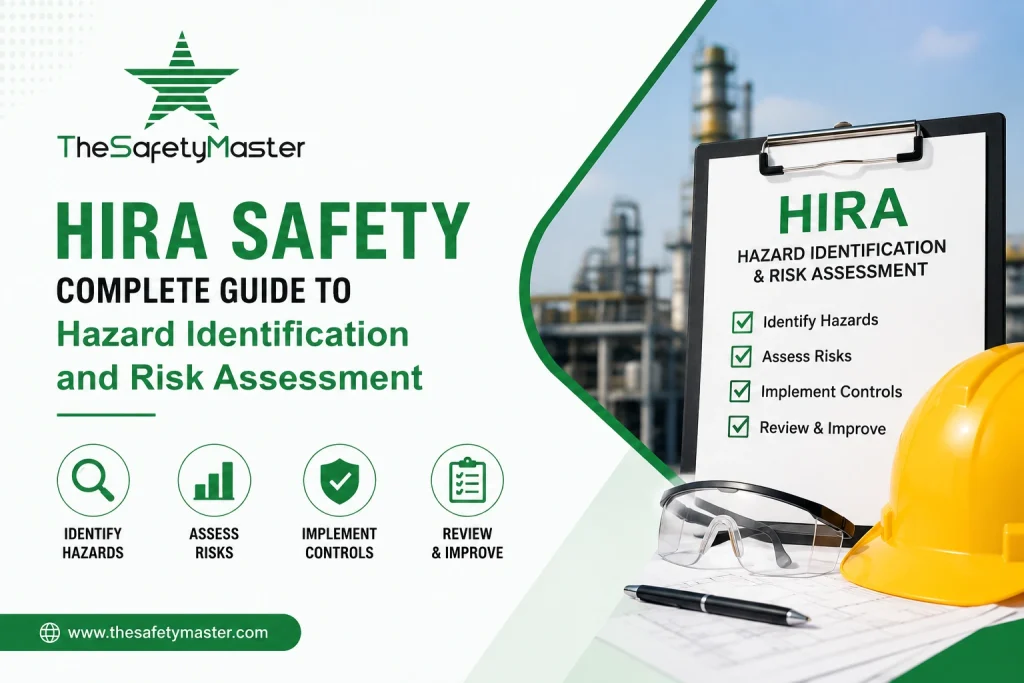
Hira Safety is an essential part of workplace safety because it helps organizations identify hazards, evaluate risks, and establish effective control measures before accidents occur. Hazard Identification and Risk Assessment (HIRA) provides a structured approach to understanding what can go wrong, how serious the consequences could be, and what actions are required to reduce the risk.
Industries such as manufacturing, construction, oil and gas, chemicals, power plants, warehouses, and other high-risk workplaces can use HIRA to improve safety performance and support compliance with occupational health and safety requirements. The Safety Master provides safety training, consulting, audits, and risk-management solutions that can help organizations implement effective HIRA practices.
What Is HIRA?
HIRA stands for Hazard Identification and Risk Assessment. It is a systematic process used to identify hazards associated with a job, activity, equipment, process, or workplace and assess the level of risk associated with those hazards.
A typical HIRA considers:
- What hazard exists?
- Who or what could be harmed?
- How could an incident occur?
- How severe could the consequences be?
- How likely is the event to happen?
- What controls are already in place?
- What additional controls are required?
The objective is not simply to create a document. HIRA should support practical risk reduction and safer working conditions.
HIRA Hazard Identification and Risk Assessment
HIRA hazard identification and risk assessment generally consists of two connected activities.
Hazard Identification
Hazard identification involves finding anything that has the potential to cause injury, illness, property damage, environmental harm, or operational disruption.
Common workplace hazards include:
- Mechanical hazards
- Electrical hazards
- Chemical hazards
- Fire and explosion hazards
- Ergonomic hazards
- Biological hazards
- Physical hazards
- Work-at-height hazards
- Confined-space hazards
- Manual-handling hazards
- Process safety hazards
Risk Assessment
After identifying a hazard, the next step is to determine the associated risk. Risk assessment normally considers the likelihood of an unwanted event and the severity of its consequences.
A commonly used approach is:
Risk = Likelihood × Severity
Organizations may use a risk matrix to classify risks as low, medium, high, or critical. The exact rating system should be established according to the organization’s risk-management procedure.
What Is the 4 Step of HIRA?
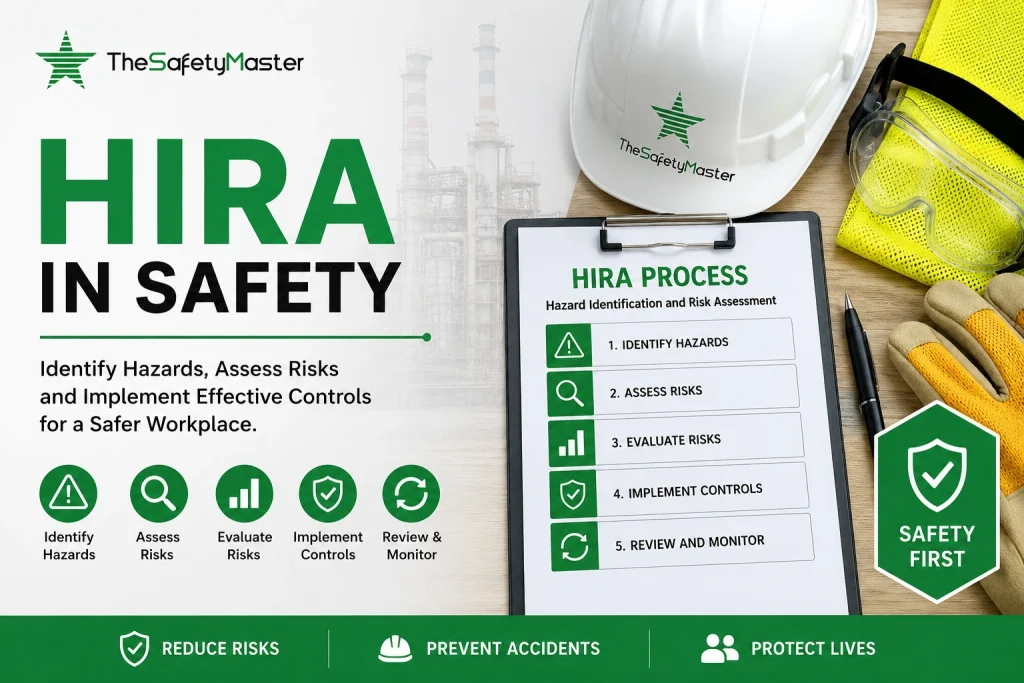
The four basic steps of HIRA can be explained as follows:
1. Identify the Hazards
Start by examining the workplace, activity, equipment, materials, and processes. Identify anything that could cause harm.
2. Assess the Risk
Determine how likely the hazardous event is to occur and how severe the potential consequences could be.
3. Implement Control Measures
Select appropriate controls to eliminate the hazard or reduce the risk to an acceptable level.
4. Monitor and Review
Review the assessment regularly and whenever there are changes to equipment, processes, materials, personnel, legislation, or working conditions.
Major Point: HIRA is not a one-time exercise. It should be reviewed whenever significant changes occur or when incidents, near misses, or new hazards are identified.
HIRA Process: Step-by-Step Guide
Step 1: Define the Activity
Clearly describe the job or process being assessed. Break complex activities into manageable tasks.
Step 2: Identify Potential Hazards
Inspect the workplace and consider normal operations, non-routine work, maintenance, emergencies, and abnormal conditions.
Step 3: Identify People at Risk
Consider employees, contractors, visitors, operators, maintenance personnel, and other people who could be affected.
Step 4: Determine Existing Controls
Document controls that are already available, such as machine guarding, ventilation, procedures, PPE, training, alarms, interlocks, and emergency arrangements.
Step 5: Evaluate the Risk
Assess likelihood and severity using the organization’s approved risk matrix.
Step 6: Determine Additional Controls
Where risk is not adequately controlled, introduce additional measures using the hierarchy of controls.
Step 7: Record and Review
Document the findings, assign responsibilities, establish target dates, and verify that corrective actions have been completed.
Hierarchy of Controls in HIRA
The hierarchy of controls helps organizations select effective risk-reduction measures.
1. Elimination
Remove the hazard completely where practical.
2. Substitution
Replace a hazardous material, process, or method with a safer alternative.
3. Engineering Controls
Use physical or technical measures such as guards, barriers, ventilation, automation, and interlocks.
4. Administrative Controls
Use procedures, training, warning systems, permits, job rotation, and supervision.
5. Personal Protective Equipment
Use PPE such as helmets, gloves, safety shoes, goggles, respirators, and hearing protection as the final layer of protection.
Engineering and higher-level controls should generally be considered before relying primarily on PPE.
HIRA Safety Format
A HIRA safety format should be simple, consistent, and easy for workers and supervisors to understand.
A typical format may contain:
| HIRA Element | Information to Record |
|---|---|
| Activity/Task | Name of the job or activity |
| Hazard | Identified source of potential harm |
| Consequence | Possible outcome |
| Existing Controls | Current preventive measures |
| Likelihood | Probability rating |
| Severity | Consequence rating |
| Risk Rating | Overall risk level |
| Additional Controls | Required risk-reduction measures |
| Responsible Person | Person responsible for action |
| Target Date | Completion deadline |
| Residual Risk | Risk after controls |
The exact format can be adapted to the organization’s activities and risk-management procedure.
HIRA Risk Assessment Template
A HIRA Risk Assessment template can make assessments more consistent across departments and projects.
A practical template can include these columns:
Activity → Hazard → Cause → Consequence → Existing Controls → Likelihood → Severity → Risk Score → Additional Controls → Responsible Person → Target Date → Residual Risk
Before using a template, the organization should define its risk-rating criteria and ensure that employees conducting assessments understand how to apply them.
HIRA Safety Examples
Example 1: Working at Height
Hazard: Falling from an elevated platform.
Possible Consequence: Serious injury or fatality.
Existing Controls: Guardrails, safe access, inspection, and fall protection.
Additional Controls: Improve edge protection, verify equipment inspection, provide competency training, and enforce the applicable work-at-height procedure.
Example 2: Electrical Maintenance
Hazard: Contact with energized electrical equipment.
Possible Consequence: Electric shock, burns, arc-flash injury, or fatality.
Controls: Isolation, lockout/tagout, competent personnel, suitable tools, testing, and appropriate PPE.
Example 3: Chemical Handling
Hazard: Exposure to a hazardous chemical.
Possible Consequence: Skin burns, inhalation injury, poisoning, or environmental release.
Controls: Substitution where possible, closed systems, ventilation, safe storage, SDS availability, training, emergency facilities, and suitable PPE.
HIRA Safety Questions
Organizations can use structured HIRA safety questions during an assessment to improve hazard identification.
Questions for Hazard Identification
- What task is being performed?
- What can go wrong?
- What equipment is involved?
- Are hazardous chemicals being used?
- Is there a potential for fire or explosion?
- Could workers fall, slip, or become trapped?
- Could machinery cause injury?
- Could electrical energy cause harm?
- Are there environmental or ergonomic hazards?
- What happens during abnormal or emergency conditions?
Questions for Risk Assessment
- Who could be exposed?
- How often does the exposure occur?
- How likely is an incident?
- What could be the worst credible consequence?
- What controls are already in place?
- Are existing controls effective?
- Is additional action required?
HIRA Safety PDF and Free Download Resources
People often search for “Hazard Identification and Risk Assessment (HIRA PDF Free Download)”, “HIRA safety PDF”, and “HIRA safety complete guide to hazard identification and risk assessment free.”
A useful HIRA PDF should explain the methodology, hazard-identification process, risk-rating approach, control measures, and documentation requirements. However, organizations should avoid relying on an outdated generic PDF as their only risk assessment.
The HIRA procedure should be customized to the actual workplace, equipment, activities, hazards, applicable requirements, and company risk criteria.
For training purposes, a HIRA guide can be used as a reference, while the organization’s approved HIRA format should be used for actual workplace assessments.
Common HIRA Mistakes to Avoid
1. Identifying Only Obvious Hazards
Some organizations identify only visible hazards and overlook maintenance, emergency, environmental, ergonomic, and process-related risks.
2. Copying an Old HIRA
A previous assessment may not reflect current equipment, processes, materials, or working conditions.
3. Focusing Only on PPE
PPE is important, but it should not replace higher-level risk controls when elimination, substitution, or engineering controls are reasonably practicable.
4. Ignoring Non-Routine Work
Maintenance, cleaning, shutdowns, startups, construction, and emergency activities can introduce significant hazards.
5. Not Following Up on Actions
A HIRA is ineffective if identified control measures are never implemented or verified.
Benefits of HIRA Safety
Effective HIRA can help organizations:
- Identify workplace hazards systematically
- Reduce the likelihood of incidents
- Improve worker safety awareness
- Prioritize corrective actions
- Strengthen operational controls
- Support safety-management systems
- Improve emergency preparedness
- Reduce workplace losses and downtime
- Support regulatory and organizational compliance
- Encourage proactive safety management
When Should HIRA Be Reviewed?
HIRA should be reviewed periodically according to the organization’s procedure and whenever significant changes occur.
A review may be required after:
- Process modifications
- New equipment installation
- Introduction of new chemicals
- Changes in work methods
- Workplace modifications
- Incidents or near misses
- Changes in personnel or responsibilities
- New legal or regulatory requirements
- Identification of previously unrecognized hazards
HIRA vs. HAZOP
HIRA and HAZOP are both important risk-management techniques, but they are not identical.
HIRA is a broader hazard-identification and risk-assessment approach that can be applied to many workplace activities and operations.
HAZOP (Hazard and Operability Study) is a structured methodology commonly used to examine process deviations in process plants and identify potential hazards and operability problems.
Depending on the industry and project, organizations may use HIRA together with other techniques such as HAZOP, JSA/JHA, FMEA, What-If analysis, and Bow-Tie analysis.
Role of The Safety Master in HIRA
Implementing effective HIRA requires more than completing a spreadsheet. Organizations need competent personnel, a defined methodology, practical risk controls, and regular review.
The Safety Master supports organizations through safety consulting, training, risk assessment, process safety services, and other safety-management solutions. Professional guidance can help organizations strengthen their approach to hazard identification, risk assessment, and risk control.
FAQs About HIRA Safety
What is HIRA in safety?
HIRA stands for Hazard Identification and Risk Assessment. It is a systematic method for identifying hazards, evaluating associated risks, determining appropriate controls, and reviewing whether those controls effectively reduce risk.
What are the 4 steps of HIRA?
The four basic steps are hazard identification, risk assessment, implementation of control measures, and monitoring/review. Organizations may divide these stages into more detailed steps depending on their internal HIRA procedure.
What is a HIRA risk assessment?
A HIRA risk assessment evaluates hazards associated with a task, process, workplace, or equipment and determines the level of risk based on factors such as likelihood and severity. It then identifies controls required to reduce the risk.
What is included in a HIRA format?
A HIRA format commonly includes the activity, hazard, cause, consequence, existing controls, likelihood, severity, risk rating, additional controls, responsible person, target date, and residual risk.
Is there a free HIRA PDF?
Generic HIRA PDFs and guides are available from various sources, but organizations should verify their relevance and accuracy before using them. A workplace HIRA should be developed according to the organization’s activities, hazards, risk criteria, and applicable requirements.
What is a HIRA Risk Assessment template?
A HIRA Risk Assessment template is a structured document used to record activities, hazards, consequences, existing controls, risk ratings, additional controls, responsibilities, and residual risk.
What questions are asked in a HIRA assessment?
Typical questions include: What can go wrong? Who can be harmed? What hazards are present? How likely is an incident? What could be the consequence? What controls exist? Are those controls effective? What additional measures are required?
Why is HIRA important?
HIRA helps organizations identify hazards before incidents occur and prioritize appropriate controls. It supports proactive safety management by turning hazard information into practical risk-reduction actions.
Conclusion
Hira Safety provides a structured way to identify hazards, assess risks, and establish effective controls before incidents occur. By following the four core stages—identifying hazards, assessing risks, implementing controls, and monitoring the results—organizations can build a stronger and more proactive safety culture. For professional support with HIRA, risk assessment, safety training, and process safety solutions, The Safety Master can help organizations develop practical and effective safety-management practices.