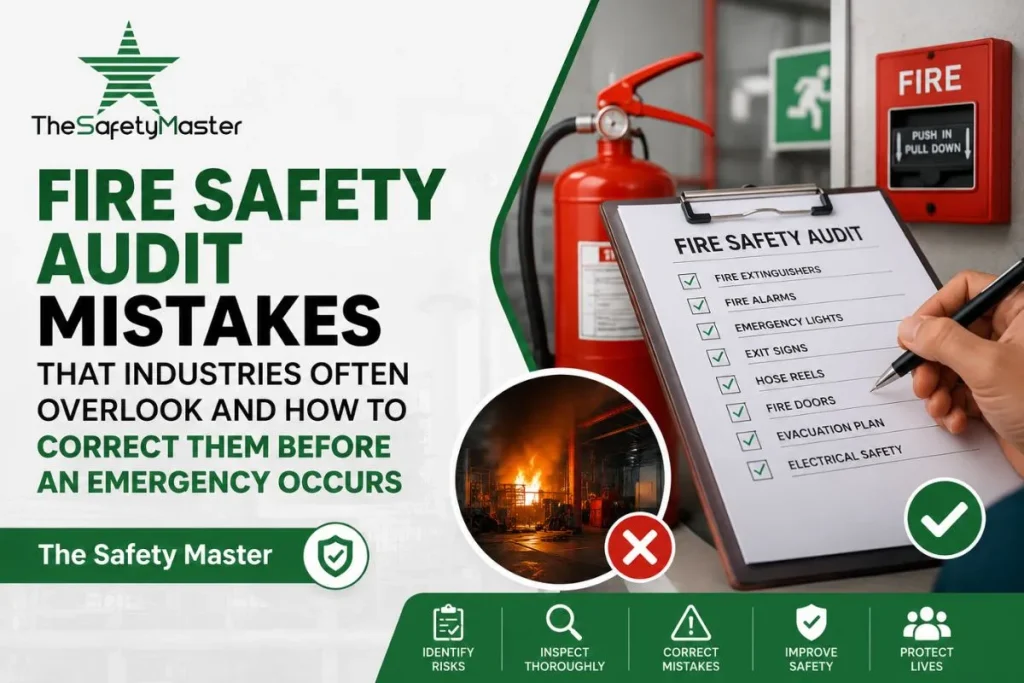
How to Calculate Fire Load: Formula, Method, and Importance Explained

Comprehensive Guide to IS 14489: Safety Audit Checklist and Standards
July 2, 2025
14 Elements of Process Safety Management: A Comprehensive Guide to the PSM System
July 8, 2025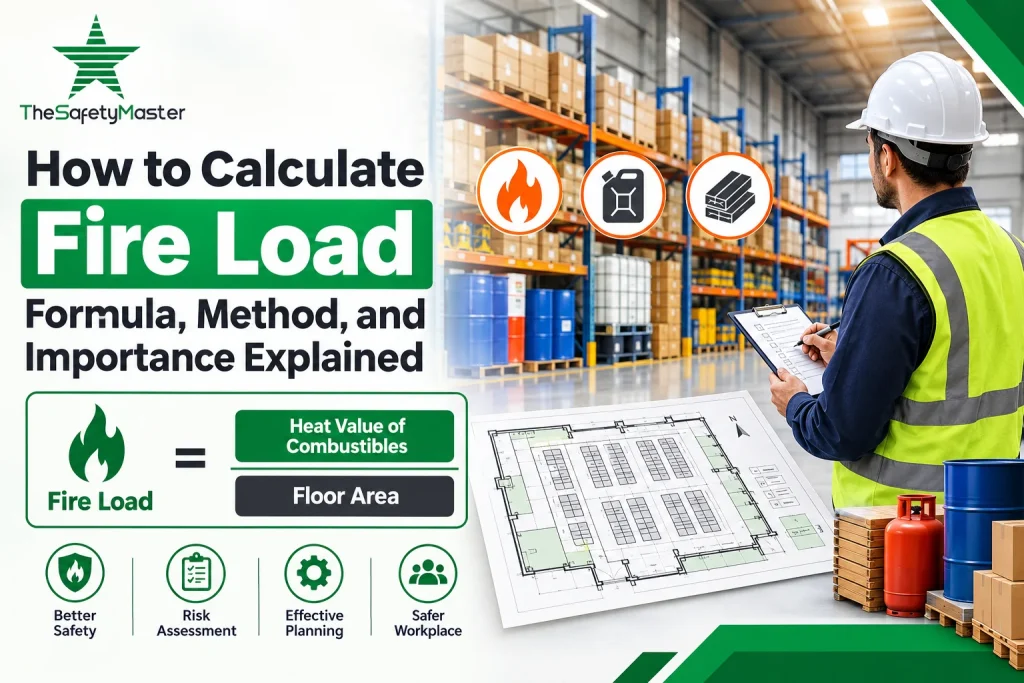
Importance of Fire Load in Fire Safety and Building Design
Fire load calculation is an important part of fire safety and risk assessment. It helps determine the amount of combustible material present in a building and the potential heat energy that could be released if those materials catch fire.
A proper fire load assessment can help safety professionals, building owners, engineers, and facility managers understand the potential severity of a fire and select appropriate fire protection measures. It can be particularly important in warehouses, factories, offices, commercial buildings, storage areas, hospitals, hotels, and other facilities where significant quantities of combustible materials are present.
The Safety Master provides professional safety consulting, fire safety audit, risk assessment, and fire load assessment services to help organizations identify fire hazards and improve their overall fire protection strategy.
What Is Fire Load?
Fire load is the total amount of heat energy that could potentially be released by the complete combustion of combustible materials within a defined area.
It is commonly expressed as:
MJ/m² (Megajoules per square metre)
Combustible materials may include:
- Wood and wooden furniture
- Paper and cardboard
- Plastics
- Textiles and fabrics
- Packaging materials
- Rubber products
- Flammable materials
- Stored combustible goods
- Other materials capable of contributing to a fire
The fire load does not simply depend on how much material is present. The quantity, type, and calorific value of each combustible material must be considered.
Why Is Fire Load Important?
A high concentration of combustible materials can increase the potential severity of a fire. Understanding the fire load therefore helps professionals evaluate whether existing fire prevention and protection systems are suitable for the occupancy.
Fire load information can support decisions relating to:
- Fire detection systems
- Fire alarm systems
- Automatic sprinkler systems
- Fire extinguishers
- Fire-resistant construction
- Compartmentation
- Emergency exits
- Evacuation planning
- Storage arrangements
- Emergency response planning
Fire Load Calculation Formula
The basic fire load calculation formula is:
Fire Load (MJ/m²) = Total Heat Energy of Combustible Materials (MJ) ÷ Floor Area (m²)
The total heat energy can be calculated by multiplying the quantity of each combustible material by its calorific value.
General Formula
Total Heat Energy = Σ (Mass of Material × Calorific Value)
Therefore:
Fire Load = Σ (Mass × Calorific Value) ÷ Floor Area
Where:
- Mass = quantity of combustible material in kg
- Calorific Value = heat released by the material in MJ/kg
- Floor Area = area being assessed in m²
- Fire Load = potential heat energy per square metre in MJ/m²
Example of Fire Load Calculation
Consider a storage room containing:
- 1,000 kg of wood
- Calorific value of wood = 18 MJ/kg
- Floor area = 200 m²
First calculate the total heat energy:
1,000 × 18 = 18,000 MJ
Now divide the heat energy by the floor area:
Fire Load = 18,000 ÷ 200
Fire Load = 90 MJ/m²
Therefore, the calculated fire load for this example is 90 MJ/m².
The actual calculation for a facility should consider all relevant combustible materials rather than only one material.
How to Calculate Fire Load Step by Step
Step 1: Identify Combustible Materials
Begin by conducting a physical inspection of the area and listing all combustible materials.
Examples include:
- Wooden furniture
- Paper
- Cardboard
- Plastic
- Fabric
- Packaging
- Rubber
- Stored products
- Combustible construction materials
The inventory should be as complete and accurate as possible.
Step 2: Determine the Quantity of Each Material
Record the approximate or measured quantity of every combustible material.
The quantity may be expressed in kilograms or another suitable unit and converted into kilograms for calculation.
For example:
| Material | Quantity |
|---|---|
| Wood | 500 kg |
| Paper | 200 kg |
| Plastic | 100 kg |
Step 3: Obtain the Calorific Value
Determine the calorific value of each combustible material.
Calorific value represents the amount of heat energy released when a material undergoes complete combustion.
The value should preferably come from reliable technical data, manufacturer information, recognized standards, laboratory data, or an appropriate engineering reference.
Step 4: Calculate Heat Contribution
For each material:
Heat Energy = Quantity × Calorific Value
For example:
Wood:
500 kg × 18 MJ/kg = 9,000 MJ
Paper:
200 kg × 16 MJ/kg = 3,200 MJ
Plastic:
Use the applicable calorific value from a reliable technical source and calculate its contribution separately.
Step 5: Add the Heat Energy
Add the heat contribution from all combustible materials.
Total Heat Energy = Heat 1 + Heat 2 + Heat 3 + …
This provides the estimated total combustible heat energy within the assessed area.
Step 6: Calculate the Floor Area
Measure the floor area of the compartment, room, warehouse, or other defined assessment area.
For a rectangular room:
Area = Length × Width
For example:
10 m × 20 m = 200 m²
Step 7: Calculate the Fire Load
Finally:
Fire Load = Total Heat Energy ÷ Floor Area
The result is normally expressed in:
MJ/m²
Fire Load Density vs Total Fire Load
These terms are sometimes confused.
Total Fire Load
Total fire load represents the total potential heat energy contained in the combustible materials within the defined area.
It is generally expressed in MJ.
Fire Load Density
Fire load density expresses the potential heat energy in relation to floor area.
It is generally expressed in MJ/m².
Fire load density is useful because it allows different spaces of different sizes to be compared more meaningfully.
What Factors Affect Fire Load?
Several factors can influence the fire load of a building or area.
Type of Occupancy
An office, warehouse, hospital, manufacturing facility, and residential building can have significantly different combustible contents.
Quantity of Combustible Materials
The greater the quantity of combustible material, the greater the potential heat energy.
Material Type
Different materials have different calorific values. Plastic, wood, paper, textiles, and other materials may contribute different amounts of energy.
Storage Arrangement
How materials are stored can affect fire development and fire spread. High-density storage can create significant fire hazards.
Building Layout
Compartmentation, room size, openings, and separation between combustible materials can influence fire development.
Ventilation
Availability of oxygen and ventilation conditions can influence combustion and fire development. Fire load should therefore be considered as one component of a broader fire risk assessment.
Importance of Fire Load Calculation in Fire Safety
1. Helps Assess Fire Risk
Fire load provides valuable information for understanding the potential severity of a fire within a particular area.
2. Supports Fire Protection Design
Fire load information can help engineers and fire safety professionals evaluate appropriate protection measures, including detection, suppression, compartmentation, and structural fire resistance.
3. Improves Emergency Planning
Understanding the potential fire hazard can support emergency response and evacuation planning.
4. Helps Identify High-Risk Areas
Areas containing large quantities of combustible materials can be identified for additional controls and monitoring.
5. Supports Fire Safety Audits
Fire load assessment can form part of a broader fire safety audit where combustible materials, storage arrangements, fire protection systems, and emergency arrangements are evaluated.
6. Supports Compliance and Risk Management
Organizations can use documented fire load assessments as part of their wider fire safety and risk management process, subject to the requirements applicable to their building, occupancy, and jurisdiction.
Fire Load Calculation in Warehouses
Warehouses can have significant fire loads because they may contain large quantities of packaged goods, plastics, paper, textiles, wooden pallets, and other combustible materials.
A warehouse fire load assessment should consider:
- Type of stored products
- Quantity of stored materials
- Packaging materials
- Pallets
- Storage height
- Storage configuration
- Aisle arrangement
- Separation between commodities
- Fire detection
- Fire alarm systems
- Sprinkler protection
- Fire access
- Emergency exits
Why Warehouse Fire Load Requires Special Attention
Even when the building structure is non-combustible, the contents may represent a substantial fire load. Therefore, the assessment should focus not only on construction materials but also on the materials stored and their arrangement.
Fire Load Calculation in Industrial Facilities
Industrial facilities can contain multiple combustible sources, including raw materials, finished products, packaging, oils, chemicals, plastics, rubber, and combustible process materials.
A professional assessment should consider the nature of the process as well as stored materials.
For high-hazard industrial operations, fire load assessment should be integrated with broader risk assessment and process safety activities.
Fire Load and Fire Safety Audit
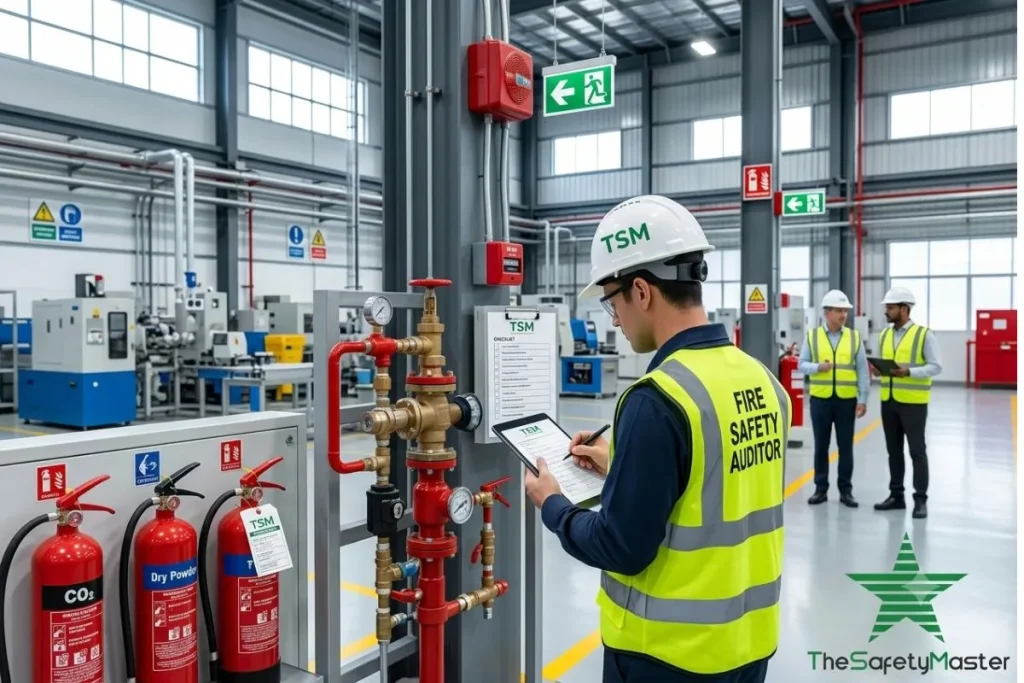
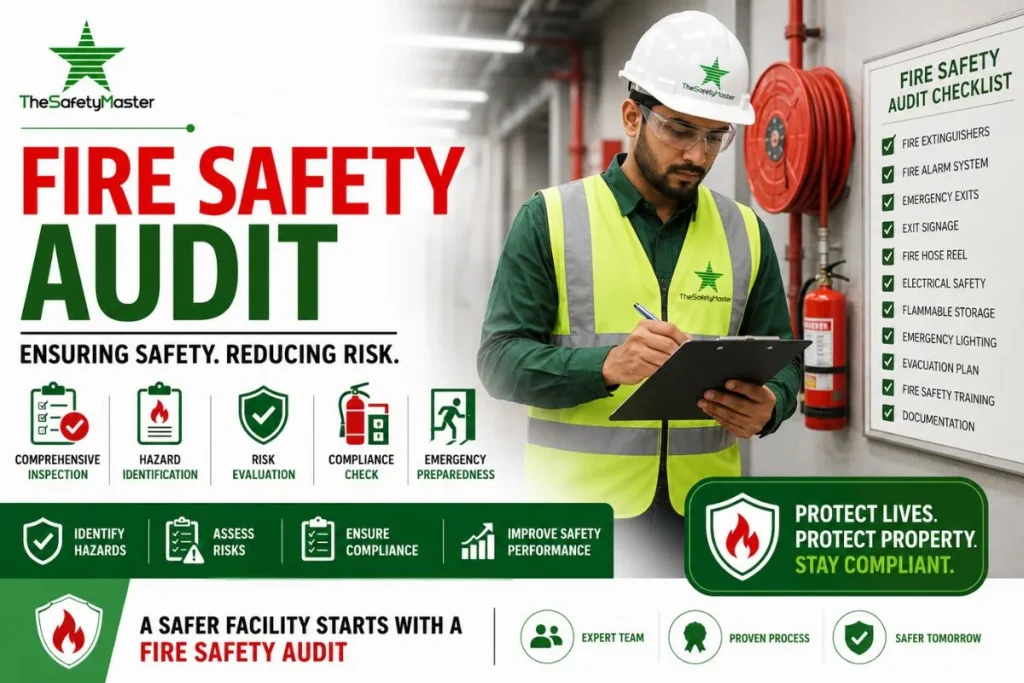
Fire load calculation can be an important component of a comprehensive Fire Safety Audit.
A fire safety audit may examine:
- Fire extinguishers
- Fire hydrants
- Sprinkler systems
- Fire pumps
- Fire alarms
- Smoke detection
- Emergency lighting
- Exit routes
- Fire doors
- Emergency response plans
- Electrical hazards
- Housekeeping
- Storage practices
- Combustible materials
- Fire load
A fire audit should not rely on fire load alone. It should evaluate the complete fire protection and emergency preparedness system.
Common Mistakes in Fire Load Calculation
Using Incorrect Material Quantities
Estimating quantities without proper site verification can produce unreliable results.
Using Unverified Calorific Values
Different materials can have different calorific values. Using unsuitable or generic values can affect the calculation.
Ignoring Packaging
Packaging such as cardboard, plastic wrapping, wooden pallets, and other materials can contribute to the fire load.
Assessing Only the Main Product
In warehouses and factories, supporting materials may also contribute significantly to the total combustible load.
Using an Incorrect Floor Area
The assessed area must correspond to the combustible materials being considered.
Not Updating the Assessment
Fire load can change when inventory, production processes, storage arrangements, or occupancy changes. Calculations should therefore be reviewed when significant changes occur.
How to Reduce Fire Load
Fire load cannot always be eliminated, but organizations can take practical measures to control combustible materials.
Improve Storage Practices
Keep combustible materials organized and avoid unnecessary accumulation.
Remove Unnecessary Combustibles
Dispose of waste paper, packaging, scrap, and other unnecessary combustible materials regularly.
Maintain Good Housekeeping
Good housekeeping reduces the accumulation of combustible waste and can help limit fire development.
Separate High-Risk Materials
Where appropriate, separate combustible materials from ignition sources and other hazards.
Control Ignition Sources
Electrical faults, hot work, smoking, open flames, and overheated equipment should be properly controlled.
Maintain Fire Protection Systems
Fire alarms, extinguishers, hydrants, sprinklers, emergency lighting, and other systems should be inspected, tested, and maintained according to applicable requirements.
Fire Load Calculation and Regulatory Requirements
Fire safety requirements depend on the building type, occupancy, location, applicable legislation, and adopted codes or standards.
In India, organizations may need to consider applicable provisions of the National Building Code of India, relevant Indian Standards, state fire service requirements, local authority requirements, and industry-specific regulations.
A fire load calculation should therefore not be treated as a standalone compliance exercise. A competent fire safety professional should determine which requirements apply to the specific facility.
How The Safety Master Can Help
The Safety Master provides safety consultancy and fire safety services designed to help organizations identify hazards, evaluate risks, and improve fire protection arrangements.
Our services can include:
- Fire Safety Audit
- Fire Risk Assessment
- Fire Load Assessment
- Safety Audit
- HIRA
- Process Safety Management
- HAZOP studies
- Emergency Response Planning
- Safety Training
- Safety Consultancy
A professional assessment can help organizations understand their existing fire risks and prioritize practical corrective actions.
Conclusion
Fire load calculation is an important tool for understanding the potential fire hazard associated with combustible materials in a building or facility. The basic approach is to determine the heat energy contributed by combustible materials and divide the total heat energy by the relevant floor area.
The basic formula is:
Fire Load (MJ/m²) = Total Heat Energy of Combustible Materials ÷ Floor Area
However, accurate assessment requires reliable material quantities, appropriate calorific values, correct area measurements, and consideration of the facility’s occupancy and storage conditions.
For complex industrial, commercial, warehouse, or high-risk facilities, fire load calculation should be considered as part of a broader fire risk assessment and fire safety management program.
The Safety Master can support organizations with professional fire safety audits, fire risk assessments, fire load assessments, and safety consultancy to help create safer and more compliant workplaces.
FAQs About Fire Load Calculation
Q-What is fire load?
Fire load is the total potential heat energy that can be released by the combustion of combustible materials within a defined area. It is commonly expressed as MJ/m² when represented as fire load density.
Q-What is the formula for calculating fire load?
The basic formula is:
Fire Load (MJ/m²) = Total Heat Energy of Combustible Materials (MJ) ÷ Floor Area (m²).
Total heat energy is calculated by multiplying the quantity of each combustible material by its applicable calorific value and adding the individual contributions.
Q-How do you calculate fire load in a building?
First, identify all relevant combustible materials. Then determine their quantities and calorific values, calculate the heat contribution of each material, add the heat contributions, and divide the total by the floor area being assessed.
Q-What is the unit of fire load?
Fire load density is generally expressed in MJ/m² (Megajoules per square metre). Total fire load, representing the total heat energy, is expressed in MJ.
Q-Why is fire load calculation important?
Fire load calculation helps professionals understand the potential severity of a fire and supports decisions about fire protection, compartmentation, emergency planning, storage controls, and risk management.
Q-What materials are included in fire load calculation?
Depending on the assessment scope, materials can include wood, paper, cardboard, plastics, textiles, rubber, packaging, pallets, combustible products, and other materials that can contribute to a fire.
Q-Is fire load calculation required for a fire safety audit?
Fire load assessment may form an important part of a fire safety audit, particularly where significant quantities of combustible materials are present. Specific requirements depend on the applicable building codes, regulations, occupancy, and local authority requirements.
Q-How can fire load be reduced?
Fire load can be controlled by reducing unnecessary combustible materials, improving housekeeping, controlling storage quantities, separating combustible materials from ignition sources, managing waste, and maintaining effective fire protection systems.
Q-Who should conduct a fire load assessment?
For complex or high-risk facilities, the assessment should be performed or reviewed by a competent fire safety professional or qualified engineer familiar with the applicable standards, building use, materials, and fire protection requirements.
Q-Can fire load change over time?
Yes. Fire load can change when inventory, production, storage arrangements, packaging, occupancy, or processes change. Facilities should review their assessment when significant changes occur.
Q-What is the difference between fire load and fire risk?
Fire load represents the potential heat energy contained in combustible materials. Fire risk is broader and considers factors such as the likelihood of ignition, potential consequences, people exposed, building characteristics, fire protection, and emergency response arrangements.