Why Every Manufacturing Plant Needs Process Safety Management (PSM) in 2026

Why Digitech AI Based Safety Management Software Is Transforming Workplace Safety in 2026
July 29, 2026
Process Hazards Analysis Techniques: Methods, Examples, Checklist & Best Practices
August 1, 2026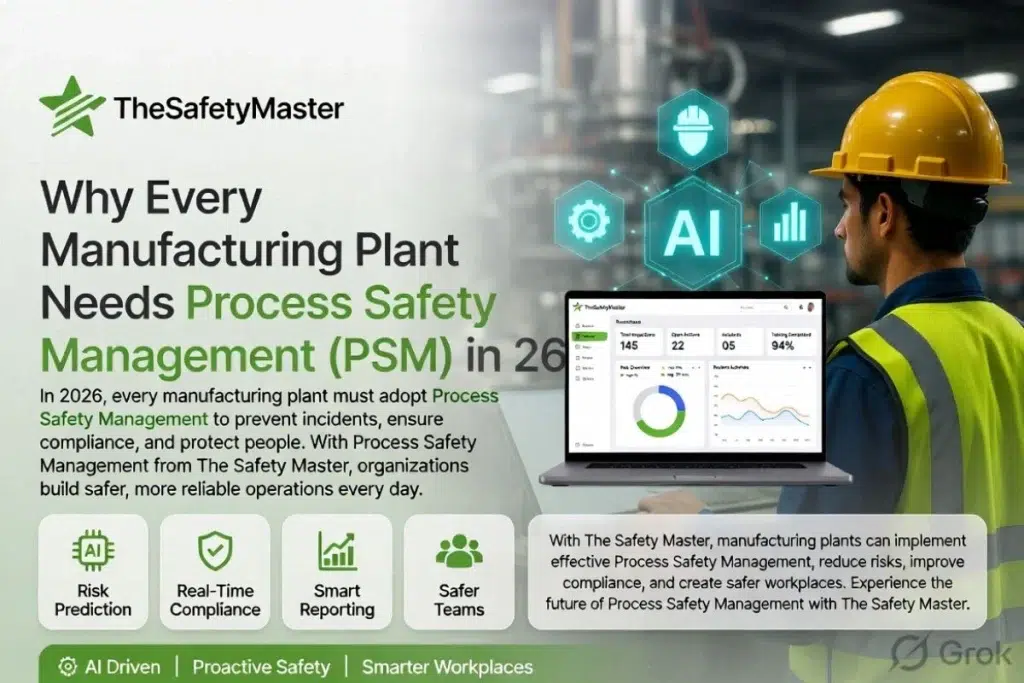
In today’s high-stakes manufacturing environment, Process Safety Management has become non-negotiable for plants handling hazardous chemicals. As operations grow more complex and regulatory expectations tighten, forward-looking organizations turn to proven frameworks and trusted experts such as The Safety Master to build resilient systems. Whether you are searching for Process Safety Management 14 elements PPT resources, a clear explanation of What is process Safety Management (PSM), or practical guidance drawn from the OSHA PSM standard PDF, understanding and implementing a robust Process Safety Management program is the difference between controlled risk and catastrophic loss.
What Is Process Safety Management (PSM)?
Process Safety Management (PSM) is the systematic approach defined by OSHA under 29 CFR 1910.119 to prevent or minimize the consequences of catastrophic releases of toxic, reactive, flammable, or explosive chemicals. Unlike general occupational safety, which focuses on slips, trips, and personal protective equipment, Process Safety Management targets the integrity of processes themselves—equipment, procedures, people, and change management—so that major incidents never occur.
The standard applies to facilities that handle listed highly hazardous chemicals above threshold quantities or that process flammable liquids or gases in quantities of 10,000 pounds or more. In 2026, with aging assets, tighter supply chains, workforce transitions, and heightened community and insurance scrutiny, a well-executed Process Safety Management program is both a regulatory requirement and a core business continuity strategy.
Many professionals begin their research by downloading a Process Safety Management elements pdf or Process safety Management PDF to grasp the full scope. Others look for a Process Safety Management 14 elements pdf or Process Safety Management 14 elements PPT to share with leadership teams. These resources help demystify the framework, but real value comes from turning the requirements into living systems on the plant floor.
Why Manufacturing Plants Cannot Afford to Ignore PSM in 2026
Manufacturing plants face several converging pressures that make Process Safety Management more critical than ever:
- Aging infrastructure and deferred maintenance increase the likelihood of mechanical failures.
- Knowledge loss as experienced operators and engineers retire creates gaps in institutional memory.
- Regulatory enforcement remains strong, with OSHA citations for incomplete Process Safety Information, weak Process Hazard Analyses, or missing Management of Change procedures carrying significant penalties.
- Business impact of a major release can include fatalities, environmental damage, multi-million-dollar losses, prolonged downtime, and irreparable reputational harm.
- Stakeholder expectations from insurers, customers, communities, and investors now treat process safety performance as a key indicator of operational excellence.
A strong Process Safety Management program does more than satisfy auditors. It reduces unplanned downtime, improves equipment reliability, strengthens safety culture, and protects the long-term viability of the operation.
The 14 Elements of Process Safety Management
OSHA’s Process Safety Management standard rests on 14 interconnected elements. Weakness in any one element can undermine the entire system. Below is a clear overview of the 14 elements of Process Safety Management that every covered facility must address.
1. Employee Participation
Employers must develop a written plan ensuring employees and their representatives are involved in every aspect of the PSM program and have access to relevant information.
2. Process Safety Information (PSI)
Complete, accurate written information on the hazards of chemicals, process technology, and equipment must be compiled before any Process Hazard Analysis is performed. This foundation supports nearly every other element.
3. Process Hazard Analysis (PHA)
A thorough hazard evaluation using methods such as HAZOP, What-If, or Checklist must be conducted initially and revalidated at least every five years. Recommendations must be tracked to resolution.
4. Operating Procedures
Clear, written procedures covering startup, normal operations, temporary operations, emergency shutdown, and normal shutdown are required and must be certified annually as current and accurate.
5. Training
Operators and other affected employees must receive initial and refresher training (at least every three years) on the process, procedures, and hazards, with documentation of understanding.
6. Contractors
Facilities must evaluate contractor safety performance, inform contractors of known hazards, and ensure contractor employees follow site safety rules.
7. Pre-Startup Safety Review (PSSR)
Before introducing highly hazardous chemicals or starting new or modified processes, a review confirms that construction, equipment, procedures, and training are adequate.
8. Mechanical Integrity
Critical process equipment must be inspected, tested, and maintained according to recognized and generally accepted good engineering practices (RAGAGEP).
9. Hot Work Permit
A permit system is required for hot work operations on or near covered processes to control ignition sources.
10. Management of Change (MOC)
Any change to process chemicals, technology, equipment, procedures, or facilities must be reviewed and authorized before implementation, with updates to PSI, procedures, and training as needed.
11. Incident Investigation
Incidents that resulted in, or could reasonably have resulted in, a catastrophic release must be investigated promptly, with findings and recommendations documented and resolved.
12. Emergency Planning and Response
Facilities must develop and implement emergency action plans that address the specific hazards of the covered processes.
13. Compliance Audits
Employers must evaluate compliance with the PSM standard at least every three years and certify that the evaluation has been completed.
14. Trade Secrets
Employees and their representatives must have access to trade-secret information needed to comply with PSM requirements, under appropriate confidentiality protections.
Together these elements form a closed-loop management system. Many teams use a Process Safety Management 14 elements PPT or Process Safety Management 14 elements pdf as training and communication tools when rolling out or refreshing their program.
Building an Effective Process Safety Management Program
A compliant Process Safety Management program is not a one-time project. It requires leadership commitment, clear accountability, accurate Process Safety Information, competent PHA teams, disciplined Management of Change, and continuous verification through audits and incident learning. Plants that treat PSM as living operational discipline—rather than a paper exercise—consistently achieve better safety and reliability outcomes.
Practical steps include conducting a gap assessment against the OSHA PSM standard, prioritizing high-risk processes, ensuring PSI is complete and accessible, and integrating PSM requirements into daily work planning, maintenance, and contractor management. Digital tools can help manage documentation, action tracking, and audit readiness, but technology never replaces competent people and a genuine safety culture.
Frequently Asked Questions
What is Process Safety Management (PSM)?
Process Safety Management is OSHA’s regulatory framework (29 CFR 1910.119) designed to prevent catastrophic releases of highly hazardous chemicals through 14 interrelated management elements covering people, procedures, equipment, and change control.
How many elements are in Process Safety Management?
There are 14 elements of Process Safety Management required by the OSHA standard.
Where can I find the OSHA PSM standard PDF?
The official text is available in the Electronic Code of Federal Regulations (eCFR) under 29 CFR 1910.119. Many training providers also offer summarized Process Safety Management elements pdf and Process safety Management PDF guides for practical use.
Is a Process Safety Management 14 elements PPT useful for training?
Yes. A well-designed Process Safety Management 14 elements PPT helps leadership, operators, and contractors understand the purpose and interconnections of each element and supports consistent messaging across the organization.
Who needs a Process Safety Management program?
Any manufacturing facility whose processes involve highly hazardous chemicals above the threshold quantities listed in Appendix A of the standard, or flammable liquids/gases at or above 10,000 pounds, must implement a full Process Safety Management program.
Conclusion
In 2026, every manufacturing plant that handles hazardous materials needs a robust Process Safety Management system. The cost of a major incident—human, financial, environmental, and reputational—far exceeds the investment required to implement and sustain the 14 elements of Process Safety Management. Whether you begin with an OSHA PSM standard PDF review, a Process Safety Management elements pdf checklist, or a Process Safety Management 14 elements PPT for your leadership team, the essential next step is decisive action. Organizations that partner with experienced advisors such as The Safety Master and treat Process Safety Management as a core operational priority protect their people, their assets, and their future.