HIRA vs HAZOP vs LOPA: Which Risk Assessment Methodology Does Your Plant Need?

HAZOP Study: How Process Deviations Are Identified Before They Become Major Incidents
September 11, 2026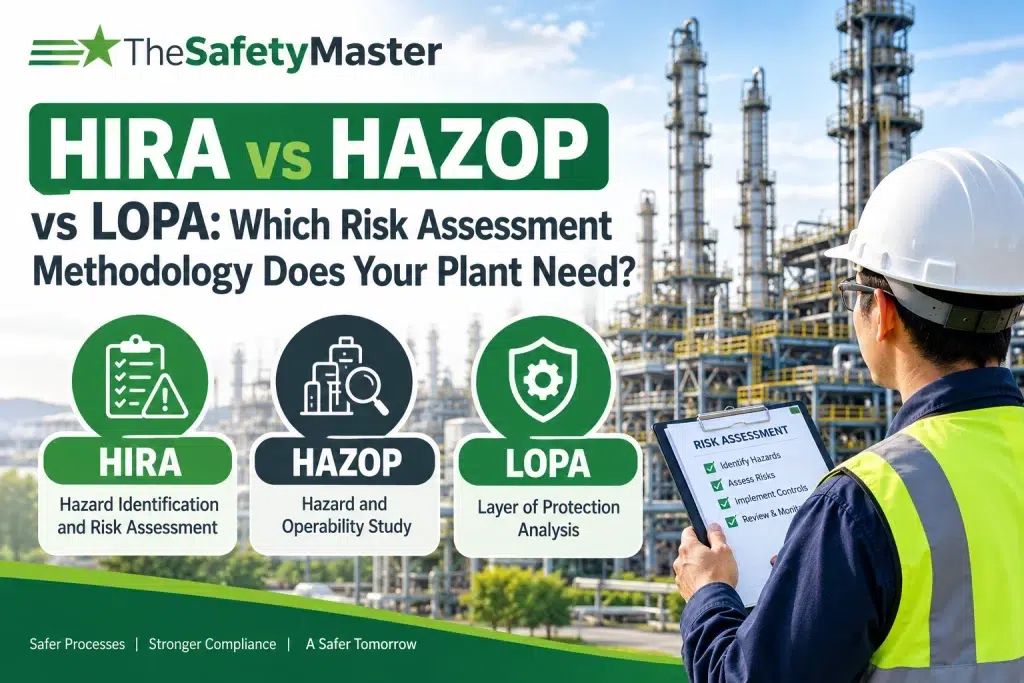
Industrial plants handle chemicals, machinery, pressure systems, flammable materials, electrical equipment, and many other hazards. Because of these risks, companies need a systematic way to identify hazards, understand possible consequences, and select suitable controls.
Three commonly used methods are HIRA, HAZOP, and LOPA. Although all three support process and workplace safety, they have different purposes and levels of detail.
Understanding HIRA vs HAZOP and LOPA can help safety professionals, engineers, and plant managers select the right risk assessment methodology for their operations.
Understanding HIRA, HAZOP and LOPA
What is HIRA?
HIRA means Hazard Identification and Risk Assessment. It is a structured process used to identify hazards, assess the associated risks, and decide appropriate control measures.
HIRA can be used for routine and non-routine activities, workplaces, construction activities, manufacturing operations, maintenance work, and industrial processes.
A typical HIRA considers:
- Hazard identification
- Possible consequences
- Existing controls
- Likelihood of an event
- Severity of consequences
- Risk rating
- Additional control measures
- Residual risk
HIRA is generally a broad risk assessment method and can be applied to many different workplace activities.
HAZOP Full Form and Meaning
The HAZOP full form is Hazard and Operability Study.
A HAZOP study is a structured and team-based method used mainly to identify process hazards and operability problems in process plants. It examines a process using design information such as P&IDs and applies guide words to identify deviations from the intended process conditions.
Common HAZOP guide words include:
- No
- More
- Less
- As well as
- Part of
- Reverse
- Other than
For example, a team may examine a process parameter such as flow and consider deviations such as No Flow, More Flow, or Less Flow.
What is LOPA?
LOPA means Layer of Protection Analysis. It is a semi-quantitative risk assessment method used to evaluate whether independent protection layers provide enough risk reduction for a specific hazardous scenario.
LOPA may consider protection layers such as:
- Basic process control systems
- Alarms and operator response
- Safety instrumented functions
- Relief systems
- Physical protection systems
- Emergency response measures
LOPA is particularly useful when a plant needs to determine whether existing or proposed safeguards provide sufficient protection.
HIRA vs HAZOP: What Is the Difference?
The main difference between HIRA and HAZOP is the way they examine hazards.
HIRA generally assesses hazards associated with activities, jobs, areas, equipment, or processes and assigns a risk level based on factors such as severity and likelihood.
HAZOP is more detailed and systematic for process design. It examines deviations from design intent using guide words and involves a multidisciplinary team.
In simple terms:
HIRA asks: What hazards are present, how serious are they, and what controls are needed?
HAZOP asks: What can deviate from the intended process, why could it happen, what are the consequences, and what safeguards are available?
Difference Between HAZOP and PHA
PHA means Process Hazard Analysis. It is a broader term used for systematic methods that identify and evaluate hazards associated with processes.
HAZOP is one of the commonly used techniques for conducting a PHA.
Other PHA techniques can include:
- HAZOP
- What-If Analysis
- Checklist Analysis
- FMEA
- Fault Tree Analysis
- Combination of What-If and Checklist
Therefore, HAZOP can be considered a PHA technique, while PHA is the broader process hazard analysis concept.
The method selected depends on the complexity of the process, type of hazards, project stage, available information, and organizational requirements.
HAZOP vs HAZID
HAZID means Hazard Identification. It is generally used at an earlier stage to identify major hazards associated with a project, facility, process, or operation.
HAZOP is normally more detailed and focuses on process deviations.
HAZID
HAZID may be used during:
- Concept design
- Feasibility studies
- Early project development
- Facility planning
- Major modifications
It helps identify major hazard sources before detailed design is completed.
HAZOP
A HAZOP study is often performed when sufficient process design information is available.
It can examine:
- Process parameters
- Equipment
- Piping
- Control systems
- Operating conditions
- Deviations
- Causes
- Consequences
- Existing safeguards
- Recommendations
Therefore, HAZID and HAZOP are complementary rather than competing techniques.
How Does a HAZOP Study Work?
A HAZOP study normally starts by dividing the process into manageable sections called nodes.
The team then reviews the design intent of each node and applies guide words to relevant process parameters.
For example:
Parameter: Flow
Guide word: No
Deviation: No Flow
Possible cause: Pump failure
Possible consequence: Loss of cooling
Safeguard: Low-flow alarm
Recommendation: Review alarm and shutdown requirements
A multidisciplinary team may include process engineers, operations personnel, instrumentation engineers, maintenance professionals, and safety specialists.
The objective is not simply to create a list of hazards. The team also evaluates causes, consequences, safeguards, and recommendations.
When Should a Plant Use HIRA?
HIRA is useful when the organization needs a practical risk assessment for activities or operations.
It can be used for:
- Manufacturing activities
- Maintenance work
- Construction activities
- Material handling
- Chemical handling
- Electrical work
- Confined space activities
- Work at height
- Hot work
- Routine operations
- Non-routine jobs
HIRA is also useful for identifying risks before starting a new task or changing an existing activity.
What Are the 4 Steps of HIRA?
The exact HIRA procedure can vary by organization, but a simple four-step approach is:
1. Hazard Identification
Identify anything that can cause injury, illness, property damage, environmental harm, or operational loss.
2. Risk Assessment
Evaluate the likelihood and severity of the identified hazard and determine the risk level.
3. Risk Control
Select appropriate control measures according to the hierarchy of controls.
4. Review and Monitor
Check whether the controls are effective and update the assessment when conditions change.
For complex plants, organizations may divide these steps into more detailed stages such as hazard identification, risk analysis, risk evaluation, control selection, implementation, and review.
When Should a Plant Use HAZOP?
HAZOP is particularly useful for process industries where deviations in process conditions can result in serious consequences.
It may be appropriate for:
- Oil and gas plants
- Chemical plants
- Petrochemical facilities
- Pharmaceutical plants
- Refineries
- Power plants
- Process manufacturing facilities
- Storage and handling systems
HAZOP can be performed during design and also during significant modifications or periodic reviews, depending on the company’s risk management system.
When Should a Plant Use LOPA?
LOPA is useful when a particular hazardous scenario requires a more detailed evaluation of protection layers.
For example, suppose an overpressure scenario has been identified during a HAZOP study. LOPA can be used to examine the initiating event and determine whether the available independent protection layers provide sufficient risk reduction.
This makes LOPA especially valuable for high-consequence scenarios where decisions about additional safeguards or safety instrumented functions may be required.
LOPA vs SIL: Are They the Same?
No. LOPA and SIL are related but they are not the same thing.
LOPA is a risk analysis method. It can be used to determine the required risk reduction for a hazardous scenario.
SIL means Safety Integrity Level. It is a level of risk reduction associated with a safety instrumented function or safety instrumented system.
A simplified relationship is:
Hazard scenario → LOPA/risk analysis → Required risk reduction → SIL determination → SIF design and verification
SIL assessment should not be treated as simply selecting a SIL number without understanding the hazardous scenario, initiating event, independent protection layers, and required risk reduction.
HIRA vs HAZOP vs LOPA: Which One Does Your Plant Need?
There is no single method that is best for every situation.
Choose HIRA when:
- You need a general workplace risk assessment.
- You are assessing specific jobs or activities.
- You need to identify hazards and assign risk ratings.
- You are assessing routine and non-routine activities.
Choose HAZOP when:
- You are assessing a complex process.
- Process deviations need detailed examination.
- You have P&IDs and sufficient process design information.
- You need a structured multidisciplinary process hazard study.
Choose LOPA when:
- A specific high-risk scenario requires deeper analysis.
- You need to evaluate independent protection layers.
- You need to determine whether additional risk reduction is required.
- Safety instrumented functions may be involved.
In many plants, these methods are used together rather than separately.
How HIRA, HAZOP and LOPA Can Work Together
A strong process safety management approach can use different methodologies at different levels.
For example:
HIRA → Identify workplace and activity hazards
HAZID → Identify major project and facility hazards
HAZOP → Analyze process deviations
LOPA → Analyze selected high-consequence scenarios and protection layers
SIL Assessment → Determine and verify the required integrity of safety instrumented functions
This layered approach gives the plant a more complete understanding of its risks.
HIRA PDF and HIRA Free Download Resources
Safety professionals often search online for Hazard Identification and Risk Assessment (HIRA PDF) or Hazard Identification and Risk Assessment (HIRA PDF free download) resources.
A HIRA PDF can be useful for learning about:
- Hazard identification
- Risk assessment
- Risk matrices
- Control measures
- Hierarchy of controls
- HIRA formats
- Examples of risk assessments
However, a downloaded HIRA format should not simply be copied and used without reviewing the actual workplace conditions. Every organization should develop its assessment according to its activities, hazards, legal requirements, equipment, processes, and existing controls.
For professional use, a HIRA should be reviewed by competent personnel and updated whenever significant changes occur.
How to Select the Right Risk Assessment Methodology
Before selecting a methodology, consider:
Type of Hazard
Is the risk related to a workplace activity, equipment, chemical, process deviation, or safety instrumented function?
Complexity of the Process
Simple activities may require HIRA, while complex process systems may require HAZOP and additional analysis.
Project Stage
HAZID may be valuable during early project development, while HAZOP normally requires more detailed process information.
Consequence Severity
High-consequence scenarios may require additional techniques such as LOPA, QRA, or SIL assessment.
Available Information
The selected methodology should match the quality and detail of available process and design information.
The Role of The Safety Master in Industrial Risk Management
Effective risk management requires more than completing a checklist. Organizations need a systematic approach that identifies hazards, evaluates risk, verifies safeguards, and continuously improves safety performance.
The Safety Master supports organizations with safety and risk management solutions, including HIRA, HAZOP, process safety, safety audits, and related professional training and consulting services.
A suitable methodology should always be selected based on the specific process, hazards, consequences, safeguards, and organizational requirements.
FAQs
Q-What is the difference between HIRA and HAZOP?
HIRA is a broad hazard identification and risk assessment method, while HAZOP is a structured process hazard analysis technique that focuses on deviations from process design intent.
Q-What is the HAZOP full form?
HAZOP stands for Hazard and Operability Study.
Q-Is HAZOP a PHA?
Yes. HAZOP is one of the commonly used techniques for conducting a Process Hazard Analysis (PHA).
Q-What is the difference between HAZOP and HAZID?
HAZID focuses on identifying major hazards, often at an earlier project stage. HAZOP provides a more detailed examination of process deviations, causes, consequences, and safeguards.
Q-Is LOPA the same as SIL?
No. LOPA is a risk analysis method used to evaluate protection layers and risk reduction. SIL refers to the required or achieved level of integrity for a safety instrumented function.
Q-What are the 4 steps of HIRA?
A simple four-step HIRA process is hazard identification, risk assessment, risk control, and review/monitoring.
Q-Can HIRA and HAZOP be used together?
Yes. They address different levels of risk assessment and can complement each other in a plant’s overall safety management system.
Q-Is a HIRA PDF free download enough for conducting a risk assessment?
A template or PDF can help with learning and documentation, but it should not replace a site-specific assessment. The assessment should reflect actual hazards, operations, controls, and applicable requirements.
Conclusion
HIRA, HAZOP, and LOPA each have an important role in industrial risk management. HIRA provides a practical approach for identifying hazards and assessing workplace risks. HAZOP provides a detailed and systematic review of process deviations, while LOPA evaluates whether independent protection layers provide sufficient risk reduction.
The best approach is not simply choosing HIRA vs HAZOP or LOPA. A well-designed safety management system uses the appropriate methodology according to the hazard, process complexity, project stage, and consequence potential.
With the right methodology and competent team, organizations can identify hazards earlier, strengthen safeguards, reduce risk, and improve overall process safety with The Safety Master.