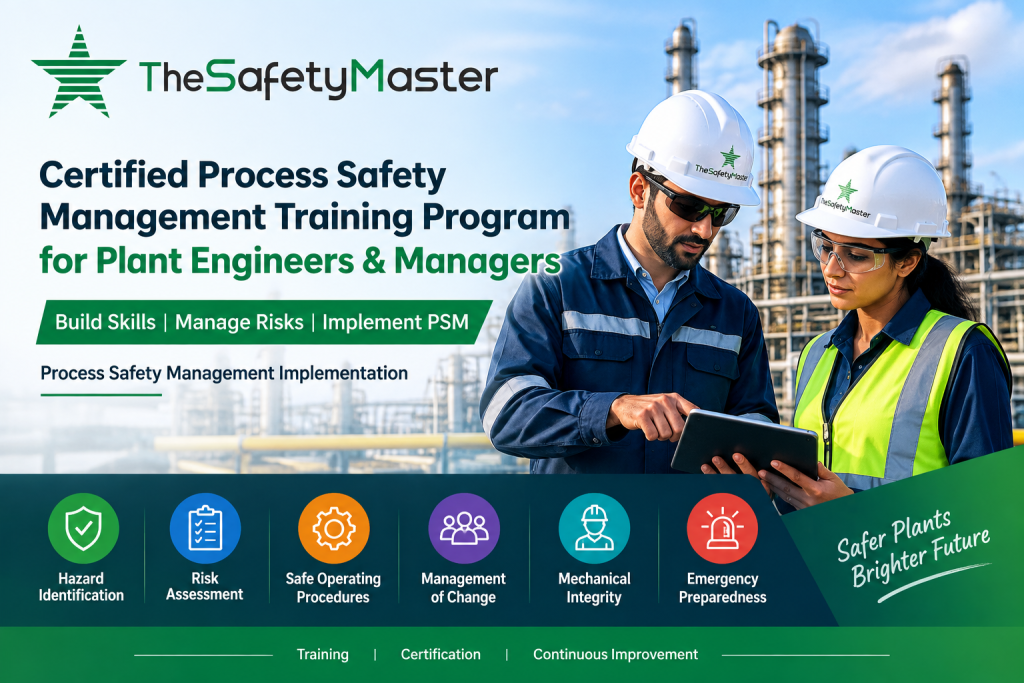
Complete Guide to Developing an ISO-Compliant Process Safety Management Framework

Top 10 Features to Look for in Enterprise Safety Software for Chemical Plants
September 23, 2026
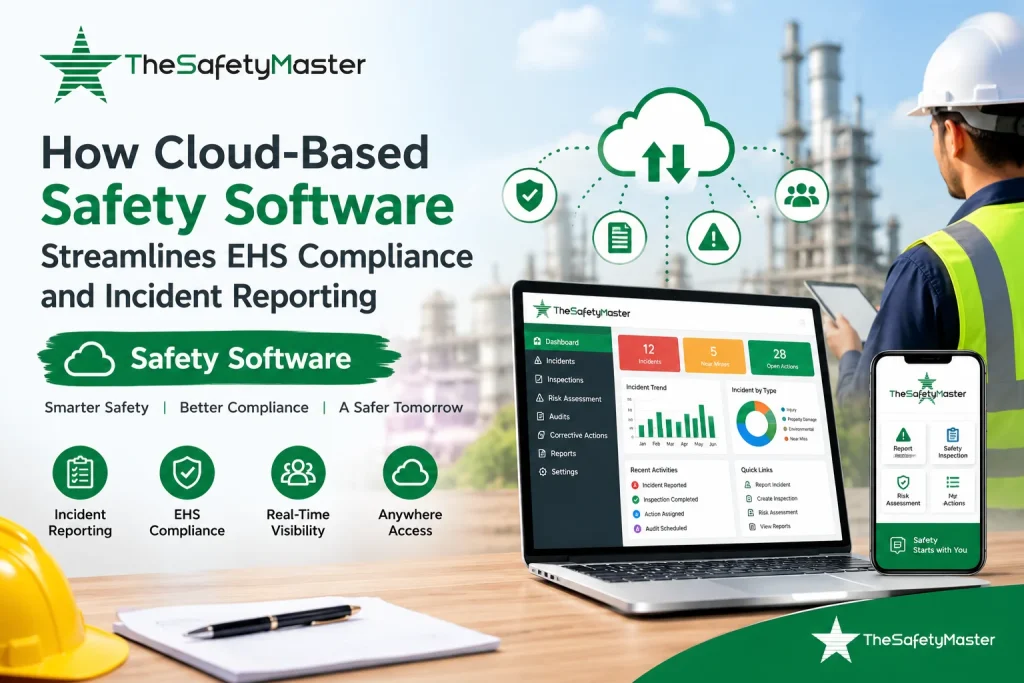
How Cloud-Based Safety Software Streamlines EHS Compliance and Incident Reporting
September 25, 2026
Process safety is important for industries that handle hazardous chemicals, flammable materials, high pressure, high temperature, and other dangerous processes. A strong process safety management framework helps organizations identify hazards, control risks, prevent major incidents, and protect workers, assets, and the environment.
An ISO-aligned framework can also help an organization create clear procedures, responsibilities, monitoring systems, emergency plans, and continuous improvement practices. The Safety Master helps organizations understand and implement practical safety systems that support better process safety performance.
What Is Process Safety Management?
Process Safety Management, commonly called PSM, is a systematic approach to identifying and controlling hazards associated with industrial processes.
It focuses on preventing serious incidents such as:
- Fires
- Explosions
- Toxic gas releases
- Chemical releases
- Equipment failures
- Loss of containment
- Major environmental incidents
Unlike personal safety programs that mainly focus on individual worker behavior, process safety management looks at the design, operation, maintenance, and management of the entire process.
A strong PSM system considers both technical and organizational controls. It also requires organizations to review hazards before making changes to processes, equipment, chemicals, or operating procedures.
Why Is Process Safety Management Important?
Industries such as oil and gas, petrochemicals, chemicals, pharmaceuticals, power generation, manufacturing, and other high-hazard industries can face major process-related risks.
A structured PSM framework can help organizations:
- Identify process hazards
- Assess and control risks
- Maintain safe operating conditions
- Improve equipment reliability
- Control process changes
- Strengthen emergency preparedness
- Reduce the possibility of major accidents
- Improve safety communication
- Support regulatory and management requirements
- Build a stronger safety culture
The goal is not only to respond to accidents but to prevent major incidents before they happen.
Understanding ISO Standards and Process Safety
ISO standards provide structured management principles that organizations can use to establish, operate, monitor, and improve management systems.
There is not one single ISO standard that contains every requirement for process safety management. Instead, organizations may use relevant ISO management-system standards together with industry-specific requirements, legislation, engineering standards, and recognized PSM practices.
For example, ISO 45001 focuses on occupational health and safety management, while ISO 9001 focuses on quality management. ISO 14001 focuses on environmental management.
For process industries, these systems can be integrated with process hazard analysis, mechanical integrity, management of change, operating procedures, emergency planning, and other process safety practices.
Key Components of an ISO-Aligned Process Safety Management Framework
Leadership and Commitment
Senior management should establish clear responsibility for process safety.
Leadership should:
- Define safety objectives
- Provide sufficient resources
- Establish accountability
- Review safety performance
- Support risk reduction
- Encourage reporting of hazards
- Promote continuous improvement
Process safety should be treated as a business responsibility rather than only a safety department activity.
Hazard Identification and Risk Assessment
Hazard identification is one of the most important parts of process safety management.
Organizations should systematically identify hazards associated with:
- Raw materials
- Chemicals
- Equipment
- Operating conditions
- Utilities
- Human factors
- Maintenance activities
- Startup and shutdown operations
- Emergency situations
Common techniques include HAZOP, HAZID, What-If Analysis, FMEA, Fault Tree Analysis, and Layer of Protection Analysis.
The selected method should match the complexity and risk of the process.
Process Safety Information
Accurate technical information is necessary for effective risk assessment and safe operation.
Process safety information may include:
- Chemical properties
- Process chemistry
- Process flow diagrams
- Piping and instrumentation diagrams
- Equipment specifications
- Operating limits
- Relief system information
- Design requirements
- Safety systems
- Hazardous area information
This information should be controlled, updated, and easily accessible to people who need it.
Operating Procedures
Written procedures should explain how processes are operated safely.
Procedures may cover:
- Normal operations
- Startup
- Shutdown
- Emergency shutdown
- Temporary operations
- Safe operating limits
- Operating deviations
- Emergency response
Employees should be trained and competent to follow applicable procedures.
Training and Competence
Training is essential for maintaining safe process operations.
Training programs should address:
- Process hazards
- Operating procedures
- Emergency response
- Safe work practices
- Equipment operation
- Permit-to-work requirements
- Incident reporting
- Process changes
Competence should be verified rather than relying only on attendance records.
Mechanical Integrity
Equipment failure can lead to loss of containment and major incidents.
A mechanical integrity program should cover critical equipment such as:
- Pressure vessels
- Storage tanks
- Piping
- Relief devices
- Pumps
- Compressors
- Safety instrumented systems
- Fire protection systems
- Critical alarms and shutdown systems
Inspection, testing, preventive maintenance, and corrective actions should be properly planned and documented.
Management of Change
Changes can introduce new hazards if they are not properly reviewed.
A Management of Change process should consider changes involving:
- Equipment
- Chemicals
- Technology
- Procedures
- Operating conditions
- Instrumentation
- Organizational responsibilities
Before implementing a significant change, the organization should evaluate potential risks, update documentation, communicate the change, and provide training where necessary.
Pre-Startup Safety Review
Before starting a new or significantly modified process, a pre-startup safety review can verify that important safety requirements have been completed.
The review may confirm:
- Equipment is installed correctly
- Safety systems are available
- Procedures are ready
- Training is completed
- Hazard assessments are addressed
- Emergency arrangements are established
- Change documentation is complete
Emergency Preparedness and Response
Even with strong preventive controls, organizations should prepare for emergencies.
Emergency plans should address scenarios such as:
- Fire
- Explosion
- Toxic release
- Chemical spill
- Equipment failure
- Power failure
- Natural hazards
- Loss of containment
Emergency drills can help test whether people understand their roles and whether response systems work as planned.
The Role of Audits in Process Safety Management
Auditing helps determine whether the PSM framework is being properly implemented.
A process safety audit may examine:
- Procedures
- Training records
- Risk assessments
- Mechanical integrity
- Management of change
- Permit systems
- Emergency preparedness
- Incident investigations
- Corrective actions
- Safety performance indicators
Audit findings should be documented and tracked until corrective actions are completed.
Incident Investigation and Corrective Action
When an incident or near miss occurs, the organization should investigate the underlying causes.
An effective investigation should look beyond immediate human error and examine:
- Equipment conditions
- Procedures
- Training
- Management systems
- Design decisions
- Maintenance
- Organizational factors
- Previous warning signs
Corrective actions should address root causes and should be monitored for completion and effectiveness.
Continuous Improvement of the PSM Framework
An ISO-aligned management system follows a continuous improvement approach.
Organizations can use a cycle such as:
Plan → Implement → Check → Improve
This can include:
- Identify hazards and risks.
- Establish controls and objectives.
- Implement procedures.
- Monitor performance.
- Conduct audits.
- Investigate incidents.
- Review management-system performance.
- Improve controls and processes.
This approach helps keep the PSM framework effective as processes, technologies, regulations, and organizational conditions change.
What Are the 14 Elements of PSM?
The commonly referenced OSHA Process Safety Management framework contains 14 elements:
- Employee participation
- Process safety information
- Process hazard analysis
- Operating procedures
- Training
- Contractors
- Pre-startup safety review
- Mechanical integrity
- Hot work permit
- Management of change
- Incident investigation
- Emergency planning and response
- Compliance audits
- Trade secrets
Organizations may use these elements as a useful framework while also considering applicable ISO standards, local regulations, and industry-specific requirements.
What Are the Six Pillars of Process Safety?
Different organizations and industry frameworks may group process safety principles differently. A commonly used way to discuss the major areas of process safety includes:
- Process safety leadership
- Risk management
- Process safety information
- Asset integrity
- Operational control
- Learning and continuous improvement
These pillars are interconnected. Strong performance requires technical controls as well as effective leadership, procedures, competence, and monitoring.
PSM in Oil and Gas
Process safety management in oil and gas focuses on preventing major accidents involving hydrocarbons, toxic substances, high pressure, high temperature, and other process hazards.
Important PSM activities in oil and gas facilities can include:
- HAZOP studies
- HAZID
- Quantitative Risk Assessment
- Safety Integrity Level assessment
- Management of Change
- Permit to Work
- Mechanical Integrity
- Emergency response
- Process safety audits
- Incident investigation
- Safety-critical equipment management
Oil and gas facilities should integrate process safety into design, construction, commissioning, operation, maintenance, and decommissioning.
How The Safety Master Can Support Process Safety
The Safety Master supports organizations with practical safety and risk-management solutions designed around their operational requirements.
Process safety activities can include hazard identification, risk assessment, HAZOP, HIRA, process safety audits, PSM implementation, training, and safety management-system support.
A structured approach can help organizations identify gaps, improve controls, strengthen procedures, and develop a more systematic process safety framework.
Conclusion
Developing an ISO-aligned process safety management framework requires more than creating safety documents. It requires leadership commitment, hazard identification, competent people, reliable equipment, effective procedures, change management, emergency preparedness, auditing, and continuous improvement.
Organizations should select applicable ISO standards and combine them with relevant legal requirements, industry practices, and process safety methodologies. A properly implemented framework can provide a structured approach for controlling process hazards and reducing the potential for major incidents.
The Safety Master can help organizations build practical safety and process risk-management systems that support safer and more controlled operations.
FAQs
Q-What are the 7 principles of QMS?
The seven quality management principles associated with ISO 9001 are:
- Customer focus
- Leadership
- Engagement of people
- Process approach
- Improvement
- Evidence-based decision making
- Relationship management
These principles provide a foundation for an effective quality management system.
Q-What are the 7 elements of ISO 45001?
ISO 45001 is structured around clauses rather than a seven-element PSM model. Its main management-system areas include organizational context, leadership and worker participation, planning, support, operation, performance evaluation, and improvement.
These areas help organizations establish and continually improve an occupational health and safety management system.
Q-What are the 5 most popular ISO standards?
Five widely used ISO management-system standards include:
- ISO 9001 – Quality Management
- ISO 14001 – Environmental Management
- ISO 45001 – Occupational Health and Safety
- ISO 27001 – Information Security Management
- ISO 50001 – Energy Management
The appropriate standard depends on an organization’s activities, risks, and objectives.
Q-What are the 3 ISO standards?
There are many ISO standards, so there is no universal group called “the three ISO standards.” Three widely recognized management-system standards are ISO 9001 for quality, ISO 14001 for environmental management, and ISO 45001 for occupational health and safety.
Q-What are the 14 elements of PSM?
The 14 commonly referenced OSHA PSM elements are employee participation, process safety information, process hazard analysis, operating procedures, training, contractors, pre-startup safety review, mechanical integrity, hot work permit, management of change, incident investigation, emergency planning and response, compliance audits, and trade secrets.
Q-What are the six pillars of process safety?
There is no single universal six-pillar model used by every organization. A commonly used grouping includes process safety leadership, risk management, process safety information, asset integrity, operational control, and learning and continuous improvement.
Q-What is Process Safety Management?
Process Safety Management is a systematic approach for identifying and controlling hazards associated with processes that can cause major fires, explosions, toxic releases, or other serious incidents. It combines technical, operational, organizational, and management controls to prevent major accidents.
Q-What is PSM in oil and gas?
PSM in oil and gas is the systematic management of hazards associated with exploration, production, processing, storage, and transportation of hydrocarbons and other hazardous materials. It can include HAZOP, HAZID, mechanical integrity, management of change, operating procedures, emergency response, incident investigation, and process safety audits.