How Safety Professionals Learn the Benefits of HAZOP Training to Prevent Accidents

Safety in Hazardous Chemical Transportation: A Complete Guide
May 12, 2023
Effective Strategies for Behavior Based Safety Training
May 12, 2023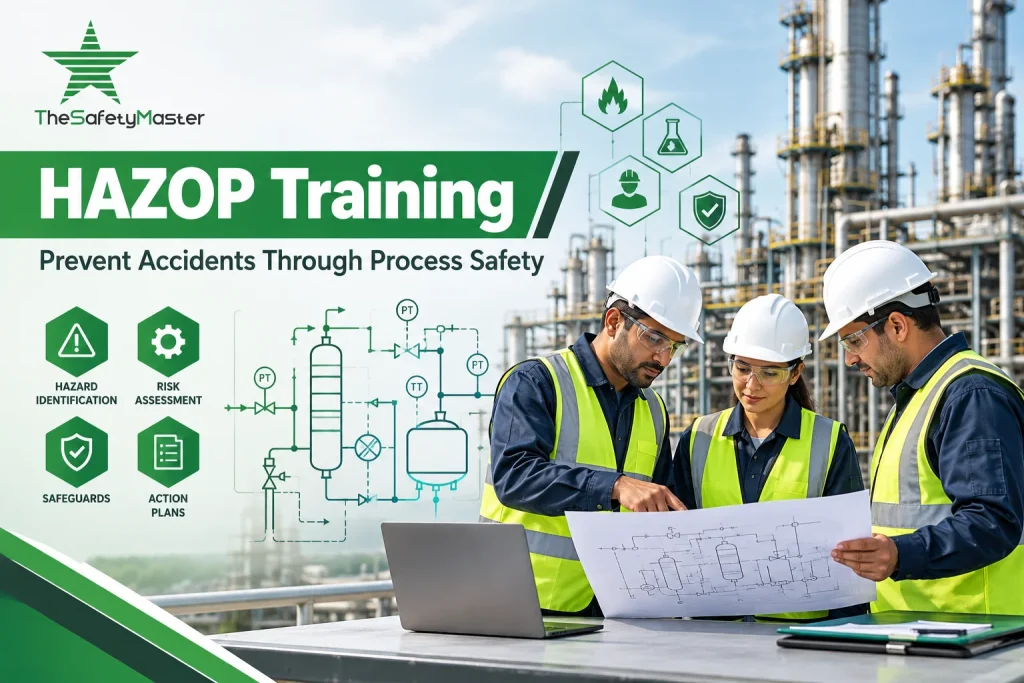
Workplace accidents can cause injuries, equipment damage, production losses, and environmental problems. In industries such as oil and gas, chemicals, pharmaceuticals, power generation, and manufacturing, process safety is very important. Safety professionals need the right knowledge and skills to identify hazards before they lead to serious incidents.
HAZOP Training helps safety professionals understand process hazards, identify possible operating problems, and recommend suitable safety measures. HAZOP stands for Hazard and Operability Study. It is a structured method used to identify potential hazards and operational difficulties in industrial processes.
With proper HAZOP Training, professionals can improve their ability to assess risks, understand process deviations, and support safer plant operations. The Safety Master provides process safety training and learning support to help professionals strengthen their industrial safety knowledge and develop practical skills.
What Is HAZOP Training?
HAZOP Training teaches participants how to conduct a Hazard and Operability Study in a systematic way. The training explains how to examine process systems, identify deviations from the intended design, understand their possible causes and consequences, and recommend suitable safeguards.
The training helps professionals understand how small changes in process conditions can create major safety risks. These conditions may include high pressure, low flow, high temperature, reverse flow, or changes in the chemical composition of materials.
Main Topics Covered in HAZOP Training
- Basic principles of HAZOP studies.
- Hazard identification and risk assessment.
- Process flow diagrams and piping and instrumentation diagrams (P&IDs).
- HAZOP guide words and process deviations.
- Identification of causes and consequences.
- Review of existing safeguards.
- Risk reduction and corrective actions.
- HAZOP worksheets and reporting.
- Roles and responsibilities of HAZOP team members.
- Follow-up and closure of recommended actions.
This knowledge helps safety professionals contribute to effective hazard management and safer industrial operations.
Key Benefits of HAZOP Training for Safety Professionals
HAZOP Training offers several benefits to professionals responsible for workplace safety, process safety, engineering, and risk management.
1. Better Hazard Identification
One of the main benefits of HAZOP Training is improved hazard identification. Professionals learn to examine each part of a process and identify possible deviations from normal operating conditions.
For example, a chemical reactor may experience a temperature increase because of a cooling system failure. A HAZOP study helps the team identify this possibility, understand its consequences, and review the available protection systems.
Early hazard identification allows organisations to take preventive action before an incident occurs.
2. Improved Accident Prevention
Accident prevention requires an understanding of how equipment failures, human errors, and process deviations can create unsafe conditions.
HAZOP Training teaches professionals to consider possible accident scenarios before they happen. They learn to evaluate potential problems and recommend actions such as improved alarms, interlocks, operating procedures, and maintenance controls.
These actions can reduce the likelihood of fires, explosions, chemical releases, and other process-related incidents when implemented and maintained effectively.
3. Stronger Risk Assessment Skills
Safety professionals must understand both the likelihood and consequences of hazardous events. HAZOP Training helps them examine risks in a structured manner.
Participants learn to identify hazards, assess possible outcomes, review safeguards, and determine whether additional risk reduction measures are needed.
This knowledge supports better risk assessment and helps organisations prioritise safety improvements.
4. Better Understanding of Process Safety
Process safety focuses on preventing major incidents involving hazardous substances, energy, equipment, and industrial processes.
HAZOP Training improves understanding of process parameters, equipment functions, operating limits, and protective systems. Professionals learn how changes in one part of a process can affect other parts of the system.
This knowledge is particularly valuable in chemical plants, refineries, oil and gas facilities, and other industries with complex operating conditions.
5. Improved Teamwork and Communication
A HAZOP study usually involves a multidisciplinary team that may include process engineers, operations staff, maintenance personnel, instrumentation engineers, and safety professionals.
Training helps participants understand their responsibilities and communicate technical concerns clearly. They learn to document deviations, discuss possible consequences, and record recommendations in a structured format.
Better communication helps the team identify hazards that might otherwise be overlooked.
How HAZOP Training Helps Prevent Workplace Accidents
HAZOP Training supports accident prevention through a systematic review of industrial processes.
Step 1: Understand the Process
The team reviews process information, including design documents, operating procedures, process flow diagrams, and P&IDs. This helps participants understand how the system should operate under normal conditions.
Step 2: Identify Process Deviations
The team uses guide words such as No, More, Less, Reverse, and Other Than to identify deviations from the intended process.
For example:
- No flow in a pipeline.
- More pressure than expected.
- Higher temperature than the operating limit.
- Reverse flow through a line.
- Less cooling water than required.
These deviations help the team identify potential problems that could affect safety or operations.
Step 3: Analyse Causes and Consequences
The team identifies the possible causes of each deviation and examines its potential consequences.
For example, excessive pressure may result from a blocked outlet, control valve failure, or an incorrect operating condition. Depending on the system, consequences may include equipment damage, leakage, or a dangerous release.
Step 4: Review Existing Safeguards
The team checks whether existing safeguards can prevent the deviation or reduce its consequences. These may include alarms, trips, pressure relief devices, interlocks, and operating procedures.
Safeguards must be suitable for the specific hazard and maintained in reliable working condition.
Step 5: Recommend Risk Reduction Measures
When existing protection is insufficient, the team recommends additional measures. These may include design changes, improved instrumentation, additional alarms, revised procedures, or other engineering controls.
Step 6: Track and Close Actions
Recommendations must be assigned to responsible persons, given suitable completion dates, and verified after implementation. Effective action tracking helps ensure that important safety improvements are not left incomplete.
The Safety Master encourages safety professionals to develop the knowledge needed to support structured hazard reviews and practical risk reduction.
Industries That Benefit From HAZOP Training
HAZOP Training is useful in industries where process deviations can affect workers, equipment, the environment, or production.
Oil and Gas Industry
Oil and gas facilities handle flammable materials under different pressure and temperature conditions. HAZOP studies help identify risks involving pipelines, storage tanks, separation units, compressors, and process equipment.
Chemical and Petrochemical Industry
Chemical plants may handle toxic, corrosive, reactive, or flammable substances. HAZOP Training helps professionals examine chemical reactions, transfer systems, temperature controls, and pressure-related hazards.
Pharmaceutical Industry
Pharmaceutical manufacturing involves controlled processes, chemicals, solvents, and specialised equipment. HAZOP studies can help identify operational problems that affect worker safety, process reliability, and product quality.
Power Generation Industry
Power plants use boilers, steam systems, fuel supplies, cooling systems, and other critical equipment. HAZOP Training helps professionals assess deviations that may lead to equipment failure or unsafe operating conditions.
Manufacturing Industry
Manufacturing facilities may use automated production systems, pressurised equipment, heating systems, and chemical processes. HAZOP knowledge helps teams review potential hazards and strengthen process controls.
Important Skills Developed Through HAZOP Training
HAZOP Training helps safety professionals develop technical and analytical skills required for industrial risk management.
- Critical thinking: Evaluate process deviations and identify possible failure scenarios.
- Hazard identification: Recognise unsafe operating conditions before they lead to incidents.
- Risk analysis: Understand potential consequences and the importance of safeguards.
- Technical documentation: Prepare clear HAZOP worksheets, findings, and recommendations.
- Team communication: Share safety concerns with engineers and operations teams.
- Problem-solving: Support the selection of practical and effective risk reduction measures.
- Action management: Follow up on recommendations and verify their completion.
These skills can support career development in process safety, industrial safety, engineering, operations, and risk management.
HAZOP Training and Process Safety Management
Process Safety Management (PSM) is a structured approach to controlling major hazards in industrial operations. HAZOP studies support PSM by identifying process risks and helping organisations determine where additional controls may be necessary.
HAZOP findings can contribute to:
- Process hazard analysis.
- Management of change.
- Operating procedure reviews.
- Mechanical integrity improvements.
- Emergency planning.
- Risk reduction planning.
- Pre-startup safety reviews.
For example, when a plant changes a process line, raw material, or operating condition, a suitable hazard review may be needed to assess the effect of that change. HAZOP Training helps professionals understand how to participate in these reviews.
However, HAZOP is not a replacement for every other safety assessment. Organisations may also require techniques such as HIRA, Job Safety Analysis (JSA), Layer of Protection Analysis (LOPA), or Safety Integrity Level (SIL) assessment, depending on the hazard and applicable requirements.
Who Should Enrol in HAZOP Training?
HAZOP Training is suitable for professionals who work with industrial processes, hazardous materials, engineering systems, and operational risk.
The course may be useful for:
- Safety officers and safety engineers.
- Process engineers and chemical engineers.
- Plant managers and production managers.
- Operations and maintenance personnel.
- Instrumentation and control engineers.
- Process safety consultants.
- EHS managers and risk assessment professionals.
- Engineers involved in plant design and commissioning.
Professionals with basic knowledge of industrial processes can benefit from introductory training. Advanced HAZOP facilitator roles generally require stronger process knowledge, relevant experience, and the ability to guide multidisciplinary teams.
How to Choose the Right HAZOP Training Course
Selecting a suitable training course helps professionals gain relevant knowledge and apply it effectively in the workplace.
Check the Course Content
Choose a course that covers HAZOP principles, guide words, process deviations, causes, consequences, safeguards, recommendations, and reporting.
Look for Practical Examples
Practical examples and case studies help participants understand how HAZOP is applied in real industrial situations. Exercises based on process diagrams and HAZOP worksheets can improve learning.
Review Trainer Experience
Consider trainers with relevant process safety, engineering, or HAZOP study experience. Industry knowledge can help connect the course material with workplace challenges.
Understand Certification Details
Check the course completion requirements, assessment method, certificate details, and recognition offered by the training provider. A training certificate should not automatically be treated as proof of independent HAZOP facilitator competence.
Consider Online and Classroom Options
Online courses may provide flexibility for working professionals, while classroom training may offer more direct interaction and group exercises. The right option depends on learning needs, schedule, and course structure.
The Safety Master is a resource for professionals and organisations seeking industrial safety training, hazard identification knowledge, and process safety support.
Common Mistakes That HAZOP Training Helps Reduce
Poorly conducted hazard reviews may miss important risks or produce recommendations that do not adequately address the identified problems.
HAZOP Training helps professionals recognise and reduce common mistakes, including:
- Starting a study without reviewing the correct process documents.
- Ignoring unusual operating conditions.
- Failing to examine credible causes of deviations.
- Overlooking the consequences of equipment failure.
- Assuming existing safeguards are always effective.
- Writing unclear or impractical recommendations.
- Failing to assign responsibility for corrective actions.
- Leaving recommendations open without proper verification.
- Excluding important departments or technical experts from the review.
A well-planned HAZOP study requires accurate information, suitable team members, effective facilitation, and proper follow-up.
Conclusion
HAZOP Training is an important learning opportunity for safety professionals who want to improve hazard identification, risk assessment, and accident prevention. It provides a structured approach to examining process deviations, identifying possible causes and consequences, reviewing safeguards, and recommending suitable risk reduction measures.
When organisations implement HAZOP recommendations effectively, they can strengthen process safety, improve operational reliability, and reduce the likelihood of serious incidents.
The Safety Master supports industrial safety learning and process risk management by helping professionals build knowledge that can contribute to safer workplaces. Investing in suitable HAZOP Training can help safety teams make better decisions and support a stronger safety culture.