HAZOP Leadership Training for 2 Days: Build Process Safety Leadership Skills with The Safety Master

Safety Audit as per Factory Act in India: A Complete Guide for Factory Compliance
August 7, 2023
Emergency Response Plan Preparation for your Factory by TheSafetyMaster
August 12, 2023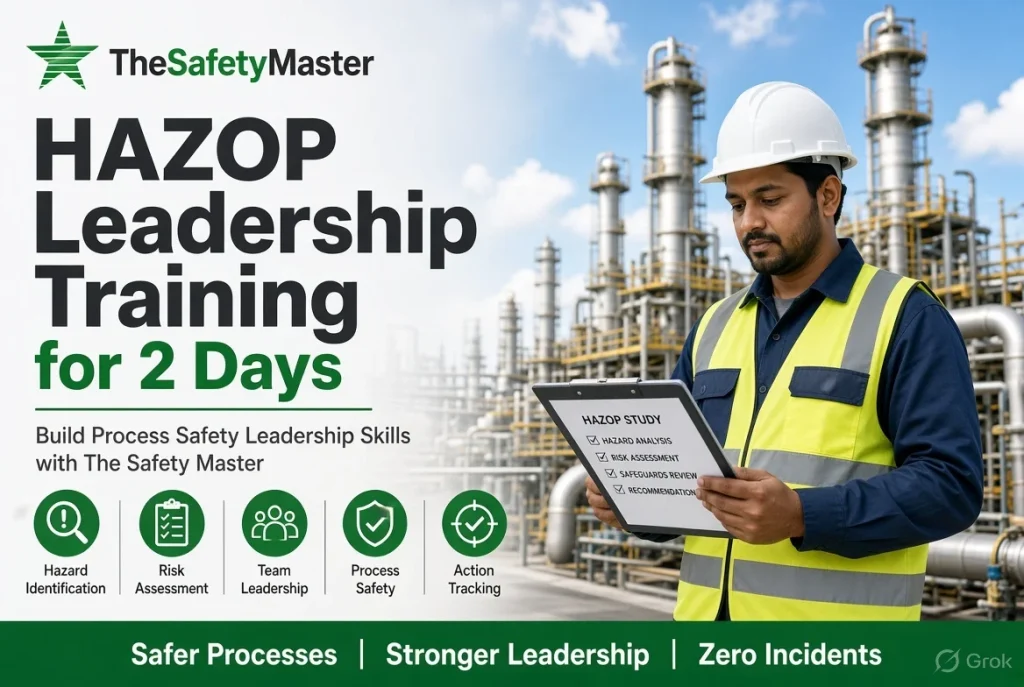
Introduction to HAZOP Leadership Training
HAZOP Leadership Training is important for professionals who want to improve their skills in process safety, hazard identification, and risk management. In industries such as chemical manufacturing, oil and gas, pharmaceuticals, petrochemicals, and industrial production, even a small process failure can create serious safety risks.
Hazard and Operability Study (HAZOP) is a systematic method used to identify potential hazards and operating problems in industrial processes. A successful HAZOP study requires technical knowledge, clear communication, teamwork, and effective leadership.
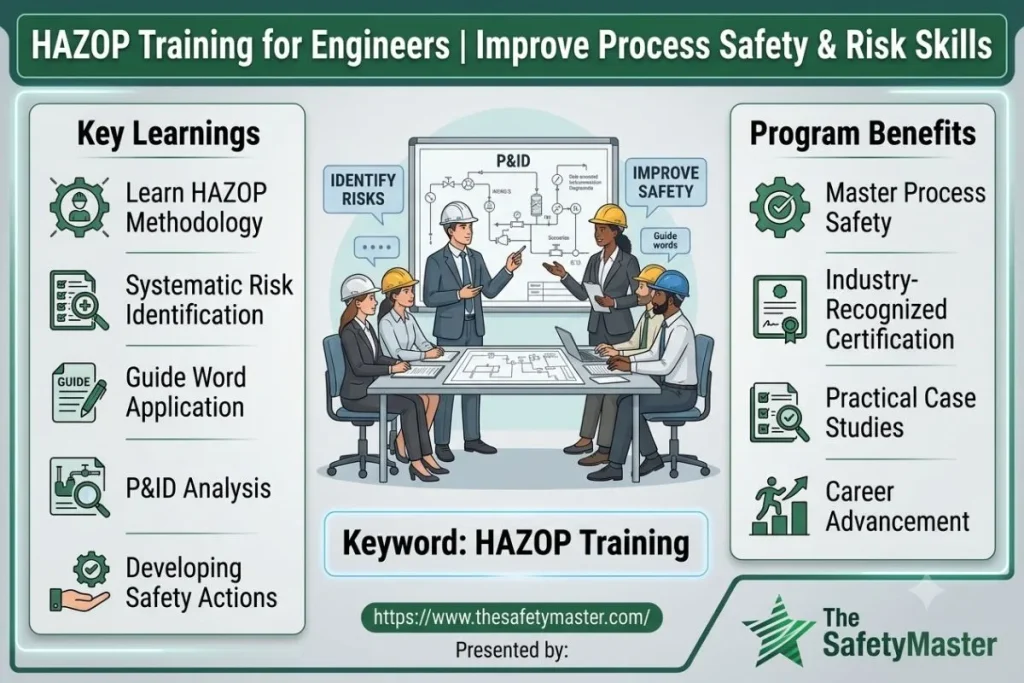
The Safety Master provides HAZOP Leadership Training for 2 days to help professionals understand HAZOP principles and develop the skills needed to lead HAZOP discussions effectively. The training focuses on hazard identification, risk assessment, team coordination, decision-making, and practical safety improvement.
This training can help safety professionals, process engineers, plant managers, operations personnel, and team leaders strengthen their understanding of HAZOP leadership and contribute to safer industrial operations.
What Is HAZOP Leadership Training?
HAZOP Leadership Training teaches professionals how to guide a team through a structured Hazard and Operability Study. It combines HAZOP methodology with leadership and communication skills.
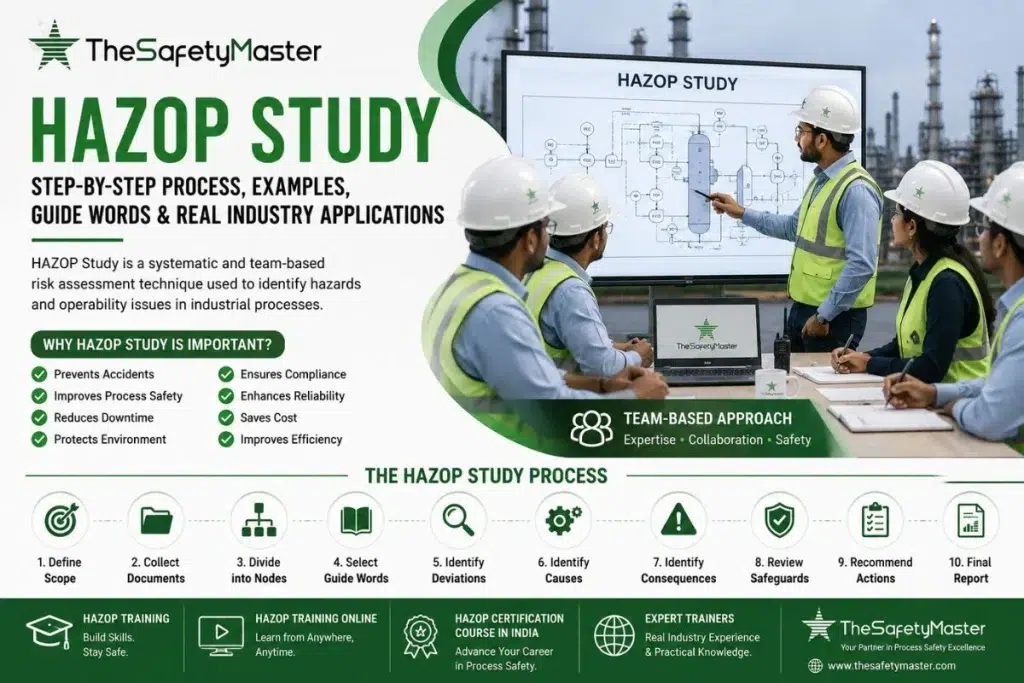
A HAZOP leader helps the team identify possible process deviations, understand their causes and consequences, review existing safeguards, and recommend suitable risk control measures.
The leader also ensures that discussions remain focused, all relevant team members contribute, and findings are recorded clearly.
The main areas covered in HAZOP leadership include:
- Understanding HAZOP principles and terminology.
- Identifying process hazards and operating problems.
- Understanding nodes, parameters, guidewords, and deviations.
- Facilitating technical discussions.
- Reviewing causes, consequences, and safeguards.
- Supporting risk assessment and decision-making.
- Preparing clear recommendations and HAZOP records.
- Following up on safety actions.
The Safety Master aims to help professionals connect theoretical knowledge with practical process safety applications.
Why Is HAZOP Leadership Important?
Effective leadership is essential for a successful HAZOP study. Even when a team has experienced engineers and safety professionals, poor communication or incomplete analysis can affect the quality of the results.
A skilled HAZOP leader helps the team follow a systematic process and examine possible failures before they lead to accidents.
Better Hazard Identification
A HAZOP leader encourages team members to examine process conditions carefully. The team considers deviations such as high pressure, low flow, high temperature, reverse flow, or no flow.
This approach helps identify possible problems before they cause equipment damage, production loss, or injury.
Improved Team Communication
HAZOP studies often involve professionals from different departments, including engineering, maintenance, operations, instrumentation, and safety.
Strong communication helps team members share their knowledge, discuss concerns, and understand different viewpoints.
Effective Risk Assessment
The HAZOP leader guides the team in reviewing potential consequences and existing safeguards. The team can then evaluate risks according to the organization’s approved risk assessment method.
Clear Safety Recommendations
HAZOP findings should lead to practical actions. Effective leadership helps the team develop clear recommendations, assign responsibility where appropriate, and support follow-up.
Stronger Safety Culture
Good HAZOP leadership promotes open discussion, careful decision-making, and shared responsibility for workplace safety.
Two-Day HAZOP Leadership Training Programme
The Safety Master’s two-day training focuses on HAZOP fundamentals and leadership techniques. The following outline provides a suggested learning structure; confirm the final agenda with The Safety Master before enrolment.
Day 1: HAZOP Fundamentals and Hazard Identification
The first day focuses on the basic principles of HAZOP and the systematic identification of process hazards.
Key learning areas include:
- Introduction to process safety and HAZOP.
- Objectives and benefits of HAZOP studies.
- Common process safety hazards.
- HAZOP terminology and methodology.
- HAZOP team roles and responsibilities.
- Process nodes and design intent.
- Parameters and guidewords.
- Identification of process deviations.
- Analysis of potential causes and consequences.
- Introduction to risk assessment and safeguards.
Participants can use these concepts to understand how a HAZOP team examines industrial processes and identifies possible operating problems.
Understanding HAZOP Guidewords
Guidewords help a team identify deviations from the intended operation of a process.
Examples include:
- No: Complete absence of an intended activity or flow.
- More: A value exceeds its intended level.
- Less: A value falls below its intended level.
- Reverse: Flow occurs in the opposite direction.
- Other than: An activity or condition differs from the intended design.
For example, a team studying a chemical transfer line may examine the possibility of no flow, excessive flow, or reverse flow. Each deviation is assessed to understand its possible causes, consequences, and safeguards.
Day 2: HAZOP Leadership and Team Management
The second day focuses on the leadership skills required to guide HAZOP discussions and support effective decision-making.
Key learning areas include:
- Responsibilities of a HAZOP leader.
- Planning and organising HAZOP meetings.
- Guiding systematic hazard identification.
- Encouraging participation from team members.
- Managing technical discussions.
- Reviewing safeguards and risk controls.
- Supporting risk-based recommendations.
- Recording findings and action points.
- Managing disagreements during meetings.
- Following up on recommendations.
Developing Effective Facilitation Skills
A HAZOP leader must guide the discussion without ignoring important technical concerns. The leader should ask clear questions, encourage evidence-based answers, and ensure that the team considers relevant hazards.
Good facilitation also involves managing time, keeping discussions focused, and making sure that important findings are documented.
Managing Team Discussions
Different team members may have different opinions about the likelihood or consequences of a process deviation. A good leader listens to these viewpoints and helps the team evaluate them using available technical information and the approved risk assessment procedure.
The aim is to reach a well-supported conclusion rather than overlook a concern because of time pressure or differences of opinion.
Who Should Attend HAZOP Leadership Training?
HAZOP Leadership Training is useful for professionals involved in process safety, industrial operations, engineering, and risk management.
Suitable participants may include:
- HSE managers and safety officers.
- Process safety engineers.
- Chemical and process engineers.
- Plant managers and production managers.
- Operations and maintenance engineers.
- Project engineers and technical managers.
- Instrumentation and control engineers.
- Risk assessment professionals.
- Existing HAZOP team leaders and facilitators.
Professionals who already understand basic process safety concepts may find the leadership-focused training particularly useful. The appropriate entry requirements should be confirmed with The Safety Master.
Key Skills Developed Through HAZOP Leadership Training
Effective HAZOP leadership requires both technical understanding and people-management skills.
Technical Understanding
Participants develop an understanding of the HAZOP process, including process deviations, causes, consequences, safeguards, and recommendations.
Critical Thinking
A HAZOP leader must help the team consider different failure scenarios instead of relying only on normal operating conditions.
Communication Skills
Clear communication helps the leader explain technical issues, ask useful questions, and encourage active participation.
Decision-Making Skills
The leader helps the team evaluate available information, understand risks, and document justified recommendations.
Documentation and Follow-Up
Accurate documentation supports the review of HAZOP findings and helps the organisation track corrective actions to completion.
Benefits of HAZOP Leadership Training for Industries
Investing in suitable HAZOP leadership training can support stronger process safety practices across an organisation.
Improved hazard management: A structured HAZOP process helps teams identify potential hazards and operating problems.
Better coordination: Leadership skills support collaboration between engineering, operations, maintenance, and safety departments.
More consistent studies: A clear methodology helps teams review process deviations systematically.
Stronger recommendations: Well-documented findings make it easier to identify required risk controls and corrective actions.
Support for continuous improvement: Reviewing HAZOP findings and following up on recommendations can help organisations improve their safety systems.
Training alone cannot guarantee accident prevention. Its value depends on the quality of the study, the experience of the team, the accuracy of available information, and the implementation of recommended safety measures.
HAZOP Leadership Training and Process Safety Management
Process Safety Management (PSM) focuses on preventing major incidents involving hazardous materials, equipment, and industrial processes. HAZOP is one of the methods that organisations may use as part of their process hazard analysis activities.
HAZOP leadership supports PSM by helping teams identify hazards, examine potential consequences, evaluate safeguards, and document actions.
A well-managed HAZOP study can also provide useful information for related activities, such as Layers of Protection Analysis (LOPA), Safety Integrity Level (SIL) assessment, and Management of Change (MOC), where applicable.
These activities have different purposes and should be carried out using suitable methods, competent personnel, and the organisation’s approved procedures.
The Safety Master offers process safety-related training and services to help professionals strengthen their understanding of industrial risk management.
Why Choose The Safety Master for HAZOP Leadership Training?
The Safety Master provides safety and process safety training designed to help professionals understand industrial hazards and improve workplace safety practices.
The two-day HAZOP leadership programme focuses on the connection between systematic hazard analysis and effective team leadership.
Potential benefits for participants include:
- A better understanding of HAZOP methodology.
- Knowledge of the responsibilities of a HAZOP leader.
- Improved understanding of hazard identification and risk assessment.
- Greater awareness of team communication and facilitation.
- Practical insight into HAZOP documentation and recommendations.
- A stronger foundation for participating in or leading HAZOP studies, subject to experience and competency.
Before registering, participants should confirm the course schedule, delivery format, fees, eligibility, assessment requirements, and certificate details directly with The Safety Master.
Conclusion
HAZOP Leadership Training helps professionals understand how to lead structured hazard identification and risk assessment discussions in industrial environments. Effective leadership improves communication, encourages systematic analysis, and supports the development of practical safety recommendations.
The Safety Master’s HAZOP Leadership Training for 2 days is relevant to professionals seeking to strengthen their knowledge of HAZOP methodology, team management, process safety, and risk control.
By combining technical understanding with strong leadership practices, professionals can contribute to more effective HAZOP studies and support a safer working environment. Contact The Safety Master to confirm the programme details and identify the training options suitable for your professional needs.