The Role of HAZOP Study in Identifying and Managing Operational Hazards in Indian Chemical Manufacturing

The Role of Safety Audits in Mitigating Occupational Hazards: Insights from Indian Manufacturing Industries
November 3, 2023
Crafting a Successful Behavior-Based Safety Implementation Program: Key Considerations and Best Practices
November 6, 2023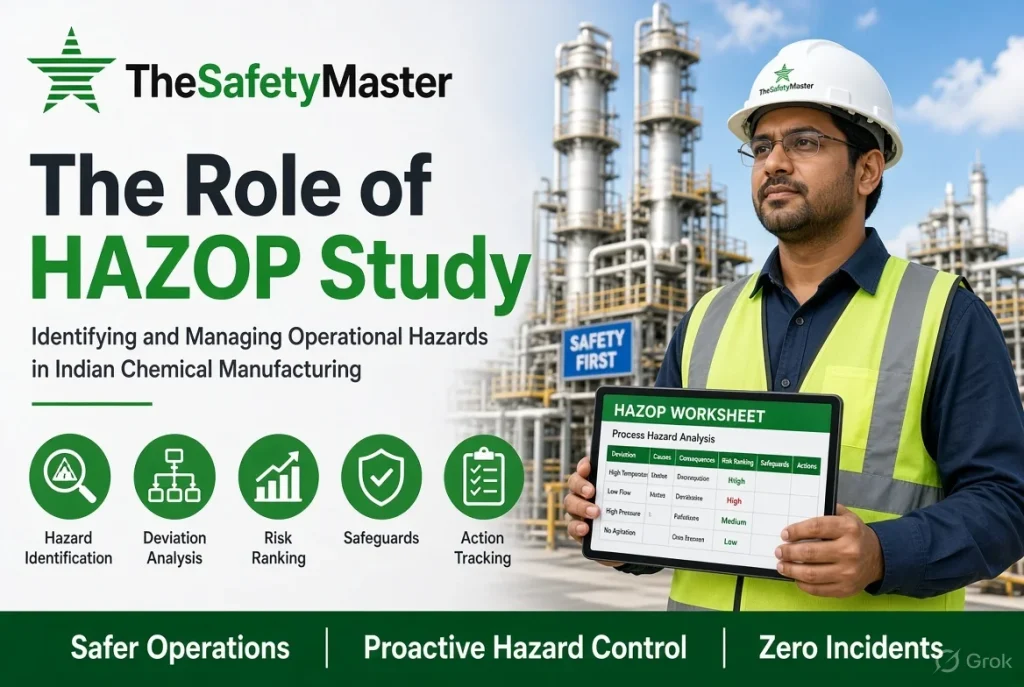
Chemical manufacturing is an important part of India’s industrial growth. Chemical plants produce materials used in pharmaceuticals, agriculture, textiles, paints, plastics, fertilizers, and many other industries. However, these operations also involve risks such as chemical leaks, fires, explosions, equipment failures, and harmful exposure to dangerous substances.
A small change in pressure, temperature, chemical flow, or operating conditions can create a serious safety problem. Identifying these risks before an incident occurs is essential for protecting workers, equipment, the environment, and nearby communities.
A HAZOP Study (Hazard and Operability Study) is a systematic method used to identify potential hazards and operational problems in industrial processes. It helps organizations understand what could go wrong, why it could happen, and which safety measures may be needed to control the risk.
The Safety Master provides safety consultancy and training services to help industries improve hazard identification, risk management, and process safety practices. A properly conducted HAZOP Study can support safer operations, better decision-making, and continuous improvement in Indian chemical manufacturing facilities.
What Is a HAZOP Study?
HAZOP stands for Hazard and Operability Study. It is a structured process hazard analysis method used to identify deviations from the intended design or normal operating conditions of a plant.
A HAZOP team examines process equipment, pipelines, storage tanks, reactors, pumps, valves, and operating procedures. The team considers possible deviations, their causes, their consequences, and the safeguards already available.
For example, a chemical reactor may operate within a specific temperature range. If the temperature rises above the safe operating limit, an unwanted reaction, equipment damage, or pressure increase may occur. A HAZOP Study examines such situations and helps the team identify suitable preventive and protective measures.
The main purpose is to identify potential problems early and recommend practical actions to reduce risk.
Why Is HAZOP Study Important in Indian Chemical Manufacturing?
Chemical manufacturing facilities often handle flammable, toxic, corrosive, and reactive substances. These materials require proper storage, controlled processing, suitable equipment, and effective emergency arrangements.
A HAZOP Study helps manufacturers review their processes systematically rather than relying only on routine inspections or individual experience.
Early Identification of Process Hazards
The study helps identify potential hazards before they result in accidents. It examines deviations such as high pressure, low flow, excessive temperature, reverse flow, and incorrect chemical composition.
Early identification gives plant management an opportunity to improve equipment design, operating procedures, and safety controls.
Prevention of Fires and Explosions
Some chemical reactions produce heat or gas under specific conditions. If these reactions are not controlled, they may cause pressure buildup, fire, or explosion.
HAZOP helps identify scenarios involving flammable substances, ignition sources, cooling failures, and unsuitable operating conditions. Recommendations may include improved temperature monitoring, suitable relief systems, interlocks, and emergency shutdown arrangements, where required by the risk assessment.
Protection of Workers
Workers may face risks from toxic gases, chemical splashes, high-pressure systems, hot surfaces, and equipment failures.
A HAZOP Study helps identify situations that could expose employees to these hazards. The findings can support better work procedures, engineering controls, alarm systems, and emergency response planning.
Improved Operational Reliability
Unsafe process conditions can lead to unplanned shutdowns, damaged equipment, production losses, and expensive repairs.
By identifying process weaknesses, a HAZOP Study helps companies improve operational reliability and reduce the likelihood of avoidable disruptions.
Common Operational Hazards in Chemical Manufacturing Plants
Chemical manufacturing involves several types of hazards. Their severity depends on the substances handled, process conditions, equipment design, and available safeguards.
Chemical Leakage and Toxic Exposure
Chemical leakage may occur because of damaged pipelines, leaking valves, failed seals, corrosion, or incorrect connections.
Toxic substances can harm workers and may affect surrounding areas if a release is not controlled.
A HAZOP team reviews possible leakage scenarios, identifies their causes, examines existing detection and isolation systems, and recommends additional safeguards where necessary.
High Temperature and Pressure
Chemical reactors, boilers, storage systems, and processing equipment may operate at elevated temperatures or pressures.
Cooling failure, blocked outlets, incorrect operating settings, or unexpected reactions may cause conditions to exceed design limits.
The study examines these deviations and evaluates whether monitoring, alarms, pressure relief, shutdown systems, and operating procedures provide suitable protection.
Incorrect Chemical Mixing
Mixing incompatible chemicals may cause unexpected reactions, excessive heat, toxic gas formation, or pressure buildup.
HAZOP helps identify possible material selection errors, incorrect charging sequences, and process deviations. Suitable controls may include verified material identification, controlled dosing, interlocks, and revised operating instructions.
Equipment Failure
Pumps, compressors, valves, sensors, and other equipment can fail during operation.
The study considers how such failures could affect the process and whether existing safeguards can prevent a hazardous situation from developing.
Human Error and Operating Problems
Incorrect valve operation, poor communication, incomplete procedures, and mistakes during maintenance can contribute to incidents.
HAZOP can identify situations in which human error may create a hazardous deviation. The findings can guide improvements in training, procedure design, supervision, and equipment interfaces.
How Is a HAZOP Study Conducted?
A HAZOP Study follows a structured process. The exact scope and depth depend on the facility, process complexity, and level of risk.
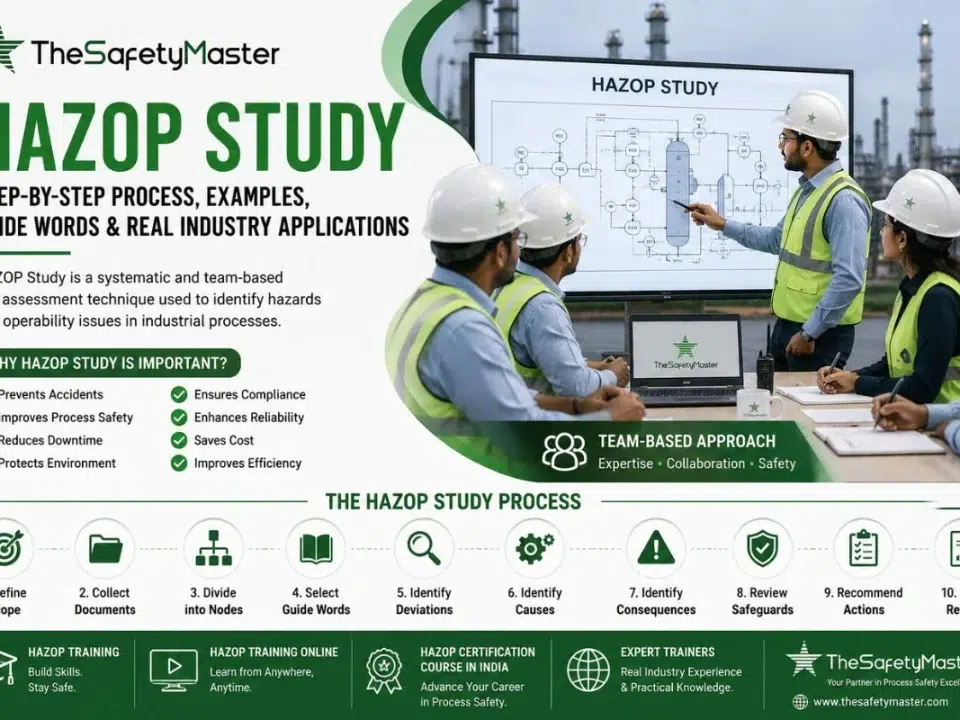
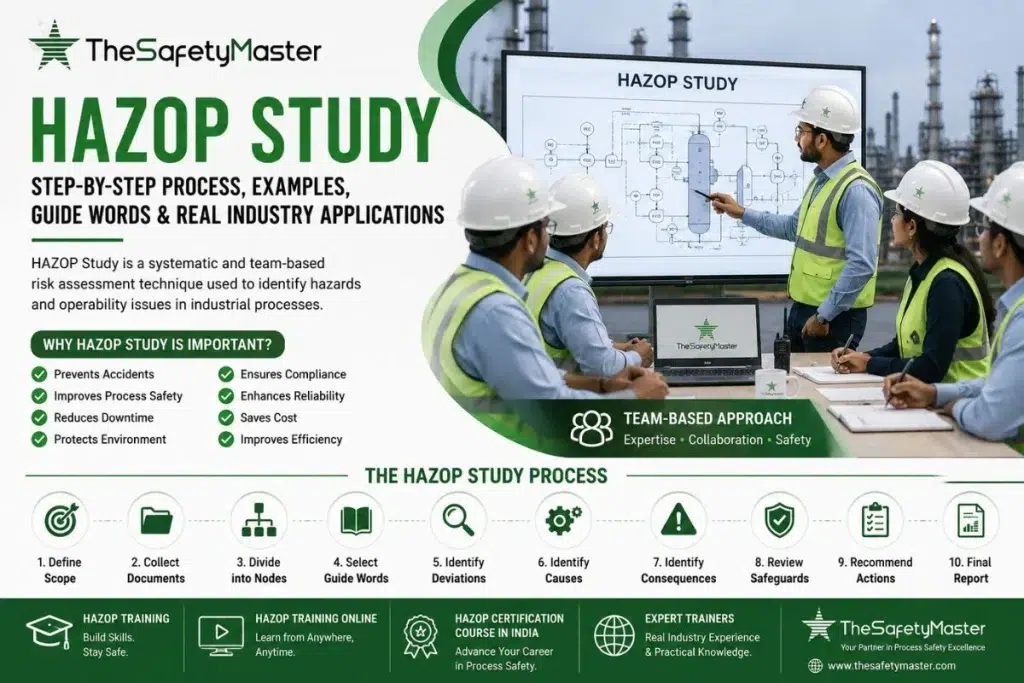
Define the Scope of the Study
The first step is to define the process, equipment, or plant section that requires examination.
The team identifies the study boundaries, objectives, operating conditions, and relevant process information. This helps ensure that the review covers the intended systems.
Collect Process Safety Documents
The team reviews the documents needed to understand the process.
These may include:
- Process Flow Diagrams (PFDs).
- Piping and Instrumentation Diagrams (P&IDs).
- Process descriptions and design specifications.
- Equipment details and operating limits.
- Chemical safety information.
- Standard Operating Procedures (SOPs).
- Existing risk assessments and incident records.
Accurate and updated documents are important for identifying realistic deviations.
Divide the Process into Nodes
The process is divided into smaller sections called nodes. Each node represents a manageable part of the system, such as a reactor, transfer line, storage tank, or heat exchanger.
The team examines each node separately to identify potential deviations from its intended operation.
Apply HAZOP Guidewords
Guidewords help the team examine different types of deviations. They are applied to relevant process parameters such as flow, pressure, temperature, level, and composition.
Common examples include:
- No: No flow or no material transfer.
- More: Higher pressure, temperature, or flow than intended.
- Less: Lower flow or temperature than intended.
- Reverse: Flow in the opposite direction.
- Other Than: A different material or operating condition than intended.
- As Well As: An additional substance or condition is present.
Not every guideword applies to every process parameter. The team selects combinations that make sense for the node under review.
Identify Causes and Consequences
For each meaningful deviation, the team identifies possible causes and examines what could happen if the deviation occurs.
For example, a high-temperature deviation in a reactor may result from cooling failure, excessive reactant addition, or a control system problem.
Possible consequences could include product damage, increased pressure, equipment failure, or an unwanted reaction. The team records credible scenarios and considers their potential impact.
Review Existing Safeguards
The team identifies the safeguards already in place to prevent the deviation or reduce its consequences.
These may include alarms, automatic shutdown systems, pressure relief devices, gas detectors, process interlocks, operating procedures, and emergency systems.
The team evaluates whether the safeguards are appropriate and sufficiently reliable for the identified scenario.
Recommend Risk Reduction Measures
When gaps are identified, the team recommends suitable corrective actions.
Examples include improving instrumentation, modifying process controls, updating operating procedures, improving ventilation, adding suitable detection systems, or reviewing equipment design.
Recommendations should be practical, clearly assigned, and tracked until completion or formal resolution.
Role of HAZOP Study in Risk Management
A HAZOP Study supports the wider process safety management system of a chemical manufacturing facility.
It helps organizations understand how individual equipment failures, process deviations, and human errors can combine to create hazardous conditions.
The findings can support risk assessments, maintenance planning, emergency preparedness, management of change, and the development of safer operating procedures.
HAZOP does not eliminate every possible risk. Its effectiveness depends on the quality of process information, the competence of the team, the scenarios examined, and the implementation of recommendations.
Benefits of HAZOP Study for Chemical Manufacturers
A properly planned and conducted HAZOP Study can deliver several important benefits.
Better hazard identification: The systematic review helps uncover potential process deviations that may not be obvious during routine operations.
Reduced accident potential: Identifying credible hazardous scenarios helps organizations introduce suitable preventive and protective measures.
Improved worker safety: Better process controls and procedures can reduce exposure to dangerous chemicals and unsafe operating conditions.
More reliable operations: Addressing process weaknesses can help reduce unplanned shutdowns, equipment damage, and production interruptions.
Stronger safety documentation: The HAZOP report records identified deviations, causes, consequences, safeguards, and recommendations for future reference.
Better teamwork: Engineers, operators, maintenance professionals, and safety specialists share knowledge and develop a common understanding of process risks.
Support for compliance: HAZOP findings can contribute to a company’s process safety and regulatory compliance activities. The exact legal requirements depend on the facility, chemicals, process, and applicable regulations.
When Should a HAZOP Study Be Conducted?
HAZOP is particularly useful when a chemical manufacturing facility needs a detailed review of process hazards.
Common situations include:
- During the design of a new chemical plant.
- Before commissioning a new process or major equipment system.
- Before significant plant modifications or capacity expansion.
- When introducing a new chemical or changing a process route.
- When reviewing existing process safety arrangements.
- After incidents or near misses that indicate possible process weaknesses.
- During periodic reviews, according to the facility’s risk management requirements.
A HAZOP review should also be considered as part of management of change when proposed modifications could affect process safety.
HAZOP Study and Regulatory Compliance in India
Indian chemical manufacturers must identify and comply with the legal and regulatory requirements applicable to their operations.
Depending on the facility and its activities, relevant requirements may include the Environment (Protection) Act, 1986, the applicable provisions of the Factories Act, 1948, associated state rules, and regulations governing hazardous chemicals and major accident hazards. Applicable requirements must be verified for the particular facility and the legislation in force.
A HAZOP Study can help organizations identify process risks and document recommended safeguards. However, completing a HAZOP Study alone does not guarantee legal compliance or replace mandatory inspections, approvals, or other risk assessments.
Companies should review applicable legal requirements, maintain required records, implement corrective actions, and periodically assess the effectiveness of their safety management systems.
Best Practices for an Effective HAZOP Study
The quality of a HAZOP Study depends on how it is planned, conducted, documented, and followed up.
Involve a Multidisciplinary Team
The team should include people with relevant knowledge of process engineering, operations, instrumentation, maintenance, and process safety. Specialist expertise should be added where the process requires it.
Use Accurate Process Information
Outdated diagrams and incomplete operating data can lead to missed hazards. The team should verify that the documents reflect the actual process and intended operating conditions.
Record Clear Recommendations
Every recommendation should explain the issue that needs to be addressed. Assign responsibility, set a realistic completion date, and define how closure will be verified.
Prioritize Significant Risks
Actions should be prioritized using the organization’s risk assessment method and applicable requirements. High-consequence scenarios may require further analysis to determine whether additional safeguards are needed.
Track Actions to Completion
A HAZOP report is useful only when its findings are managed effectively. Organizations should maintain an action register, review progress, verify completed actions, and document any justified decisions not to implement a recommendation.
Review Changes and New Hazards
Process changes, new chemicals, equipment upgrades, and operating experience can introduce new risks. Regular reviews and management of change help keep the safety assessment relevant.
How The Safety Master Supports Process Safety
The Safety Master supports industries through safety consultancy, training, and risk management services. For chemical manufacturing facilities, structured hazard identification and process safety reviews can help identify weaknesses and develop practical risk reduction measures.
A HAZOP Study should be tailored to the specific plant, process, and operating conditions. It should be conducted by a competent team using suitable process documents and a systematic methodology.
By combining sound technical analysis with effective implementation and follow-up, organizations can strengthen their process safety practices and work toward safer, more reliable operations.
Conclusion
A HAZOP Study plays an important role in identifying and managing operational hazards in Indian chemical manufacturing. It helps teams examine process deviations, understand possible causes and consequences, review existing safeguards, and recommend practical improvements.
From chemical leakage and high pressure to equipment failure and incorrect material mixing, a systematic HAZOP review can help manufacturers identify potential problems before they develop into serious incidents.
For long-term results, companies must go beyond preparing a report. They should implement recommendations, train employees, maintain accurate documentation, and review process safety whenever significant changes occur.
The Safety Master can support organizations in strengthening hazard identification, risk management, and workplace safety through suitable consultancy and training services. A proactive approach to process safety helps protect workers, assets, the environment, and business continuity.