A Complete Guide to HAZOP, HIRA & QRA for Industries in Jeedimetla, Patancheru & Sangareddy

Top Industrial Safety Challenges in Hyderabad & How Companies Can Overcome Them in 2025
December 4, 2025
Fire Safety & Emergency Preparedness Requirements for Industries in Visakhapatnam Port and SEZ Areas
December 6, 2025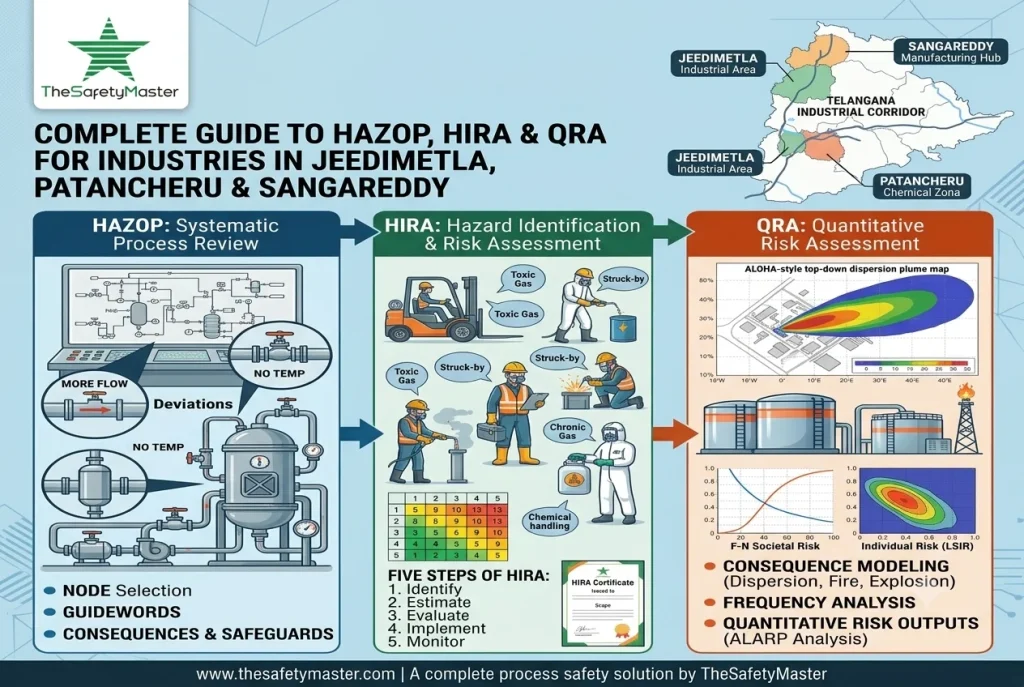
Industrial hubs such as Jeedimetla, Patancheru, and Sangareddy form the core backbone of Telangana’s chemical, pharmaceutical, bulk drug, and manufacturing ecosystem. While high-volume processing and active pharmaceutical ingredient (API) synthesis drive significant economic growth, they also expose facilities to complex operational risks. Managing high-pressure reactors, toxic chemical storage, flammable solvents, and exothermic reactions requires rigorous Process Safety Management (PSM) systems.
To prevent catastrophic incidents, regulatory bodies such as the Factories Act, State Pollution Control Boards, and petroleum/chemical safety authorities mandate thorough hazard evaluations. The three most critical pillars of industrial risk assessment are Hazard and Operability Study (HAZOP), Hazard Identification and Risk Assessment (HIRA), and Quantitative Risk Assessment (QRA).
Partnering with an experienced safety consulting firm like The Safety Master enables industrial facilities across Jeedimetla, Patancheru, and Sangareddy to conduct precise risk evaluations, satisfy compliance norms, and protect workforce and capital assets.
Understanding Process Risk Assessment in Industrial Hubs
Industries located in Jeedimetla, Patancheru, and Sangareddy process complex chemical compounds daily. Minor deviations in process parameters—such as flow rate variations, temperature spikes, or valve failures—can lead to runaway reactions, fires, toxic releases, or severe environmental contamination.
Standardized safety risk assessments provide a structured framework to detect process anomalies before they turn into major accidents.
 ┌─────────────────────────────────────────────────────────┐
 │ Industrial Risk Assessment │
 └────────────────────────────┬────────────────────────────┘
 │
 ┌──────────────────────────┼──────────────────────────┐
 │ │ │
 ▼ ▼ ▼
 ┌─────────────┐ ┌─────────────┐ ┌─────────────┐
 │ HAZOP │ │ HIRA │ │ QRA │
 │ Process & │ │ Workplace & │ │ Numerical & │
 │ Deviation │ │ Operational │ │ Frequency │
 │ Analysis │ │ Hazards │ │ Analysis │
 └─────────────┘ └─────────────┘ └─────────────┘
Why Jeedimetla, Patancheru & Sangareddy Facilities Require Specialized Risk Studies
- Dense Industrial Clusters: Proximity between manufacturing units increases the risk of domino effects during emergency incidents.
- Complex Chemical Operations: Solvent handling, hydrogenation, halogenation, and high-pressure reactions demand dedicated study methodologies.
- Regulatory Compliance Requirements: Regulatory authorities require up-to-date hazard evaluation documentation during periodic site inspections, expansions, and consent renewals.
Deep-Dive into HAZOP (Hazard and Operability Study)
A Hazard and Operability Study (HAZOP) is a structured, systematic examination of a planned or existing process/operation. It evaluates how process design intents might fail, leading to hazardous consequences or operational inefficiencies.
┌─────────────────┐ ┌──────────────────┐ ┌──────────────────┐
│ Process Design │ ──► │ Apply Guidewords│ ──► │ Identify Causes │
│ Intent & P&IDs │ │ (No, More, Less) │ │ & Consequences │
└─────────────────┘ └──────────────────┘ └─────────┬────────┘
 │
 ▼
 ┌──────────────────┐
 │ Evaluate & Draft │
 │ Safeguards/Recs │
 └──────────────────┘
The HAZOP Methodology and Node Division
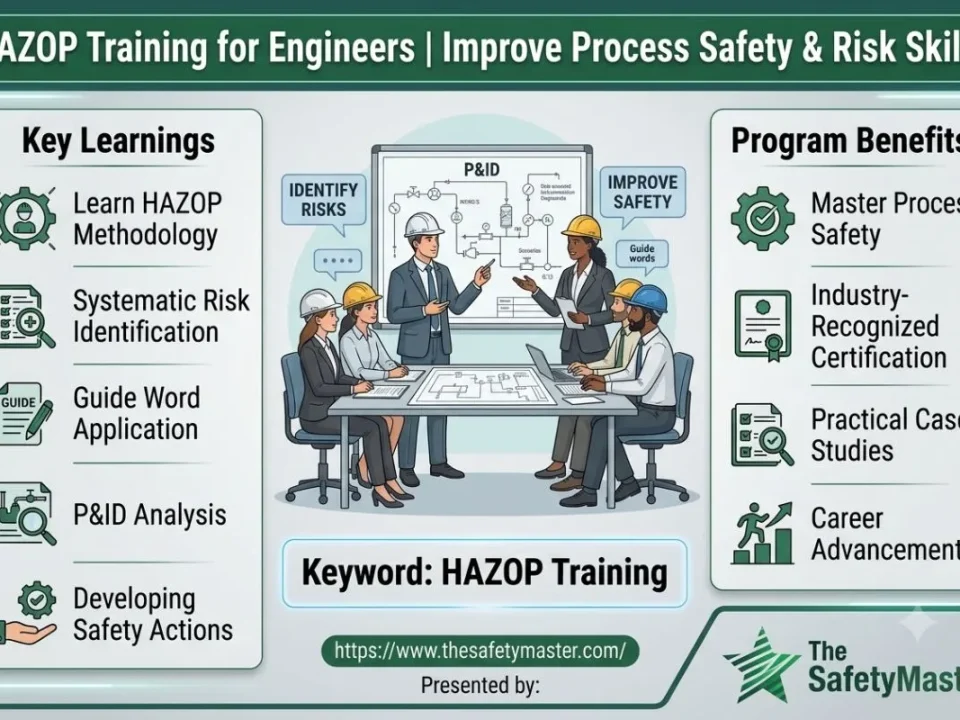
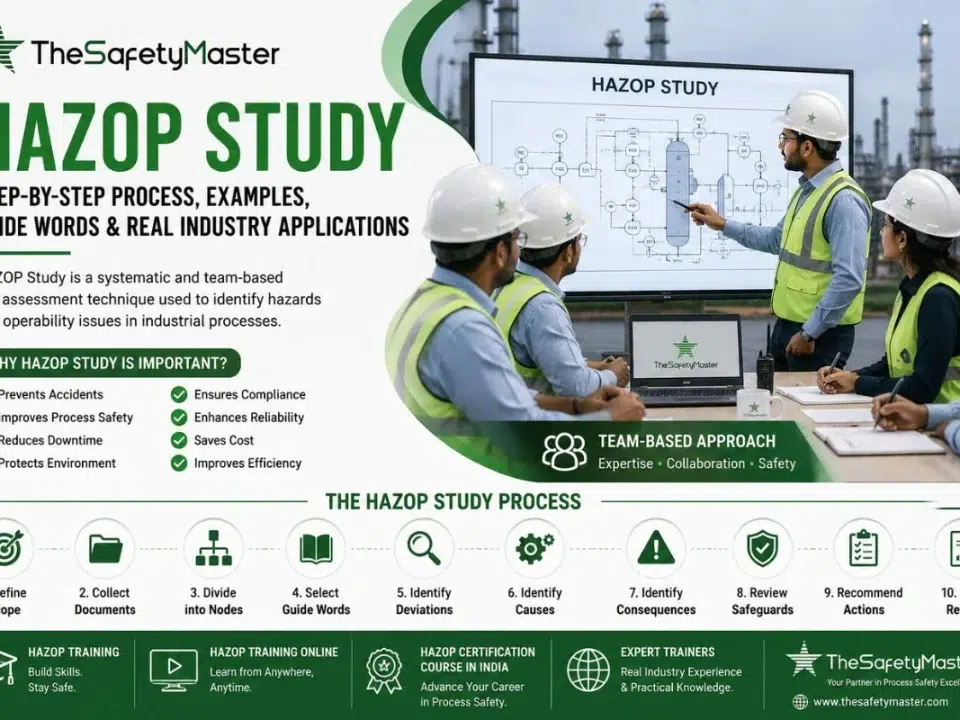
During a HAZOP study, process flow diagrams (PFDs) and Piping and Instrumentation Diagrams (P&IDs) are divided into manageable sections called nodes. A multidisciplinary team led by a trained HAZOP Chairman systematically applies specialized guidewords (e.g., No, More, Less, As Well As, Part Of, Reverse) to process parameters like Flow, Pressure, Temperature, and Level.
Key Steps in a HAZOP Session
- Node Selection: Dividing line sections, reactors, and vessels into distinct units.
- Applying Guidewords: Evaluating parameters (e.g., More Temp in a jacketed reactor).
- Identifying Causes & Consequences: Pinpointing failure points, instrument miscalibrations, or operator errors.
- Evaluating Safeguards: Inspecting existing safety interlocks, relief valves, and emergency shutoff systems.
- Recommending Actions: Recommending engineering or administrative controls where safeguards fall short.
Role of The Safety Master in Executing HAZOP Studies
The Safety Master brings experienced process safety experts to facilitate HAZOP studies tailored to chemical synthesis, pharmaceutical manufacturing, and bulk solvent plants across Jeedimetla, Patancheru, and Sangareddy.
Hazard Identification & Risk Assessment (HIRA)
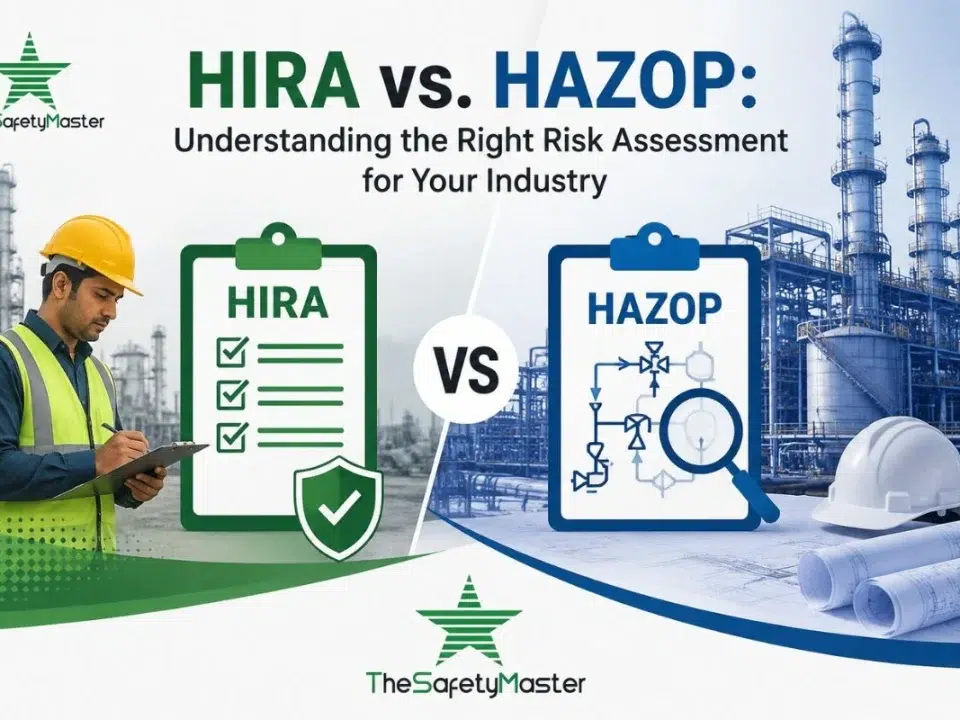
While HAZOP focuses primarily on chemical processes and piping loops, HIRA evaluates general workplace activities, machinery usage, material handling, maintenance work, and plant infrastructure.
┌─────────────────┐ ┌──────────────────┐ ┌──────────────────┐
│ Identify Work │ ──► │ Evaluate Risk │ ──► │ Apply Hierarchy │
│ Tasks & Hazards │ │ Severity x Prob. │ │ of Controls │
└─────────────────┘ └──────────────────┘ └──────────────────┘
The Core Structure of a HIRA Study
HIRA identifies potential physical, chemical, biological, ergonomic, and electrical hazards present across routine and non-routine facility activities.
The 5 Steps of HIRA
- Identify the Hazards: Surveying workplace activities, machinery, chemical handling, and maintenance tasks.
- Determine Who or What Might Be Harmed: Assessing workers, contractors, site visitors, equipment, or nearby community areas.
- Evaluate the Risk: Scoring risk based on likelihood and severity using a standard Risk Matrix.
- Record Findings & Implement Controls: Applying the Hierarchy of Controls to reduce risk levels to As Low As Reasonably Practicable (ALARP).
- Review and Update: Periodically updating the risk register following process modifications, equipment upgrades, or incident events.
Quantitative Risk Assessment (QRA)
When hazards carry potential for high-consequence incidents—such as boiling liquid expanding vapor explosions (BLEVE), toxic gas dispersions, or major pool fires—a qualitative approach alone is insufficient. Quantitative Risk Assessment (QRA) introduces numerical modeling to calculate specific damage distances and risk frequencies.
 Hazard Identification ──► Consequence Modeling (ALOHA/PHAST)
 │
 ▼
 Frequency Analysis ──► Risk Calculation (LSIR / FAR)
 │
 ▼
 ALARP Evaluation
Key Components of QRA
- Consequence Modeling: Simulates toxic plume dispersion, radiant thermal heat flux from fires, and overpressure blast waves using software tools.
- Frequency Analysis: Uses fault tree and event tree methodologies to calculate failure probability rates.
- Risk Representation: Plots Individual Risk (LSIR contours) and Societal Risk (F-N curves) to determine community and plant safety buffers.
Comparison: HAZOP vs. HIRA vs. QRA
| Parameter | HAZOP | HIRA | QRA |
| Primary Focus | Process parameter deviations in P&IDs / piping loops | Workplace activities, physical hazards, task safety | High-consequence accidental events & damage modeling |
| Approach | Qualitative (Guidewords + Nodes) | Qualitative / Semi-Quantitative (Risk Matrix) | Fully Quantitative (Numerical probability & distance modeling) |
| Typical Target | Process design, interlocks, instrumentation | Task activities, maintenance, routine work | Chemical storage tanks, gas pipelines, high-pressure systems |
| Output | Action items, safeguards, interlock recommendations | Risk register, Standard Operating Procedures (SOPs), PPE requirements | Individual Risk Contours (LSIR), F-N curves, thermal radiation limits |
Why Choose The Safety Master for Industrial Risk Studies in Telangana?
Selecting the right process safety consultancy ensures actionable recommendations, clear audit readiness, and seamless plant operations.
- Domain Expertise: Experience in bulk drug manufacturing, API synthesis, chemical distillation, and heavy industrial facilities.
- End-to-End Solutions: Comprehensive service coverage from initial hazard identification to full quantitative modeling and safety audits.
- Regulatory Compliance: Tailored studies aligned with state and national industrial safety standards.
- Customized Execution: On-site and remote risk evaluation options designed for operating facilities in Jeedimetla, Patancheru, and Sangareddy.
Frequently Asked Questions (FAQs)
Q1: What is HAZOP and HIRA?
HAZOP (Hazard and Operability Study) is a systematic, guideword-driven process evaluation method used to identify process deviations in chemical and processing equipment. HIRA (Hazard Identification and Risk Assessment) is a broader risk management tool used to evaluate physical, operational, and workplace task hazards across routine and non-routine facility activities.
Q2: How much is a HIRA certificate?
The cost of a HIRA certification or consultancy report varies based on the facility size, number of operational activities, headcount, and specific risk assessment scope. Professional safety consulting firms like The Safety Master provide tailored proposals following initial site review.
Q3: What is the difference between a HAZOP and a QRA?
A HAZOP is a qualitative group study focused on process deviations, root causes, and interlock safeguards. A QRA (Quantitative Risk Assessment) is a numerical study that models exact thermal heat radiation, overpressure levels, toxic dispersion distances, and loss-of-containment frequencies.
Q4: What are the five steps of hazard identification & risk assessment (HIRA)?
- Identify hazards in the workplace.
- Determine who or what could be harmed and how.
- Evaluate the risk levels and determine appropriate safeguards.
- Document the findings and implement action plans.
- Review and update the assessment periodically.
Q5: What are the 5 pillars of risk assessment?
- Identification: Spotting hazards, process risks, and unsafe conditions.
- Analysis: Determining cause, likelihood, and potential severity.
- Evaluation: Comparing risks against acceptable criteria (ALARP principles).
- Mitigation: Implementing controls following the Hierarchy of Controls.
- Monitoring & Review: Continuously auditing and updating safety parameters.
Q6: How many types of HIRA are there?
There are three primary types of HIRA:
- Baseline HIRA: Comprehensive initial risk assessment covering all site operations.
- Issue-Based HIRA: Conducted for specific equipment additions, modifications, or process changes.
- Continuous HIRA: Ongoing assessments performed before daily work tasks (e.g., job safety analyses, work permits).
Conclusion and Call to Action
Proactive process safety management helps prevent operational disruptions, safeguard personnel, and ensure regulatory compliance. Operating facilities in Jeedimetla, Patancheru, and Sangareddy can strengthen their safety framework by conducting structured HAZOP, HIRA, and QRA assessments.
Contact The Safety Master to schedule an industrial process safety review for your plant.