EHS Audit Checklist: A Complete Guide for Workplace Safety and Compliance

Fire Risks in EV Charging Stations: What Every Facility Must Know
June 8, 2026
Your Fire Extinguisher May Not Be Enough: Preparing for Lithium-Ion Battery Fires in the Workplace
June 17, 2026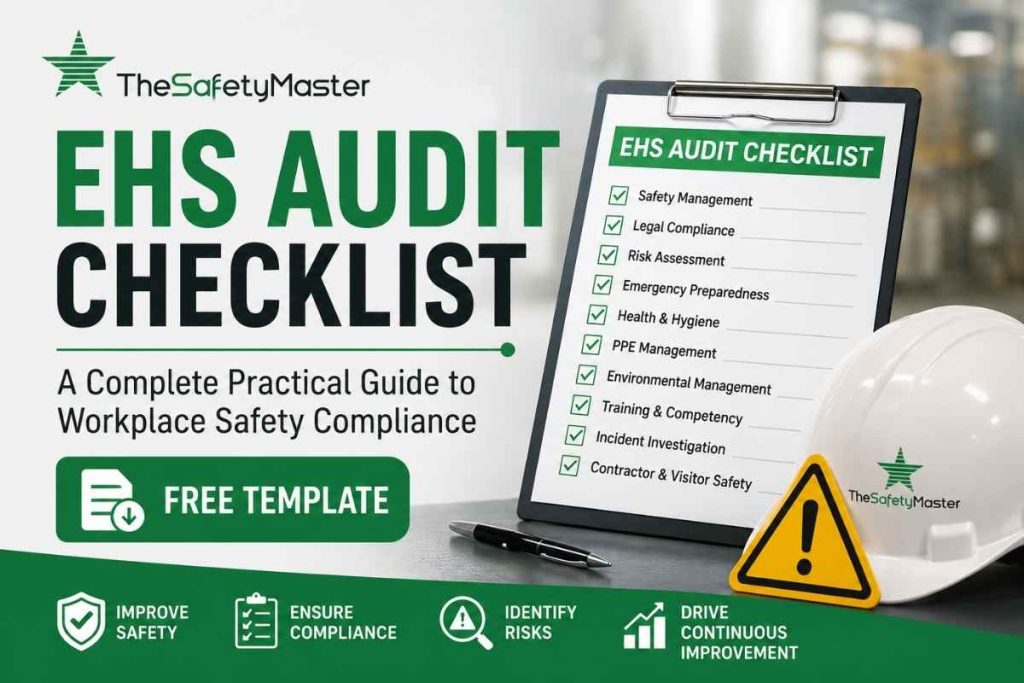
EHS Audit Checklist: A Practical Guide to Safer and Compliant Workplaces
Environmental, Health, and Safety management is an important part of every organization that wants to protect employees, contractors, visitors, property, and the environment. An EHS Audit Checklist provides a structured way to review workplace conditions, identify hazards, check compliance, and monitor corrective actions.
A properly prepared checklist helps safety professionals avoid missing important audit areas. It can be adapted for manufacturing plants, construction sites, warehouses, offices, chemical facilities, process industries, healthcare facilities, and other workplaces.
The Safety Master supports organizations with safety audits, risk assessment, process safety, fire safety, environmental management, and other EHS solutions.
What Is an EHS Audit?
An EHS audit is a systematic review of an organization’s environmental, health, and safety practices. It checks whether workplace activities, procedures, documents, and controls are meeting applicable requirements and internal standards.
An audit can identify:
- Unsafe workplace conditions
- Environmental risks
- Missing or outdated documentation
- Training gaps
- Emergency preparedness issues
- PPE problems
- Regulatory compliance gaps
- Incomplete corrective actions
- Contractor safety issues
The purpose is not only to find non-compliance. A good EHS audit also helps organizations identify risks early and improve their overall safety management system.
Why Is an EHS Audit Checklist Important?
A checklist gives auditors a consistent structure for reviewing different areas of a workplace. It can also make it easier to compare findings between departments, locations, and audit periods.
Important benefits include:
- Better hazard identification
- Improved compliance monitoring
- Consistent audit processes
- Better documentation
- Improved employee safety awareness
- Easier corrective action tracking
- Better emergency preparedness
- Stronger environmental controls
- Continuous safety improvement
A checklist should not be treated as a simple form. It should reflect the actual hazards, activities, equipment, processes, and legal requirements of the workplace.
Main Areas Covered in an EHS Audit Checklist
1. Safety Management System
The first section should examine the organization’s overall safety management system.
Check whether the workplace has:
- A documented safety policy
- Clearly defined safety objectives
- Assigned safety responsibilities
- Management involvement
- Safety procedures
- Incident reporting arrangements
- Periodic safety reviews
A strong management system provides the foundation for other EHS activities.
2. Legal and Regulatory Compliance
Legal compliance is an important part of an EHS audit.
The auditor can review:
- Applicable licenses and permits
- Statutory records
- Inspection certificates
- Compliance documents
- Environmental approvals
- Safety certifications
- Required registers and records
Requirements should be checked according to the organization’s location, industry, activities, and applicable legislation.
3. Hazard Identification and Risk Assessment
Hazard identification should be a major part of every EHS Audit Checklist.
The audit can review:
- HIRA records
- Hazard registers
- Risk assessments
- Control measures
- High-risk activities
- Periodic risk reviews
- Implementation of recommended controls
The auditor should compare documented risk assessments with actual workplace conditions. This helps identify situations where controls exist on paper but are not effectively implemented.
4. Emergency Preparedness
Emergency preparedness is essential for reducing the impact of fires, chemical releases, accidents, natural events, and other emergencies.
The checklist should review:
- Emergency response plans
- Evacuation procedures
- Emergency exits
- Assembly points
- Firefighting equipment
- Emergency contact information
- Mock drill records
- Emergency response training
Organizations with significant fire hazards may also require dedicated fire safety audits to evaluate fire protection and emergency arrangements.
5. Workplace Health and Hygiene
An EHS audit should also examine occupational health conditions.
Important points include:
- Drinking water
- Sanitation
- Ventilation
- Workplace cleanliness
- Occupational health monitoring
- Medical examination records
- Noise exposure
- Indoor air quality
- Exposure to workplace hazards
The exact requirements will depend on the type of workplace and potential employee exposures.
Personal Protective Equipment Audit
PPE is an important workplace control, but simply providing PPE does not guarantee effective protection.
The EHS Audit Checklist should verify:
- Appropriate PPE availability
- Correct PPE selection
- PPE condition
- Proper storage
- Employee training
- PPE usage
- Replacement procedures
- Supervisor monitoring
Auditors should also observe whether employees actually use the required PPE during their normal activities.
Environmental Management Checklist
Environmental performance should be reviewed alongside workplace health and safety.
An environmental section may include:
- Waste management
- Hazardous waste handling
- Waste segregation
- Air emission controls
- Water management
- Spill prevention
- Chemical storage
- Environmental monitoring
- Disposal records
- Environmental documentation
The checklist should be customized according to the organization’s environmental aspects and activities.
Training and Competency Verification
Employees need appropriate knowledge and skills to perform their jobs safely.
An EHS audit can verify:
- Safety induction records
- Job-specific training
- Refresher training
- Emergency training
- PPE training
- Contractor training
- Competency assessments
- Training attendance records
Training records should also be compared with actual employee responsibilities to identify competency gaps.
Incident Investigation and Corrective Actions
An effective EHS program should learn from incidents, near misses, and unsafe conditions.
Review:
- Incident reporting
- Near-miss reporting
- Investigation procedures
- Root cause analysis
- Corrective actions
- Action owners
- Target completion dates
- Closure verification
- Lessons learned
Finding a problem is only one part of an audit. Corrective actions should be tracked until they are completed and verified.
Contractor and Visitor Safety
Contractors and visitors may face different risks from permanent employees.
The checklist should examine:
- Contractor selection
- Safety induction
- Contractor training
- Permit-to-work systems
- Contractor safety evaluations
- Visitor registration
- Access control
- Site safety rules
- Emergency arrangements
Contractor activities should be included in the audit instead of focusing only on employees.
Simple EHS Audit Checklist Format
A basic checklist can use the following structure:
| Audit Area | Yes | No | Observation |
|---|---|---|---|
| Safety policy available | ✓ | ||
| Risk assessment completed | ✓ | ||
| Emergency procedures available | ✓ | ||
| Fire equipment inspected | ✓ | ||
| PPE available and used | ✓ | ||
| Employee training completed | ✓ | ||
| Incident reporting system available | ✓ | ||
| Waste management controls implemented | ✓ | ||
| Emergency drills conducted | ✓ | ||
| Corrective actions closed | ✓ |
This basic format can be expanded according to industry-specific risks and compliance requirements.
Common EHS Audit Mistakes
Even when organizations conduct regular audits, some common problems can reduce their effectiveness.
Using an Outdated Checklist
Workplaces change over time. New equipment, chemicals, processes, contractors, and regulations may create new risks.
Focusing Only on Documents
Documents are important, but auditors should also inspect actual workplace conditions and observe work practices.
Ignoring Employee Feedback
Employees often understand practical workplace risks because they perform the tasks every day. Their observations can provide valuable audit information.
Not Following Up on Findings
An audit report has limited value if corrective actions remain open for long periods.
Using a Generic Checklist
A checklist should be customized to the organization’s activities, hazards, processes, and applicable requirements.
Best Practices for an Effective EHS Audit
For better audit results:
- Define the audit scope clearly.
- Customize the checklist for the workplace.
- Review previous audit findings.
- Inspect actual working conditions.
- Speak with employees and supervisors.
- Prioritize high-risk findings.
- Identify root causes.
- Assign corrective actions to responsible persons.
- Set realistic completion dates.
- Verify corrective action closure.
- Monitor recurring findings.
- Conduct follow-up audits.
The Safety Master also provides safety audit solutions that can support systematic workplace inspections and corrective action management.
EHS Audit Checklist and Digital Safety Audits
Organizations managing multiple departments or locations may find manual spreadsheets difficult to maintain. Digital safety audit systems can help centralize checklists, observations, evidence, corrective actions, reports, and audit records.
A digital approach can support:
- Digital audit checklists
- Audit assignment
- Observation recording
- Evidence uploading
- Corrective action tracking
- Action status monitoring
- Audit reports
- Safety performance analysis
This can make the audit process more organized and improve visibility of outstanding actions.
Conclusion
An EHS Audit Checklist provides a practical framework for reviewing workplace safety, environmental performance, occupational health, emergency preparedness, training, PPE, risk assessment, contractor management, and corrective actions.
The most effective audit is not simply a checklist exercise. It combines document review, workplace inspection, employee involvement, hazard identification, compliance verification, and corrective action follow-up.
With a structured and workplace-specific approach, The Safety Master helps organizations strengthen EHS practices, identify potential risks, and support continuous improvement.
FAQs
1. What is an EHS Audit Checklist?
An EHS Audit Checklist is a structured list of questions and inspection points used to assess environmental, health, and safety conditions, procedures, documentation, and compliance within a workplace.
2. What should an EHS Audit Checklist include?
It can include safety management, legal compliance, hazard identification, risk assessment, emergency preparedness, PPE, occupational health, environmental management, training, incident investigation, and contractor safety.
3. Why is an EHS audit important?
An EHS audit helps identify workplace hazards, compliance gaps, unsafe practices, environmental risks, and weaknesses in safety controls. It also supports corrective actions and continuous improvement.
4. Can an EHS Audit Checklist be customized?
Yes. A checklist should ideally be customized according to the organization’s industry, workplace activities, hazards, processes, equipment, environmental aspects, and applicable requirements.
5. Can EHS audits be managed digitally?
Yes. Digital safety audit systems can help organizations create checklists, record findings, upload evidence, assign corrective actions, monitor closure, and generate audit reports.