Fire Risks in EV Charging Stations: What Every Facility Must Know

Reducing Unsafe Acts Through Effective Behavior-Based Safety Management Strategies
June 6, 2026
EHS Audit Checklist: A Complete Guide for Workplace Safety and Compliance
June 11, 2026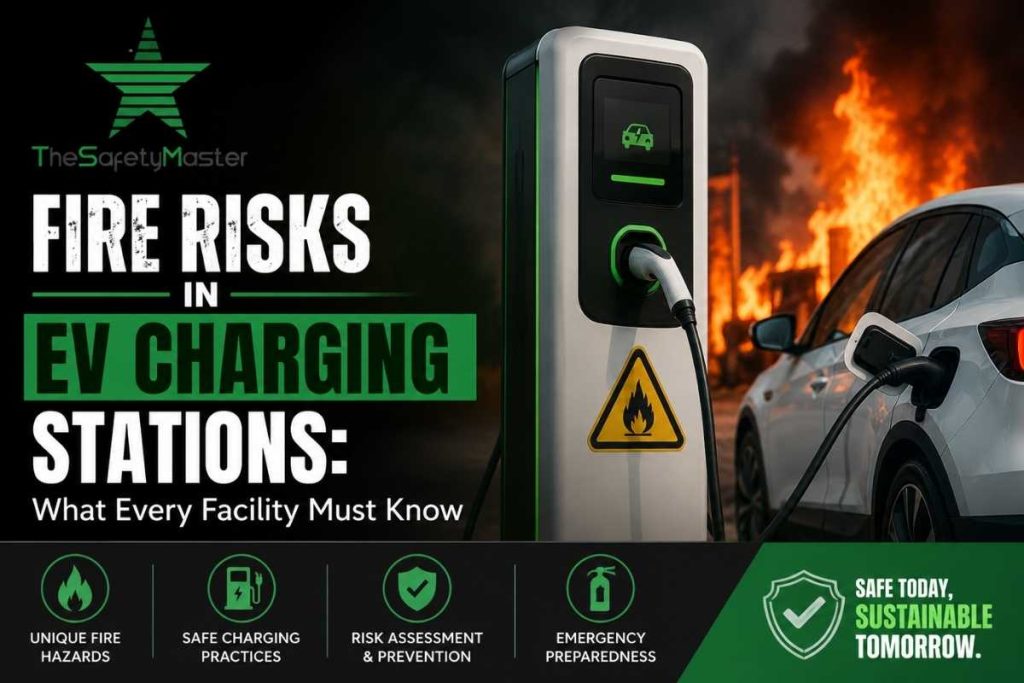
As electric vehicles (EVs) become increasingly common across India, the demand for EV charging infrastructure is growing at an unprecedented pace. From shopping malls and office complexes to residential societies and highway rest stops, charging stations are becoming a standard feature of modern facilities.
While this transition supports cleaner transportation, it also introduces a new set of fire safety challenges that many organizations are still learning to manage. Unlike conventional fuel-related fires, EV battery fires can behave differently, spread rapidly, and require specialized emergency response measures.
For facility owners, safety professionals, and business leaders, understanding these risks is no longer optional. It is an essential part of ensuring safe operations, protecting assets, and safeguarding lives.
Why EV Charging Stations Present Unique Fire Risks
An EV charging station is more than just a power outlet. It is a complex system involving high-voltage electrical equipment, charging infrastructure, communication systems, and lithium-ion batteries.
While EVs are generally considered safe, incidents involving charging equipment, battery defects, improper installations, or electrical faults can lead to serious fire hazards.
Some common risk factors include:
- Overheating of charging equipment
- Faulty electrical connections
- Battery thermal runaway
- Poor ventilation in charging areas
- Use of non-certified chargers
- Inadequate maintenance practices
- Overloaded electrical systems
- Water ingress and environmental damage
The challenge is that lithium-ion battery fires often behave differently from conventional fires. Once thermal runaway begins, the battery can generate intense heat, release toxic gases, and reignite even after the visible flames appear extinguished.
Understanding Thermal Runaway
One of the most critical concepts in EV fire safety is thermal runaway.
Thermal runaway occurs when a battery cell experiences an uncontrolled increase in temperature. This heat spreads to neighboring cells, creating a chain reaction that can result in fire, explosion, or toxic gas release.
The process can be triggered by:
- Manufacturing defects
- Physical damage
- Overcharging
- Internal short circuits
- Exposure to excessive heat
- Electrical faults during charging
What makes thermal runaway particularly dangerous is its speed. Once initiated, intervention opportunities become limited, making prevention and early detection essential.
Real Example: EV Scooter Fire Incidents in India
India witnessed several EV fire incidents during 2022 that attracted national attention.
One of the most widely reported incidents involved electric scooters manufactured by Ola Electric. Multiple scooter fire incidents led to investigations and vehicle recalls across the country.
Similarly, incidents involving vehicles from Pure EV and Jitendra EV raised concerns regarding battery safety and thermal management systems.
These incidents highlighted a critical lesson: even when vehicles meet regulatory requirements, battery safety remains a complex engineering challenge requiring continuous monitoring and risk management.
Although many of these events occurred while vehicles were parked or charging, they demonstrated how rapidly lithium-ion battery fires can escalate.
Real Example: Fire at an EV Bus Depot in India
Large-scale charging facilities face even greater challenges.
Several EV bus depots across India have implemented extensive charging infrastructure to support electric public transportation fleets. Industry experts have repeatedly emphasized the importance of electrical load assessments, fire detection systems, thermal monitoring, and emergency response planning in these facilities.
A single battery incident involving a bus can potentially impact multiple vehicles parked nearby, increasing the severity of the event and complicating emergency response efforts.
This is why EV depots require risk assessments that go beyond traditional electrical safety reviews.
Common Fire Hazards at EV Charging Stations
Improper Electrical Design
Many facilities install charging stations without fully evaluating the capacity of their existing electrical infrastructure.
Undersized cables, overloaded transformers, and inadequate circuit protection can create overheating conditions that increase fire risk.
Lack of Preventive Maintenance
Charging equipment operates under significant electrical loads. Without routine inspections, minor defects can develop into major failures.
Loose connections, damaged cables, and degraded insulation are frequently identified during safety inspections.
Inadequate Separation Distances
Parking multiple EVs too closely together can allow fire to spread from one vehicle to another.
Appropriate spacing and compartmentalization become increasingly important in fleet charging facilities.
Poor Ventilation
Charging areas located in enclosed basements or poorly ventilated spaces may experience heat accumulation and gas concentration issues during battery failures.
Proper ventilation design helps reduce these risks.
Unauthorized Modifications
Using uncertified chargers, adapters, or modified charging systems significantly increases the likelihood of electrical failures.
Facilities should only use approved equipment from reputable manufacturers.
What Facility Owners Should Evaluate
Facility managers often focus on installing charging infrastructure quickly to meet market demand. However, fire safety considerations should be integrated from the planning stage.
Key questions include:
- Is the electrical infrastructure designed for projected charging loads?
- Are charging stations protected against overcurrent and short circuits?
- Is there continuous monitoring of charger performance?
- Are emergency shutdown systems available?
- Have emergency responders been trained for EV-related incidents?
- Are thermal imaging inspections conducted regularly?
- Is battery fire response included in emergency planning?
Addressing these questions early can significantly reduce operational risks.
The Role of Fire Detection and Suppression Systems
Traditional fire protection systems remain important but may not always be sufficient for lithium-ion battery incidents.
Modern EV charging facilities increasingly use:
- Advanced smoke detection systems
- Thermal monitoring cameras
- Gas detection sensors
- Automatic alarm systems
- Water-based cooling strategies
- Emergency isolation systems
Early detection is often the most effective defense against escalation.
Why Risk Assessments Matter
Every charging station operates within a unique environment. A charging facility in a shopping mall faces different risks than a fleet depot, manufacturing plant, or residential complex.
This is why structured assessments are critical.
A comprehensive Fire Audit helps identify potential ignition sources, evaluate emergency preparedness, and verify the effectiveness of fire protection systems.
Similarly, a detailed Safety Audit can uncover broader operational risks associated with charging infrastructure, electrical systems, and workplace practices.
For large industrial facilities and high-risk operations, integrating EV charging risks into a formal Process Safety Management framework can provide an additional layer of protection by ensuring hazards are systematically identified, analyzed, and controlled.
Emergency Response Planning for EV Fires
One of the biggest mistakes organizations make is assuming that conventional fire emergency procedures are sufficient for EV incidents.
Emergency plans should specifically address:
- EV battery fire scenarios
- Isolation procedures
- Evacuation routes
- Emergency shutdown protocols
- Coordination with local fire departments
- Post-fire monitoring requirements
- Re-ignition risks
Training employees on these procedures is equally important.
The Future of EV Charging Safety
India’s EV market is expected to expand significantly over the coming decade. As charging infrastructure becomes more widespread, regulators, manufacturers, facility owners, and safety professionals must work together to address emerging fire risks.
Advancements in battery chemistry, smart charging systems, thermal monitoring technologies, and predictive maintenance tools are already helping improve safety performance.
However, technology alone cannot eliminate risk. Effective planning, engineering controls, regular inspections, and strong safety management practices remain essential.
Conclusion
EV charging stations are playing a vital role in India’s transition toward sustainable mobility. Yet the rapid growth of charging infrastructure brings new fire safety challenges that cannot be overlooked.
From thermal runaway and electrical faults to charging equipment failures and emergency response complexities, facility owners must understand the unique hazards associated with EV charging operations.
The incidents reported across India’s EV sector serve as important reminders that safety must evolve alongside technology. Organizations that proactively assess risks, maintain infrastructure, and strengthen emergency preparedness will be far better positioned to support the future of electric mobility safely and responsibly.