Industrial Fire Safety Audit: A Technical Framework for Identifying Critical Fire Risks

Complete Guide to HIRA Risk Assessment: Process, Examples & Safety Controls
September 3, 2026
Fire Risk Assessment in Chemical Plants: Identifying, Evaluating and Controlling Fire Hazards
September 7, 2026
Industrial facilities face complex fire hazards due to combustible materials, flammable liquids and gases, electrical systems, hot work, process equipment, storage areas, and human factors. A systematic Fire Safety Audit helps organizations identify these hazards, evaluate the effectiveness of existing fire protection measures, and reduce the possibility of fire-related losses.
For industrial organizations, a fire audit should go beyond checking fire extinguishers and emergency exits. It should technically evaluate fire prevention systems, detection and alarm systems, firefighting arrangements, emergency preparedness, electrical safety, hazardous material storage, housekeeping, and compliance requirements.
The Safety Master provides professional safety and risk-management solutions that can help industries develop a structured approach to fire risk identification and control.
What Is a Fire Audit?
Fire Audit Meaning
A fire audit is a systematic examination of a facility’s fire hazards, fire prevention measures, fire protection systems, emergency arrangements, and compliance practices.
The objective is to determine whether the facility has adequate controls to prevent fire, detect a fire at an early stage, control its development, and safely evacuate people.
A professional fire audit normally evaluates:
- Fire hazards and ignition sources
- Electrical installations
- Fire detection and alarm systems
- Fire extinguishers
- Hydrant and sprinkler systems
- Fire pumps and water supply
- Emergency exits and escape routes
- Emergency lighting and signage
- Flammable and combustible material storage
- Hot work activities
- Housekeeping
- Emergency response procedures
- Fire training and drills
- Inspection and maintenance records
Why Is a Fire Safety Audit Important for Industry?
Industrial facilities can contain multiple interconnected fire hazards. A small ignition source can potentially develop into a major incident when combustible materials, process conditions, or inadequate fire protection systems are present.
A fire audit helps management:
- Identify critical fire hazards
- Evaluate existing controls
- Detect gaps in fire protection systems
- Improve emergency preparedness
- Reduce fire-related business interruption
- Protect employees, assets, and infrastructure
- Support regulatory and insurance requirements
- Prioritize corrective actions
Industrial Fire Risk: What Should an Audit Identify?
Electrical Fire Hazards
Electrical systems are among the important areas to examine during an industrial fire audit.
The assessment should consider:
- Overloaded circuits
- Damaged cables
- Loose electrical connections
- Improper earthing
- Faulty electrical panels
- Inadequate protection devices
- Temporary electrical connections
- Electrical equipment installed in hazardous areas
Electrical Panel Inspection
Auditors should examine the condition, accessibility, identification, protection, ventilation, and housekeeping around electrical panels.
Thermal imaging, where appropriate, can also help identify abnormal heating that may indicate electrical problems.
Flammable and Combustible Materials
Industrial facilities should assess how flammable liquids, gases, chemicals, packaging materials, waste, and other combustibles are stored and handled.
The audit should review:
- Storage quantities
- Container condition
- Segregation
- Ventilation
- Ignition-source control
- Spill control
- Safety signage
- Fire protection provisions
Hot Work and Ignition Sources
Welding, cutting, grinding, brazing, and other hot work can introduce ignition sources into areas containing combustible or flammable materials.
A technical audit should review the hot-work permit system, gas-cylinder management, combustible-material removal, fire watch arrangements, and post-work monitoring.
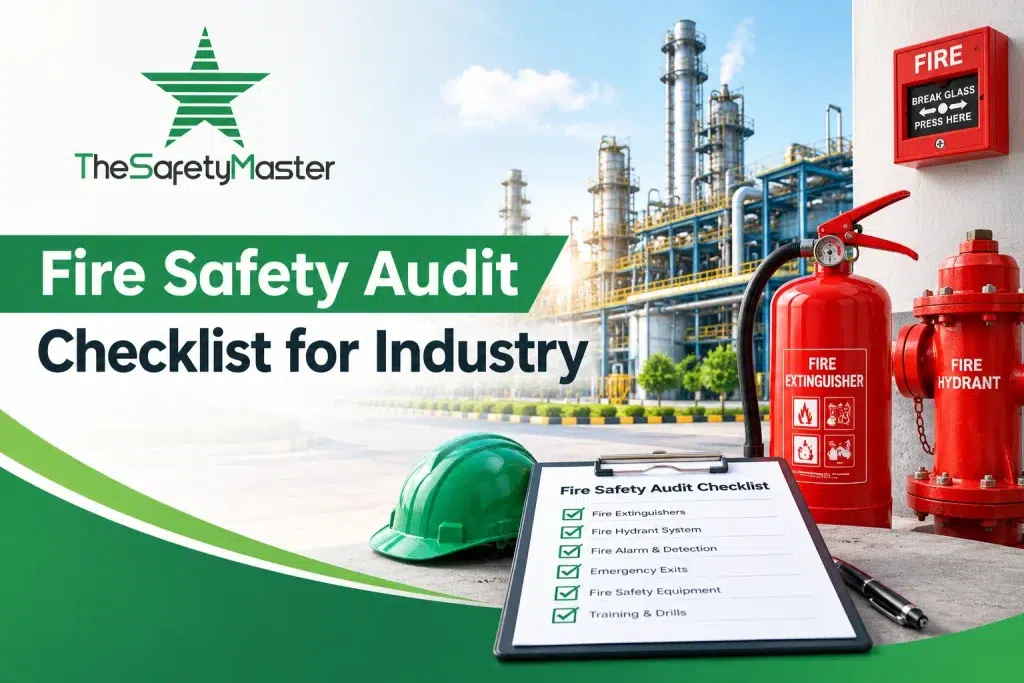
Fire Safety Audit Checklist for Industry
A fire safety audit checklist for industry should cover both passive and active fire protection systems.
1. Building and Occupancy
Check:
- Building construction and fire-resistant elements
- Fire compartments
- Fire doors
- Emergency exits
- Stairways
- Escape routes
- Exit signage
- Emergency lighting
- Access for emergency responders
2. Fire Detection and Alarm Systems
Verify:
- Smoke detectors
- Heat detectors
- Manual call points
- Fire alarm panels
- Audible and visual alarms
- Detector coverage
- Testing and maintenance records
- Alarm audibility in critical areas
3. Fire Extinguishers
Inspect:
- Correct extinguisher type
- Location and accessibility
- Identification signage
- Pressure condition
- Physical condition
- Inspection tags
- Maintenance records
- Suitability for the identified fire class
4. Hydrant and Sprinkler Systems
Review:
- Hydrant network
- Hose reels
- Sprinkler coverage
- Valves
- Fire pumps
- Jockey pump
- Diesel/electric pump arrangements
- Water storage
- Pressure
- Pump testing records
5. Emergency Preparedness
Check:
- Emergency response plan
- Evacuation procedures
- Assembly points
- Fire drills
- Emergency contact information
- Trained emergency response teams
- Communication arrangements
- Rescue arrangements
6. Housekeeping
Evaluate:
- Accumulation of combustible waste
- Oil and chemical spills
- Storage practices
- Waste disposal
- Access to firefighting equipment
- Clearance around electrical panels
- Clearance around emergency exits
Fire Audit Checklist: How to Conduct a Technical Inspection
A fire audit checklist should be used as a structured inspection tool rather than simply as a formality.
Step 1: Define the Audit Scope
Identify the areas, buildings, processes, equipment, and activities that will be assessed.
Step 2: Review Existing Documentation
Review available:
- Fire system drawings
- Emergency plans
- Inspection records
- Maintenance reports
- Fire drill records
- Previous audit reports
- Incident and near-miss records
- Statutory approvals and certificates
Step 3: Conduct a Site Inspection
Inspect the facility physically and identify actual conditions that may not appear in documentation.
Step 4: Identify and Classify Risks
Fire hazards can be categorized according to their likelihood, potential consequence, and existing controls.
Step 5: Evaluate Fire Protection Systems
Assess whether detection, alarm, suppression, firefighting equipment, evacuation systems, and emergency response arrangements are adequate for the facility’s hazards.
Step 6: Prepare Corrective Actions
Each significant finding should have:
- Finding description
- Risk significance
- Recommended action
- Responsible department
- Target completion date
- Verification status
Fire Safety Audit Scope of Work
The fire safety audit scope of work should be established before beginning the assessment.
Depending on the facility, the scope may include:
Physical Infrastructure
- Manufacturing buildings
- Warehouses
- Utility areas
- Offices
- Laboratories
- Workshops
- Electrical rooms
- Control rooms
- Tank farms
- Loading and unloading areas
Fire Protection Systems
- Fire detection
- Fire alarm
- Fire extinguishers
- Hydrants
- Hose reels
- Sprinklers
- Fire pumps
- Fire-water storage
- Special suppression systems
Fire Prevention Controls
- Electrical safety
- Hot work
- Smoking controls
- Flammable-material management
- Chemical storage
- Housekeeping
- Ignition-source control
Emergency Management
- Emergency response plan
- Evacuation
- Fire drills
- Emergency communication
- Fire team competency
- Assembly points
The exact scope should be customized according to the facility’s processes, hazards, size, occupancy, and applicable requirements.
How to Prepare a Fire Audit Report
A professional fire audit report should clearly communicate the condition of the facility and the actions required to reduce risk.
Recommended Fire Audit Report Structure
- Executive summary
- Audit objectives
- Audit scope
- Facility information
- Methodology
- Applicable requirements
- Observations
- Fire-risk findings
- Photographic evidence
- Risk classification
- Recommended corrective actions
- Priority ranking
- Conclusion
- Action-tracking table
Risk-Based Findings
Findings can be prioritized according to their potential impact and urgency.
For example:
- Critical: Immediate attention required
- High: Corrective action should be prioritized
- Medium: Action required within a defined timeframe
- Low: Improvement recommended
The classification method should be clearly defined and consistently applied.
Fire Safety Audit PDF and Checklist Resources
Organizations often search for a Fire safety Audit PDF, Fire safety audit Checklist PDF, or downloadable Fire audit checklist when preparing for an inspection.
A PDF checklist can be useful for:
- Pre-audit preparation
- Internal inspections
- Contractor assessments
- Fire equipment verification
- Corrective-action tracking
- Periodic safety reviews
However, a generic checklist should not replace a site-specific technical assessment. Industrial facilities have different processes and hazards, so the audit criteria should be adapted to the actual risk profile.
Fire Audit in Bihar and Other Indian States
A Fire audit Bihar requirement or assessment should be considered in the context of the applicable state fire-safety framework, building requirements, occupancy type, and local authority requirements.
Organizations operating in Bihar or any other Indian state should verify the latest requirements applicable to their specific facility rather than relying on an outdated checklist.
For multi-location organizations, the audit methodology can be standardized while allowing state-specific compliance requirements to be incorporated into each site assessment.
Common Fire Safety Audit Findings
Industrial fire audits frequently identify gaps such as:
Inadequate Fire Equipment Accessibility
Fire extinguishers, hydrants, or other firefighting equipment may be blocked, poorly identified, incorrectly positioned, or difficult to access.
Poor Housekeeping
Combustible waste, packaging materials, oily materials, and other unnecessary combustibles can increase fire severity.
Inadequate Emergency Exits
Blocked escape routes, locked exits, missing signage, or inadequate emergency lighting can delay evacuation.
Weak Hot-Work Controls
Failure to properly control welding, cutting, grinding, and other hot-work activities can create significant ignition risks.
Poor Maintenance of Fire Protection Systems
Fire pumps, alarms, detectors, hydrants, sprinklers, and extinguishers require appropriate inspection, testing, and maintenance.
How to Improve Industrial Fire Safety After an Audit
Completing an audit is only the beginning. The organization should establish a corrective-action process.
Develop an Action Plan
Prioritize findings based on risk and assign responsibility to specific departments.
Conduct Periodic Inspections
Fire safety conditions can change because of process modifications, new equipment, construction, storage changes, or organizational changes.
Train Employees
Employees should understand:
- Fire prevention
- Alarm response
- Emergency evacuation
- Extinguisher use where appropriate
- Emergency communication
- Assembly-point procedures
Conduct Fire Drills
Drills help evaluate whether employees understand emergency procedures and whether the response plan works under realistic conditions.
Maintain Fire Protection Systems
Preventive maintenance should be planned and documented for fire alarms, extinguishers, pumps, hydrants, sprinklers, emergency lighting, and other relevant systems.
Why Choose The Safety Master for Fire Safety Audit?
A technically effective audit requires more than completing a checklist. It requires understanding the facility’s processes, hazards, fire protection systems, emergency arrangements, and risk profile.
The Safety Master can support organizations with structured safety and risk-management services designed around their operational requirements.
A professional audit approach can help organizations move from simply identifying deficiencies to developing practical corrective actions that strengthen overall fire risk management.
Conclusion
An industrial Fire Safety Audit is an important tool for identifying fire hazards, evaluating existing protection systems, and strengthening emergency preparedness. A properly designed audit examines electrical systems, combustible and flammable materials, hot work, fire detection, firefighting systems, evacuation arrangements, housekeeping, training, and maintenance.
Using a structured fire safety audit checklist for industry can improve consistency, but the assessment should always be adapted to the facility’s specific hazards and applicable requirements. A detailed fire audit report should then convert observations into prioritized corrective actions.
For industries seeking a systematic approach to fire-risk identification and improvement, The Safety Master can help develop practical safety solutions aligned with industrial requirements.
Frequently Asked Questions
Q-What is a Fire Safety Audit?
A Fire Safety Audit is a systematic assessment of fire hazards, fire prevention measures, fire protection systems, emergency arrangements, and related safety practices within a facility.
Q-What is the Fire Audit Meaning?
The meaning of a fire audit is the systematic inspection and evaluation of a facility to identify fire hazards, assess existing controls, and recommend measures to improve fire safety.
Q-What should a fire audit checklist include?
A fire audit checklist should generally include building safety, emergency exits, electrical systems, fire extinguishers, fire alarms, hydrants, sprinklers, fire pumps, emergency lighting, housekeeping, flammable-material storage, hot work, training, drills, and maintenance records.
Q-What is included in a fire safety audit checklist for industry?
An industrial checklist normally covers passive fire protection, active firefighting systems, electrical hazards, process-related fire hazards, combustible materials, emergency response, evacuation, housekeeping, training, and maintenance.
Q-What is a Fire Safety Audit PDF?
A Fire Safety Audit PDF is typically a digital document containing audit criteria, inspection questions, checklists, or reporting formats used to assess fire-safety conditions.
Q-Can a Fire Safety Audit Checklist PDF be used for every industry?
A generic checklist can provide a starting point, but it should be customized according to the industry’s processes, materials, building characteristics, fire hazards, and applicable requirements.
Q-What should a fire audit report contain?
A fire audit report should generally include the audit scope, methodology, observations, identified risks, photographs or supporting evidence, risk priorities, recommendations, and corrective-action requirements.
Q-What is covered under a Fire Safety Audit scope of work?
The scope may cover buildings, manufacturing areas, warehouses, electrical rooms, fire detection and alarm systems, extinguishers, hydrants, sprinklers, fire pumps, emergency exits, hot work, chemical storage, housekeeping, training, drills, and emergency response.
Q-Is Fire Safety Audit required in Bihar?
Requirements can vary according to the facility, occupancy, applicable regulations, and local authority requirements. Organizations in Bihar should verify the current requirements applicable to their specific premises.
Q-How often should an industrial fire safety audit be conducted?
The frequency should be determined based on applicable requirements, facility risk, changes in processes or infrastructure, previous findings, incident history, and the organization’s internal safety-management program.
Q-What is the difference between a fire inspection and a fire audit?
A fire inspection generally focuses on checking specific conditions or equipment, while a fire audit is broader and evaluates fire hazards, prevention, protection systems, emergency preparedness, management controls, and corrective actions.