HAZOP Safety Audit: Complete Guide to Hazard Identification and Process Safety

Electrical Safety Audit – The Safety Master
March 28, 2024
ISO45001 or ISO14001 System Implementation – The Safety Master
April 9, 2024
A HAZOP Safety Audit is a systematic approach used to identify process hazards, evaluate operational risks, and check whether adequate safety controls are in place. HAZOP, or Hazard and Operability Study, is widely used in chemical, oil and gas, pharmaceutical, petrochemical, power, and other process industries where deviations from normal operating conditions can create serious consequences.
A properly conducted HAZOP Safety Audit helps organizations identify weaknesses in process design, operating procedures, safety systems, maintenance practices, and risk controls. The Safety Master provides professional process safety and risk-management solutions to help industries improve their safety performance and reduce major accident risks.
What Is a HAZOP Safety Audit?
A HAZOP Safety Audit combines the systematic principles of HAZOP with an audit-based review of process safety arrangements. The objective is to identify potential deviations from intended process conditions and determine whether existing safeguards are adequate.
A typical assessment may examine:
- Process design and operating conditions
- P&IDs and process documentation
- Equipment and instrumentation
- Operating procedures
- Safety instrumented systems
- Emergency shutdown systems
- Alarms and interlocks
- Pressure relief systems
- Maintenance practices
- Management of Change
- Emergency response arrangements
- Previous HAZOP recommendations
- Corrective-action implementation
The main purpose is to identify hazards before they develop into major incidents.
Why Is a HAZOP Safety Audit Important?
Process industries can involve hazardous chemicals, high pressure, high temperature, flammable materials, and complex equipment. A small process deviation can sometimes result in fire, explosion, toxic release, equipment damage, or production interruption.
A HAZOP Safety Audit helps organizations take a proactive approach to these risks.
Major Benefits of a HAZOP Safety Audit
1. Identifies Process Hazards
The audit helps identify deviations such as high pressure, low flow, reverse flow, high temperature, contamination, or loss of utilities.
2. Improves Existing Safeguards
It evaluates whether alarms, interlocks, relief devices, procedures, and other protection layers are suitable for identified hazards.
3. Reduces Major Accident Risk
Early identification of weaknesses can help organizations reduce the likelihood and potential consequences of fires, explosions, toxic releases, and other major events.
4. Supports Process Safety Compliance
A structured audit can help organizations review their process safety arrangements against applicable regulatory requirements, standards, and internal procedures.
5. Strengthens Safety Culture
Regular reviews encourage employees, engineers, and management to actively participate in identifying and controlling process hazards.
HAZOP Study vs HAZOP Safety Audit
Although the terms are related, a HAZOP study and HAZOP Safety Audit are not exactly the same.
A HAZOP study is primarily a structured hazard identification technique. A multidisciplinary team examines process nodes using guide words to identify possible deviations and their consequences.
A HAZOP Safety Audit can go further by reviewing whether identified HAZOP recommendations, safeguards, procedures, and process safety controls are actually implemented and maintained.
| HAZOP Study | HAZOP Safety Audit |
|---|---|
| Identifies process deviations | Reviews process safety performance |
| Uses guide words | Reviews controls and implementation |
| Focuses on process hazards | Can include documentation and field verification |
| Generates recommendations | Checks corrective-action implementation |
| Usually team-based | Can involve document and site audits |
Both activities can complement each other within a strong process safety management system.
Key Elements of a HAZOP Safety Audit
Process Safety Information
The audit should verify whether important process information is current and available. This can include process flow diagrams, P&IDs, chemical information, operating limits, equipment specifications, and safety-system information.
Process Hazard Analysis
The organization should review whether appropriate hazard identification studies have been completed and whether recommendations have been properly documented.
Operating Procedures
Operating procedures should clearly cover normal operations as well as startup, shutdown, emergency conditions, abnormal operations, and maintenance activities.
Safety Instrumented Systems
Safety-critical instrumentation, alarms, interlocks, trips, and emergency shutdown systems should be appropriately identified, maintained, tested, and documented.
Mechanical Integrity
Critical equipment should have suitable inspection, testing, preventive maintenance, and repair programs.
Management of Change
Changes to equipment, chemicals, technology, procedures, or operating conditions should be reviewed before implementation so that new hazards are not unintentionally introduced.
HAZOP Safety Audit Process
A systematic process makes the audit more effective and easier to track.
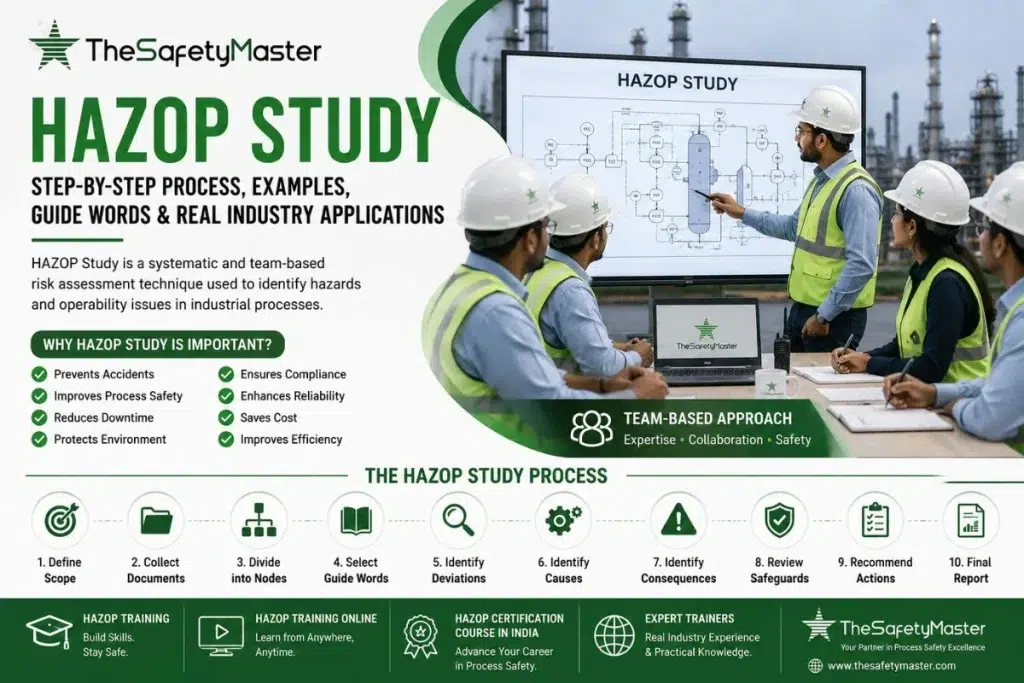
1. Define the Audit Scope
First, determine which plant, process, unit, equipment, or operation will be reviewed.
2. Collect Process Information
Gather relevant documents such as:
- P&IDs
- Process flow diagrams
- Equipment specifications
- Operating procedures
- Previous HAZOP reports
- Risk assessments
- Incident records
- Maintenance records
- Management of Change records
3. Review Previous HAZOP Findings
Previous HAZOP recommendations should be reviewed to determine whether actions were completed, partially completed, or remain outstanding.
4. Conduct Field Verification
The audit team should compare documentation with actual plant conditions. This helps identify differences between what is documented and what is actually implemented.
5. Identify Safety Gaps
Potential weaknesses should be recorded and categorized according to their significance.
6. Evaluate Existing Safeguards
Review whether engineering controls, alarms, interlocks, procedures, emergency systems, and other safeguards are appropriate.
7. Prepare the Audit Report
The report should clearly document observations, risk priorities, evidence, recommendations, and responsible actions.
8. Track Corrective Actions
Corrective actions should be assigned to responsible persons with realistic completion dates and followed until closure.
Common Hazards Identified During HAZOP
A HAZOP review can identify many different types of process deviations.
Common examples include:
- High pressure
- Low pressure
- High temperature
- Low temperature
- No flow
- Low flow
- High flow
- Reverse flow
- Wrong composition
- Contamination
- Loss of utilities
- Equipment failure
- Instrument failure
- Human error
- Leakage
- Loss of containment
The significance of each deviation depends on the process, materials, equipment, operating conditions, and existing safeguards.
Role of The Safety Master in HAZOP Safety Audits
The Safety Master supports organizations with process safety, HAZOP, risk assessment, safety audits, and related industrial safety solutions. Its current process-safety offering includes HAZOP, QRA, SIL, LOPA, PHSER, PSSR, and other risk-management activities.
A professional approach can help organizations:
- Identify process hazards
- Review HAZOP recommendations
- Evaluate existing safeguards
- Identify process safety gaps
- Improve risk controls
- Strengthen documentation
- Track corrective actions
- Improve overall process safety performance
The Safety Master also provides digital solutions for managing HAZOP studies, actions, recommendations, safety audits, MOC, PSSR, and HIRA activities.
Best Practices for Effective HAZOP Safety Audits
Organizations should follow several best practices to obtain better results.
Use a Multidisciplinary Team
Include professionals with knowledge of process engineering, operations, instrumentation, maintenance, safety, and other relevant disciplines.
Use Updated Documentation
Outdated P&IDs and process information can reduce the effectiveness of hazard identification and audit activities.
Verify Conditions in the Field
Do not depend only on documents. Physical verification helps identify gaps between procedures and actual practices.
Prioritize High-Risk Findings
Critical findings should receive immediate attention based on potential consequences and risk level.
Track Recommendations
Every recommendation should have an owner, target date, status, and verification of closure.
Review Changes Regularly
Process changes should trigger appropriate risk reviews and Management of Change procedures.
HAZOP Safety Audit Checklist
A basic checklist can include:
- Current P&IDs available
- Process safety information updated
- Previous HAZOP completed
- HAZOP recommendations reviewed
- Critical actions closed
- Operating procedures updated
- Emergency procedures available
- Alarms and interlocks functional
- Emergency shutdown systems tested
- Relief systems maintained
- Safety-critical equipment identified
- Mechanical integrity program implemented
- MOC procedure implemented
- Incident findings reviewed
- Employee training records available
- Corrective actions tracked
HAZOP Safety Audit for Different Industries
Chemical Industry
Chemical plants often handle hazardous, reactive, toxic, or flammable substances. HAZOP audits can help identify process deviations and weaknesses in safeguards.
Oil and Gas Industry
Oil and gas facilities involve significant risks from hydrocarbons, pressure, temperature, and energy sources. HAZOP is an important part of process hazard analysis for many such facilities.
Pharmaceutical Industry
Pharmaceutical manufacturing requires careful control of process parameters, materials, contamination risks, utilities, and equipment.
Power Industry
Power plants contain high-energy systems, pressure equipment, fuels, electrical systems, and complex operating processes. Systematic risk reviews can help identify potential failures.
How Often Should a HAZOP Safety Audit Be Conducted?
There is no single frequency suitable for every facility. The appropriate frequency depends on factors such as process complexity, hazard level, regulatory requirements, previous findings, incidents, modifications, and organizational risk-management procedures.
Additional reviews may be appropriate following major process modifications, significant incidents, or changes that could affect process safety.
Conclusion
A HAZOP Safety Audit provides organizations with a structured way to identify process hazards, evaluate safeguards, review HAZOP recommendations, and improve process safety performance. It should not be treated as a one-time documentation exercise. Effective auditing combines document review, technical analysis, field verification, corrective actions, and continuous improvement.
With experience in process safety, HAZOP, risk assessment, safety audits, and industrial safety solutions, The Safety Master can help organizations develop a more systematic approach to identifying and managing process risks.
FAQs About HAZOP Safety Audit
Q-What is a HAZOP Safety Audit?
A HAZOP Safety Audit is a systematic review of process hazards, safeguards, HAZOP recommendations, procedures, and process safety controls to identify gaps and improve risk management.
Q-What is the main purpose of a HAZOP audit?
The main purpose is to identify potential process safety weaknesses, verify existing safeguards, review previous HAZOP recommendations, and ensure that corrective actions are effectively implemented.
Q-What is the difference between HAZOP and HAZOP audit?
HAZOP primarily identifies process deviations and their consequences, while a HAZOP audit can review the implementation and effectiveness of HAZOP recommendations and broader process safety controls.
Q-What are common HAZOP deviations?
Common deviations include high pressure, low pressure, high temperature, low temperature, no flow, low flow, high flow, reverse flow, wrong composition, contamination, and loss of utilities.
Q-Who should conduct a HAZOP Safety Audit?
The audit should be conducted by competent professionals with appropriate knowledge of process safety, hazard identification, engineering, operations, and the specific industrial process being assessed.
Q-Why is HAZOP important for process industries?
HAZOP helps organizations systematically identify potential process deviations before they result in serious incidents. It can support better engineering controls, operating procedures, emergency planning, and risk reduction.
Q-Can HAZOP audits improve process safety compliance?
Yes. A properly structured audit can help identify gaps in procedures, documentation, safeguards, training, maintenance, Management of Change, and corrective-action systems, supporting stronger process safety management.
Q-How can The Safety Master help with HAZOP?
The Safety Master provides process safety and industrial safety solutions, including HAZOP, risk assessment, process safety consulting, safety audits, and related services designed to help organizations identify and control industrial risks.