Integrating HAZOP into Process Design and Modification Processes

Ethical Consideration in Quantitative Risk Analysis Ensuring Transparency & Accountability
May 10, 2024
Safety GAP Assessment with Technology and Artificial Intelligence
May 15, 2024
HAZOP, or Hazard and Operability Study, is a systematic technique used to identify process hazards, operational problems, and potential deviations from design intent. It is particularly valuable in industries such as oil and gas, chemicals, pharmaceuticals, power generation, and manufacturing, where process deviations can lead to fires, explosions, toxic releases, equipment damage, or production losses.
Integrating HAZOP into process design and modification processes allows organizations to identify risks before they become incidents. The Safety Master helps organizations strengthen process safety through HAZOP studies, risk assessment, safety consulting, and specialized training.
What Is HAZOP?
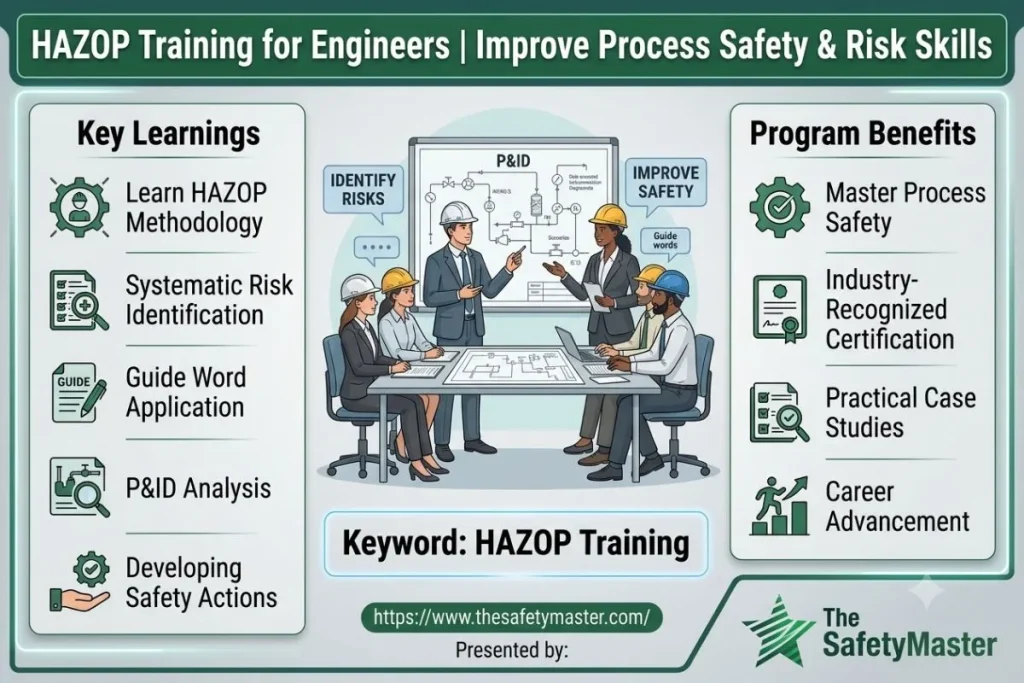
HAZOP stands for Hazard and Operability Study. It is a structured and systematic process hazard analysis technique in which a multidisciplinary team examines a process and identifies deviations from its intended operating conditions.
A typical HAZOP study examines:
- Process design intent
- Process parameters
- Guidewords
- Deviations
- Causes
- Consequences
- Existing safeguards
- Recommendations
Common guidewords include No, More, Less, Reverse, Other Than, As Well As, and Part Of. For example, a team may examine a pipeline for deviations such as No Flow, More Flow, Less Flow, or Reverse Flow.
Why Integrate HAZOP into Process Design?
HAZOP should not be treated as an activity that happens only after a process has been designed. Integrating it during the design stage allows engineers and safety professionals to identify hazards while changes are still relatively practical and cost-effective.
Early Hazard Identification
Design-stage HAZOP can identify potential hazards before equipment is installed or a plant becomes operational.
This can help identify:
- Equipment failure scenarios
- Pressure and temperature deviations
- Loss of containment
- Incorrect flow conditions
- Instrumentation failures
- Human-error possibilities
- Utility failures
- Inadequate safeguards
Improved Process Safety
Early identification allows design teams to incorporate appropriate engineering controls and protective systems before commissioning.
This supports a stronger Process Safety Management (PSM) framework and helps organizations reduce the possibility of major process incidents.
Cost-Effective Risk Reduction
Changing a design during the engineering stage is generally easier than modifying an operating facility. HAZOP therefore provides an opportunity to address hazards before they become expensive operational problems.
Integrating HAZOP into the Process Design Lifecycle
HAZOP can be incorporated at several stages of a project rather than being considered a single isolated activity.
Concept and Feasibility Stage
At the early stage, organizations can identify major hazards associated with the proposed process, materials, operating conditions, and technology.
This provides an initial understanding of the process safety requirements that need to be considered during detailed engineering.
Basic and Detailed Engineering
As process information becomes more developed, the HAZOP team can review documents such as:
- Process Flow Diagrams (PFDs)
- Piping and Instrumentation Diagrams (P&IDs)
- Equipment specifications
- Process descriptions
- Control philosophies
- Operating conditions
- Safety system information
The review becomes more detailed as the design develops.
Pre-Commissioning and Start-Up
Before commissioning, HAZOP findings and recommendations should be reviewed to confirm that agreed safeguards and design changes have been incorporated.
Open actions should be tracked and formally closed before the relevant system is placed into operation.
Integrating HAZOP into Process Modification
Existing facilities frequently undergo changes such as equipment replacement, capacity expansion, raw-material changes, process optimization, or control-system upgrades.
Even a relatively small modification can introduce new hazards.
Why Management of Change Matters
A process modification should be evaluated through a structured Management of Change (MOC) process.
HAZOP can support MOC by examining:
- What has changed?
- What new deviations can occur?
- Could existing safeguards become ineffective?
- Are operating procedures still suitable?
- Does the modification affect emergency systems?
- Are additional controls required?
Common Modifications Requiring HAZOP Review
HAZOP may be appropriate when an organization introduces:
- New equipment
- New chemicals or raw materials
- Production capacity changes
- New process technology
- Pipeline modifications
- Instrumentation changes
- Control-system upgrades
- Changes in operating conditions
- Process routing changes
The objective is to ensure that modifications do not unintentionally introduce unacceptable risks.
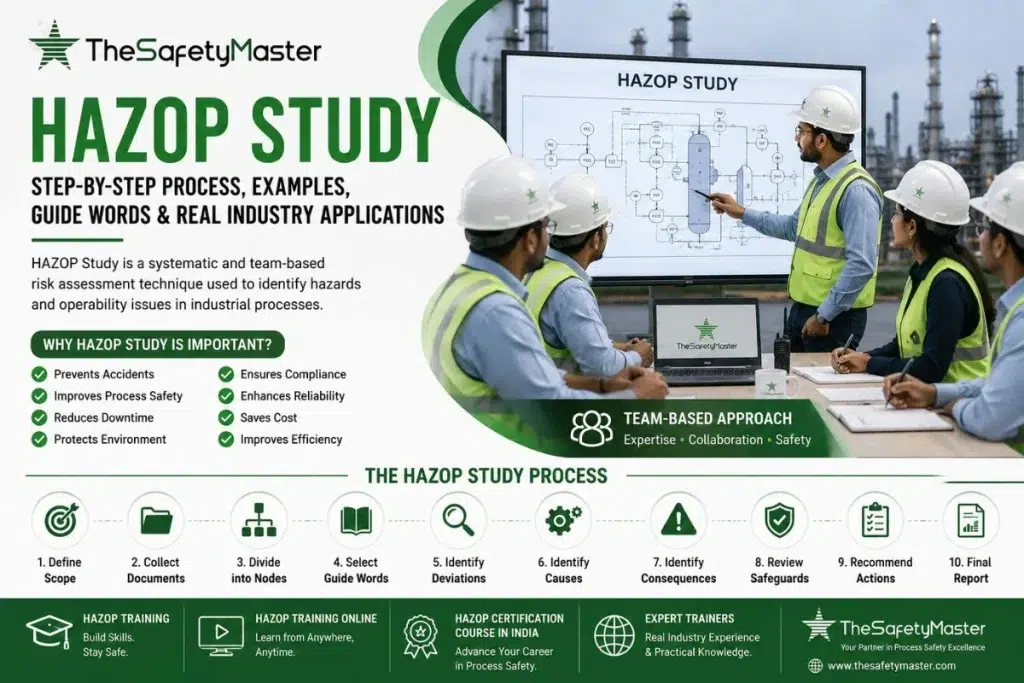
Step-by-Step Process for Conducting HAZOP
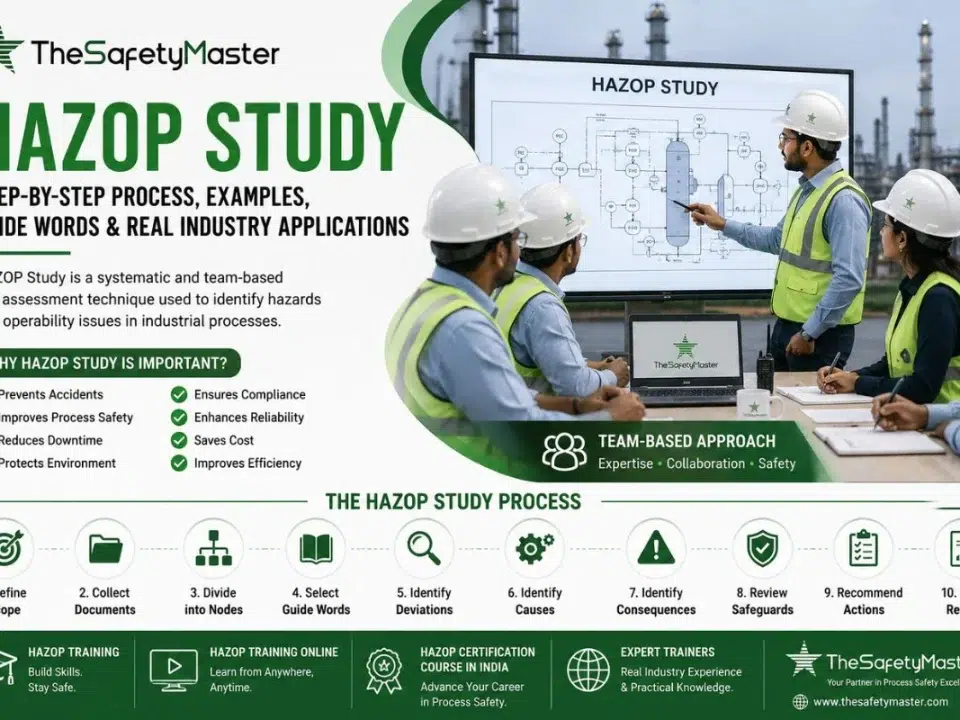
Step 1: Define the Scope
Clearly identify the process, plant section, equipment, or modification being reviewed.
Step 2: Assemble a Multidisciplinary Team
A strong HAZOP team may include:
- HAZOP facilitator
- Process engineer
- Operations representative
- Instrumentation engineer
- Mechanical engineer
- Maintenance professional
- Safety or process safety professional
Different perspectives help the team identify hazards that one discipline may overlook.
Step 3: Divide the Process into Nodes
The process is divided into manageable sections called nodes. Each node should have a clear design intent.
Examples may include a reactor, storage tank, pump system, heat exchanger, or pipeline section.
Step 4: Select Parameters and Guidewords
The team applies guidewords to process parameters such as:
- Flow
- Pressure
- Temperature
- Level
- Composition
- Time
Step 5: Identify Deviations
The team determines meaningful deviations from the intended operating condition.
For example:
Parameter: Flow
Guideword: No
Deviation: No Flow
Step 6: Identify Causes and Consequences
The team discusses credible causes and evaluates what could happen if the deviation occurs.
Step 7: Review Existing Safeguards
Existing protection layers are identified and evaluated to determine whether they adequately control the scenario.
Step 8: Develop Recommendations
Where additional risk reduction is necessary, the team develops recommendations and assigns responsibility for implementation.
The typical HAZOP sequence can be summarized as:
Design Intent → Node → Parameter → Guideword → Deviation → Cause → Consequence → Safeguard → Recommendation.
How HAZOP Findings Should Be Managed
Conducting the study is only one part of the process. The findings must be converted into actions.
Document HAZOP Recommendations
Every recommendation should be clearly documented with relevant information such as:
- Finding
- Risk or consequence
- Recommended action
- Responsible person
- Target completion date
- Status
- Verification requirements
Prioritize Critical Findings
Not every recommendation has the same importance. Organizations should prioritize findings according to their potential impact and risk.
Track Action Closure
HAZOP recommendations should remain open until the responsible team verifies that the required action has been completed.
This helps prevent a common problem: conducting a detailed HAZOP study but failing to implement its findings.
Common Challenges in HAZOP Integration
Lack of Accurate Process Information
Incomplete or outdated P&IDs and process documents can reduce the quality of a HAZOP study.
Limited Team Participation
HAZOP depends heavily on multidisciplinary knowledge. Missing key expertise can result in important scenarios being overlooked.
Time and Resource Constraints
Poorly planned studies can become rushed or excessively long. Defining the scope and preparing documents in advance helps improve efficiency.
Failure to Close Recommendations
Unclosed HAZOP actions can leave known hazards inadequately controlled.
Resistance to Design Changes
Teams may resist recommendations because of cost, schedule, or production concerns. Safety-related recommendations should be evaluated through a structured risk-based decision process.
Best Practices for Effective HAZOP
Use a Competent HAZOP Facilitator
An experienced facilitator can keep the study structured, focused, and technically productive.
Prepare Before the Workshop
Ensure that relevant PFDs, P&IDs, operating information, equipment data, and previous risk assessments are available before the HAZOP begins.
Encourage Multidisciplinary Participation
Include people who understand design, operations, maintenance, instrumentation, and process safety.
Focus on Credible Scenarios
The team should concentrate on realistic deviations and meaningful consequences rather than creating excessive theoretical scenarios.
Review HAZOP Findings Regularly
HAZOP findings should be reviewed when significant process changes occur and should remain connected to the organization’s broader process safety activities.
Role of HAZOP Software and Digital Tools
Technology can make HAZOP documentation, action tracking, and recommendation management more efficient.
Digital HAZOP systems can help organizations:
- Maintain HAZOP worksheets
- Track recommendations
- Assign responsibilities
- Monitor action status
- Store study records
- Improve collaboration
- Generate reports
However, software should support the HAZOP methodology rather than replace the knowledge and judgment of an experienced multidisciplinary team.
HAZOP and Process Safety Management
HAZOP is an important part of a broader process safety strategy. It can work alongside techniques such as HIRA, HAZID, LOPA, SIL assessment, QRA, and Management of Change.
For example, HAZOP can identify a hazardous scenario, while LOPA may subsequently be used to examine whether sufficient independent protection layers are available.
This integrated approach helps organizations move from simply identifying hazards toward systematically managing process risk.
How The Safety Master Can Help
The Safety Master provides safety and process-risk solutions for organizations looking to strengthen their industrial safety systems. Its services include HAZOP studies, process analysis, risk assessment, safety consulting, and HAZOP training.
Organizations can use professional HAZOP support to improve hazard identification, evaluate safeguards, manage process modifications, and develop practical recommendations for reducing process risk.
Conclusion
Integrating HAZOP into process design and modification processes helps organizations identify hazards before they become costly or dangerous incidents. When HAZOP is incorporated into design reviews, Management of Change, commissioning, and ongoing process safety activities, it becomes more than a one-time workshop—it becomes part of a proactive safety strategy.
For high-risk industries, combining competent HAZOP teams, accurate process information, effective action tracking, and continuous improvement can significantly strengthen process safety performance. The Safety Master can support organizations with HAZOP studies, process safety consulting, risk assessment, and professional training.
Frequently Asked Questions
Q-What is HAZOP in process design?
HAZOP is a systematic hazard identification technique used during process design to identify deviations from the intended operating conditions, evaluate their causes and consequences, review safeguards, and recommend additional risk controls.
Q-When should HAZOP be conducted?
HAZOP can be conducted during the design and engineering stages and should also be considered when significant process modifications are introduced. It can be particularly valuable before commissioning and when changes could introduce new hazards.
Q-Why is HAZOP important for process modification?
Process modifications can introduce new hazards or change existing risk scenarios. HAZOP helps the team systematically examine the modification and determine whether additional safeguards, procedures, or engineering controls are required.
Q-Who should participate in a HAZOP study?
A HAZOP team generally includes a facilitator along with professionals from process engineering, operations, instrumentation, mechanical engineering, maintenance, and safety/process safety.
Q-What are the main steps of a HAZOP study?
The main steps include defining the scope, assembling the team, dividing the process into nodes, selecting parameters and guidewords, identifying deviations, analyzing causes and consequences, reviewing safeguards, and developing recommendations.
Q-What is the difference between HAZOP and HIRA?
HIRA focuses broadly on identifying hazards and assessing associated risks, while HAZOP is a structured process hazard analysis technique that examines deviations from process design intent.
Q-Can HAZOP be used for existing plants?
Yes. HAZOP can be applied to existing plants, particularly when processes are modified, equipment is changed, operating conditions are altered, or significant process safety concerns require systematic review.
Q-How does HAZOP improve process safety?
HAZOP helps identify potential hazards, operational problems, causes, consequences, and weaknesses in existing safeguards. This enables organizations to introduce additional controls and improve the overall safety of their processes.