The Importance of Developing an Emergency Response and Disaster Management Plan (ERDMP) in Todays World

Electrical Safety Regulations in India: Complete Guide to Rules, Standards & CEA Regulations
October 14, 2025
The Safety Master: Pioneering Behavior-Based Safety Training
October 16, 2025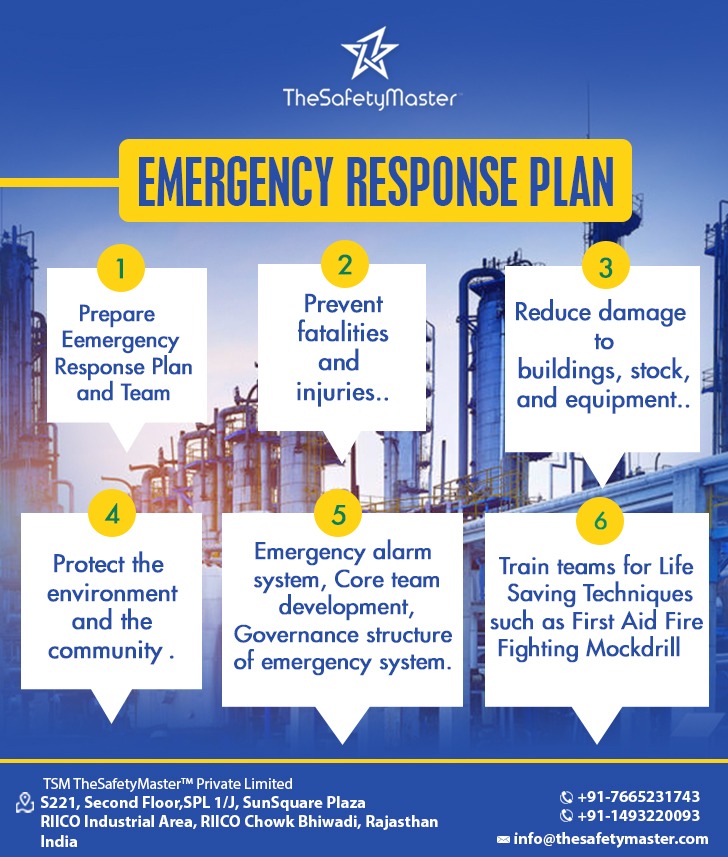
Emergencies can happen without warning—from fires, explosions, gas leaks, and chemical spills to natural disasters and other unforeseen events. For organizations operating in high-risk environments, preparedness is essential to protect people, assets, the environment, and business operations.
An Emergency Response and Disaster Management Plan (ERDMP) provides a structured framework for identifying hazards, assigning responsibilities, establishing communication procedures, coordinating emergency resources, and managing response and recovery activities.
What Is an Emergency Response and Disaster Management Plan (ERDMP)?
An ERDMP is a documented emergency-management framework that defines how an organization will prepare for, respond to, and recover from potential emergency situations.
A well-developed ERDMP typically addresses:
- Hazard identification and risk assessment
- Emergency response procedures
- Roles and responsibilities of emergency teams
- Communication and reporting protocols
- Evacuation and assembly arrangements
- Emergency resources and equipment
- Coordination with external agencies
- Training, mock drills, and emergency exercises
- Post-incident review and recovery
For industrial facilities, an ERDMP should be tailored to the site’s processes, hazards, layout, personnel, surrounding environment, and applicable regulatory requirements.
Why Is ERDMP Important for Organizations?
Protecting People and Reducing Losses
The primary objective of emergency preparedness is to protect human life. A clearly defined response plan helps employees and emergency teams understand what actions must be taken when an incident occurs.
A coordinated response can also help minimize damage to equipment, buildings, inventory, the environment, and surrounding communities.
Improving Emergency Response and Decision-Making
During an emergency, confusion and delayed decisions can increase the severity of an incident. An ERDMP establishes predefined response procedures, responsibilities, communication channels, and escalation mechanisms so that teams can act quickly and systematically.
Supporting Business Continuity
Major incidents can interrupt production, supply chains, utilities, and other critical operations. Effective emergency planning supports controlled shutdown, incident response, recovery, and restoration of operations, helping organizations reduce unnecessary downtime.
Strengthening Safety Culture
Emergency preparedness should not be limited to a written document. Regular training, drills, inspections, and plan reviews help employees understand their responsibilities and build confidence in responding to emergencies.
Key Components of an Effective ERDMP
1. Hazard Identification and Risk Assessment
The first step is to identify credible emergency scenarios associated with the organization’s operations.
These may include:
- Fire and explosion
- Gas or chemical leaks
- Equipment failure
- Natural disasters
- Electrical emergencies
- Structural incidents
- Environmental emergencies
- Medical emergencies
The risks should be evaluated according to their potential consequences, likelihood, affected areas, and available controls.
2. Emergency Organization and Responsibilities
The plan should clearly define the emergency organization and establish who is responsible for incident command, communication, evacuation, firefighting, rescue, first aid, security, and coordination with external agencies.
Clear roles reduce duplication and confusion during an incident.
3. Emergency Communication System
Communication is one of the most important elements of emergency response. The ERDMP should establish how alerts will be raised, who must be informed, what information should be communicated, and how communication will continue if normal systems are unavailable.
4. Evacuation and Emergency Procedures
The plan should define evacuation routes, assembly points, emergency exits, accountability procedures, and shelter-in-place arrangements where appropriate.
Site-specific emergency procedures should also be developed for credible scenarios such as fires, gas leaks, explosions, chemical releases, and other major incidents.
5. Emergency Resources and Equipment
Organizations should identify the resources required for emergency response, including firefighting systems, personal protective equipment, first-aid facilities, rescue equipment, emergency vehicles, communication systems, and other site-specific resources.
6. Training and Mock Drills
An ERDMP becomes effective when people know how to implement it. Training and scenario-based mock drills help identify weaknesses in emergency procedures and improve response coordination.
7. Monitoring, Review, and Continuous Improvement
Emergency plans should be reviewed periodically and whenever there are significant changes in operations, infrastructure, hazards, personnel, or regulatory requirements.
Post-drill and post-incident findings should be used to update procedures and improve emergency preparedness.
Benefits of a Strong ERDMP
Enhanced Emergency Preparedness
A structured plan gives employees and management a clear understanding of what to do before, during, and after an emergency.
Faster and More Coordinated Response
Clearly defined responsibilities and communication procedures help emergency teams coordinate their actions efficiently.
Reduced Impact on People, Property, and the Environment
Preparedness can help organizations reduce the potential consequences of emergencies by enabling early detection, rapid response, evacuation, containment, and recovery.
Improved Regulatory and Safety Compliance
Organizations operating in regulated sectors should ensure that their emergency-management arrangements meet applicable laws, standards, permits, and industry requirements. For petroleum and natural-gas facilities, applicable PNGRB requirements should be considered during ERDMP development.
Who Needs an ERDMP?
An ERDMP can be valuable for organizations where emergencies could affect people, property, the environment, or continuity of operations, particularly:
- Oil and gas facilities
- Chemical and petrochemical industries
- Manufacturing plants
- Warehouses and logistics facilities
- Power and utility facilities
- Healthcare facilities
- Large commercial and industrial sites
- Infrastructure projects
- Other high-risk workplaces
The plan should always be customized according to the organization’s actual hazards and operating conditions.
How The Safety Master Can Help With ERDMP
The Safety Master provides ERDMP-related consultancy and planning support focused on site-specific emergency preparedness. Its approach can include risk assessment, emergency-scenario identification, response procedures, emergency-team responsibilities, coordination protocols, training, mock drills, and periodic review.
An effective ERDMP should not be treated as a document prepared only for compliance. It should be a practical system that employees can understand, emergency teams can execute, and management can continuously improve.
ERDMP and Fire Safety
Fire emergencies are an important consideration for many industrial and commercial facilities. ERDMP planning should therefore be integrated with existing fire prevention, detection, firefighting, evacuation, and emergency-response arrangements.
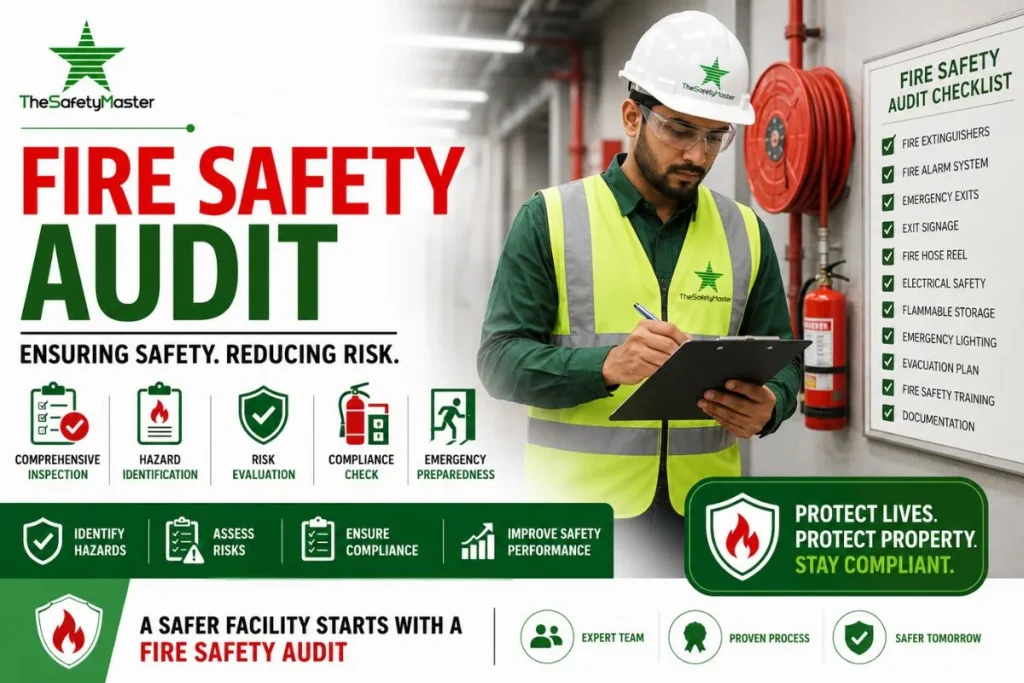
A fire safety audit can help identify gaps in fire detection systems, firefighting equipment, emergency exits, evacuation arrangements, and employee preparedness, with relevant findings incorporated into emergency planning.
Conclusion
An Emergency Response and Disaster Management Plan is an essential part of a proactive safety-management strategy. It helps organizations prepare for credible emergencies, establish clear responsibilities, improve communication, protect people and assets, and support faster recovery.
The most effective ERDMP is not simply a document—it is a living system supported by risk assessment, training, drills, communication, resource readiness, monitoring, and continuous improvement.
Be prepared. Stay safe. Protect lives.
FAQs
Q-What is ERDMP?
ERDMP stands for Emergency Response and Disaster Management Plan. It is a structured plan that defines how an organization prepares for, responds to, and recovers from emergencies such as fires, explosions, gas leaks, chemical releases, and other hazards.
Q-Why is an ERDMP important?
An ERDMP helps organizations protect people, reduce potential damage, coordinate emergency resources, improve response times, support business continuity, and meet applicable safety and regulatory requirements.
Q-What are the main components of an ERDMP?
Key components generally include hazard identification, risk assessment, emergency organization, roles and responsibilities, communication procedures, evacuation arrangements, emergency resources, training, mock drills, and periodic review.
Q-How often should an ERDMP be reviewed?
An ERDMP should be reviewed periodically and whenever there are significant changes in processes, infrastructure, hazards, emergency resources, personnel, or applicable regulations. Regular drills and exercises should also be used to identify areas for improvement.
Q-Is ERDMP mandatory for every organization?
The exact legal and regulatory requirements depend on the industry, facility, location, activities, and applicable authorities. Organizations should identify the requirements relevant to their operations and ensure that their emergency-management arrangements comply with them.
Q-What industries commonly require ERDMP planning?
ERDMP planning is particularly important for high-risk sectors such as oil and gas, petrochemicals, chemicals, manufacturing, utilities, and other facilities where emergencies could have significant consequences.
Q-How can The Safety Master help with ERDMP?
The Safety Master provides ERDMP consultancy and related safety services, including site-specific risk assessment, emergency planning, response procedures, training, mock drills, and plan improvement.
Q-What is the difference between an ERDMP and an Emergency Response Plan?
An Emergency Response Plan generally focuses on immediate actions during an emergency, while an ERDMP provides a broader framework covering preparedness, emergency response, coordination, mitigation, and recovery.