How HAZOP Supports Functional Safety and SIL Assessment

Benefits of HAZOP Studies for Oil & Gas, Chemical, and Manufacturing Industries
May 29, 2026
Reducing Unsafe Acts Through Effective Behavior-Based Safety Management Strategies
June 6, 2026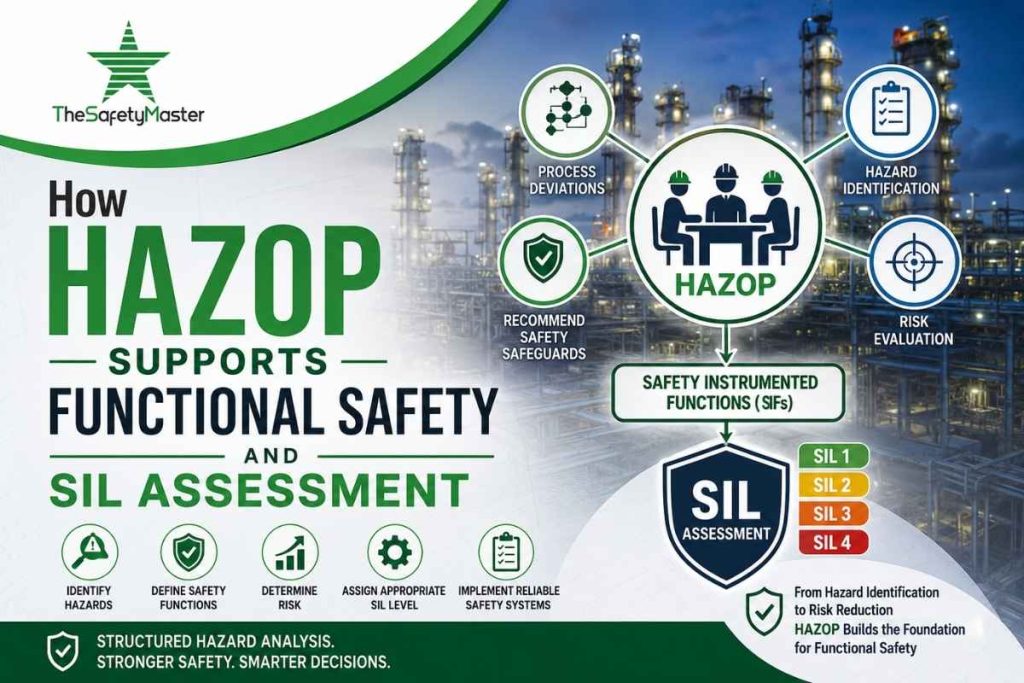
Functional safety has become a critical component of modern industrial operations. Industries such as oil and gas, chemicals, pharmaceuticals, power generation, and manufacturing rely heavily on automated systems to maintain safe operating conditions. While these systems improve efficiency and productivity, they also introduce risks that must be carefully managed.
This is where Hazard and Operability Studies (HAZOP) and Safety Integrity Level (SIL) assessments play a crucial role. Together, they help organizations identify potential hazards, evaluate risks, and implement appropriate safety measures to prevent catastrophic incidents.
Understanding how HAZOP supports functional safety and SIL assessment is essential for organizations seeking to strengthen their process safety management systems and protect people, assets, and the environment.
Understanding Functional Safety
Functional safety refers to the ability of safety-related systems to perform their intended functions correctly in response to process demands or failures. These systems are designed to detect hazardous conditions and automatically take corrective actions before an incident occurs.
Examples of safety functions include:
- Automatic emergency shutdown systems
- High-pressure protection systems
- Gas detection systems
- Fire suppression activation systems
- High-temperature trip systems
The goal of functional safety is simple: reduce risk to an acceptable level through reliable safety instrumented functions (SIFs).
However, before determining what safety functions are needed, organizations must first identify the hazards present within the process. This is where HAZOP becomes invaluable.
What Is a HAZOP Study?
A Hazard and Operability Study (HAZOP) is a structured and systematic method used to identify potential process hazards and operational issues.
A multidisciplinary team reviews process systems by applying guidewords such as:
- No
- More
- Less
- Reverse
- Other Than
These guidewords help identify deviations from normal operating conditions and uncover potential causes, consequences, and existing safeguards.
HAZOP serves as the foundation for many process safety activities, including SIL assessments and functional safety lifecycle management.
The Connection Between HAZOP and Functional Safety
Functional safety systems are designed to address specific hazards. However, those hazards must first be identified and evaluated.
HAZOP provides this critical information by:
- Identifying hazardous scenarios
- Determining potential consequences
- Evaluating existing protection layers
- Highlighting gaps in risk controls
- Recommending additional safeguards
Without a thorough HAZOP study, organizations may overlook significant hazards or implement inadequate safety measures.
Simply put, HAZOP helps answer an important question:
“What could go wrong?”
Functional safety then answers:
“How can we prevent or mitigate it?”
How HAZOP Supports SIL Assessment
Safety Integrity Level (SIL) is a measure of the performance required from a safety instrumented function.
SIL levels range from:
- SIL 1 – Lowest risk reduction requirement
- SIL 2 – Moderate risk reduction
- SIL 3 – High risk reduction
- SIL 4 – Extremely high risk reduction
Before assigning a SIL level, organizations need a clear understanding of process hazards and associated risks. This information comes directly from the HAZOP study.
Identification of Hazardous Scenarios
One of the primary objectives of HAZOP is identifying credible hazardous scenarios.
Examples may include:
- Reactor overpressure
- Toxic gas release
- Loss of cooling systems
- Runaway chemical reactions
- Tank overfilling
These scenarios become the basis for subsequent SIL determination studies.
Without HAZOP, there would be no structured way to identify all possible process deviations and associated risks.
Evaluation of Consequences
HAZOP helps assess the potential consequences of each identified hazard.
Consequences may involve:
- Personnel injuries
- Fatalities
- Environmental damage
- Equipment destruction
- Production losses
Understanding consequence severity is essential when determining the level of protection required from a safety instrumented system.
Assessment of Existing Safeguards
During the HAZOP process, teams review existing safeguards such as:
- Alarms
- Relief valves
- Interlocks
- Emergency shutdown systems
- Operator interventions
This evaluation helps determine whether current protections are sufficient or whether additional safety functions are needed.
If existing safeguards do not adequately reduce risk, SIL assessment may recommend implementing a higher-performance safety instrumented function.
Defining Safety Instrumented Functions (SIFs)
Many recommendations generated during HAZOP studies lead directly to the creation of Safety Instrumented Functions.
For example:
If a reactor temperature exceeds a critical limit, a safety system may automatically stop reactant feed and initiate shutdown.
This protective action becomes a Safety Instrumented Function requiring SIL verification.
HAZOP provides the technical justification for these safety functions.
Establishing Risk Reduction Requirements
The ultimate purpose of SIL assessment is determining how much risk reduction is necessary.
HAZOP helps quantify:
- Hazard likelihood
- Consequence severity
- Existing risk controls
- Residual risk levels
This information enables organizations to assign appropriate SIL targets based on actual process risks rather than assumptions.
Benefits of Integrating HAZOP and SIL Assessment
Improved Process Safety
When HAZOP and SIL assessments are performed together, organizations gain a deeper understanding of process risks and protection requirements.
This leads to:
- Better hazard identification
- More effective safeguards
- Reduced incident potential
- Improved emergency preparedness
Enhanced Regulatory Compliance
Many process safety standards require organizations to conduct formal hazard studies and functional safety evaluations.
Integrated HAZOP and SIL assessments support compliance with:
- IEC 61511
- IEC 61508
- Process Safety Management (PSM) requirements
- Industry-specific regulations
Regulators often expect organizations to demonstrate that safety systems are based on documented hazard analyses.
More Reliable Safety Systems
A properly conducted HAZOP ensures safety systems address real-world hazards rather than theoretical concerns.
This improves:
- System reliability
- Equipment performance
- Operational confidence
- Maintenance planning
Organizations can invest resources where they are truly needed.
Reduced Business Risk
Major process incidents can lead to:
- Operational shutdowns
- Financial losses
- Regulatory penalties
- Legal liabilities
- Reputational damage
Integrating HAZOP with SIL assessment helps prevent these outcomes by strengthening risk management strategies.
Building Competency Through Training
The effectiveness of any HAZOP or SIL study depends on the competence of the individuals involved.
Organizations that invest in professional HAZOP Training can significantly improve the quality of their risk assessments and recommendations.
Training equips teams with the knowledge required to identify hazards, evaluate risks, and contribute effectively during study sessions.
Similarly, programs such as Behavior-Based Safety Training help strengthen the human side of safety by encouraging safe behaviors and proactive risk awareness throughout the workplace.
Supporting Functional Safety Through Comprehensive Audits
Functional safety does not end after a SIL assessment is completed. Organizations must continuously verify that safety systems remain effective throughout their lifecycle.
A comprehensive Safety Audit Service helps organizations evaluate operational practices, system performance, and compliance with safety requirements.
Additionally, fire hazards remain one of the most significant threats in process industries. Conducting a regular Fire Safety Audit helps verify fire protection systems, emergency response preparedness, and regulatory compliance while complementing broader functional safety initiatives.
Conclusion
HAZOP and SIL assessments are closely connected components of an effective process safety management system. HAZOP identifies hazards, evaluates risks, and highlights potential failure scenarios, while SIL assessment determines the level of protection required to manage those risks effectively.
Together, they provide a structured framework for designing reliable safety instrumented systems, improving operational safety, and reducing the likelihood of major industrial accidents.
As industrial processes continue to become more complex and automated, organizations that integrate HAZOP studies with functional safety and SIL assessments will be better positioned to protect their workforce, maintain compliance, and achieve long-term operational excellence.