Certified Process Safety Management Training Program for Plant Engineers & Managers

How Process Hazard Analysis Consultants Improve Process Safety and Hazard Management
September 21, 2026
Top 10 Features to Look for in Enterprise Safety Software for Chemical Plants
September 23, 2026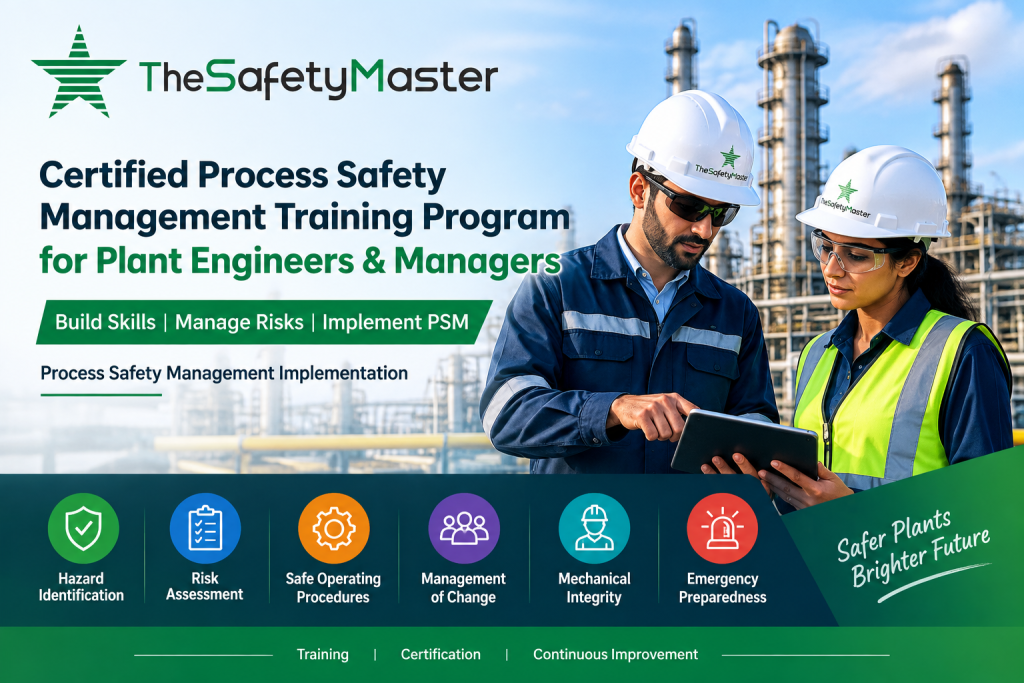
Process safety is important for plants, manufacturing facilities, chemical industries, oil and gas companies, and other high-risk workplaces. Plant engineers and managers need practical knowledge to identify process hazards, control major risks, and prevent serious incidents.
A Certified Process Safety Management Training Program for Plant Engineers & Managers helps professionals understand process safety principles, hazard identification, risk assessment, emergency planning, and safe operating practices. The Safety Master provides safety training designed to help professionals improve their knowledge and support effective Process Safety Management Implementation in their workplaces.
What Is Process Safety Management Implementation?
Process Safety Management Implementation is the systematic application of safety procedures, controls, responsibilities, and management practices to prevent major incidents involving hazardous chemicals, processes, equipment, and operations.
Effective implementation can help organizations manage risks related to:
- Hazardous chemicals
- Flammable materials
- High-pressure systems
- Toxic substances
- Chemical reactions
- Process equipment
- Storage and handling systems
- Maintenance activities
- Emergency situations
A strong PSM system requires cooperation between plant engineers, managers, operators, maintenance teams, and safety professionals.
Why Plant Engineers and Managers Need PSM Training
Plant engineers and managers often make decisions that can directly affect process safety. They may be responsible for equipment, operating procedures, maintenance, modifications, contractors, or emergency preparedness.
PSM training helps professionals understand how to:
- Identify process hazards
- Assess and control risks
- Review operating procedures
- Understand process safety information
- Participate in HAZOP and risk studies
- Manage process changes
- Improve mechanical integrity
- Investigate incidents
- Strengthen emergency planning
- Monitor safety performance
Benefits of Process Safety Management Training
A structured training program can help organizations develop a stronger safety culture and improve the consistency of safety practices.
Key benefits include:
- Better understanding of process hazards
- Improved risk management
- Stronger operating procedures
- Better incident prevention
- Improved management of change
- More effective process safety audits
- Improved emergency preparedness
- Better understanding of PSM responsibilities
Free Certified Process Safety Management Training Program for Plant Engineers & Managers
Many professionals search for a free certified process safety management training program for plant engineers & managers because they want to develop their knowledge without a high initial training cost.
Free learning resources can be useful for understanding basic PSM concepts. However, professionals should check carefully whether a course actually provides an industry-recognized certification or only provides a certificate of participation or completion.
A professional PSM program should ideally cover practical subjects such as hazard identification, risk assessment, operating procedures, management of change, mechanical integrity, incident investigation, and emergency planning.
The Safety Master can help professionals understand process safety concepts and develop practical safety knowledge through structured training programs.
Certified Process Safety Management Training Program for Plant Engineers & Managers Online
An online certified process safety management training program for plant engineers & managers provides flexibility for professionals who cannot attend classroom training.
Online learning can cover important subjects such as:
Process Safety Fundamentals
Participants learn the basic principles of process safety, major accident prevention, and process hazard management.
Hazard Identification and Risk Assessment
Training can introduce methods such as:
- HAZOP
- HAZID
- What-If Analysis
- FMEA
- LOPA
- Risk assessment
- Consequence analysis
Management of Change
Participants learn why changes to equipment, processes, chemicals, technology, or procedures should be properly reviewed before implementation.
Mechanical Integrity
The training explains the importance of inspection, testing, maintenance, and reliability of safety-critical equipment.
Incident Investigation
Professionals learn how incidents and near misses can be investigated to identify root causes and develop corrective actions.
Understanding the 14 Elements of Process Safety Management
One of the most important areas of PSM training is understanding the commonly referenced 14 elements of Process Safety Management under the OSHA PSM framework.
They are:
- Process Safety Information
- Process Hazard Analysis
- Operating Procedures
- Training
- Contractors
- Pre-Startup Safety Review
- Mechanical Integrity
- Hot Work Permit
- Management of Change
- Incident Investigation
- Emergency Planning and Response
- Compliance Audits
- Trade Secrets
- Employee Participation
How the 14 Elements Support PSM
These elements address different parts of process safety management. Together, they provide a framework for identifying hazards, controlling risks, maintaining equipment, managing changes, and preparing for emergencies.
Plant engineers and managers should understand how these elements connect with their daily responsibilities.
Process Safety Management Course in India
A Process Safety Management course in India can be useful for professionals working in industries where hazardous processes or materials are involved.
Typical learners may include:
- Plant engineers
- Process engineers
- Safety engineers
- HSE professionals
- Production managers
- Maintenance managers
- Operations managers
- Chemical engineers
- Project engineers
- Plant heads
The right course should combine process safety theory with practical examples and workplace applications.
NEBOSH HSE Certificate in Process Safety Management
The NEBOSH HSE Certificate in Process Safety Management is a qualification focused on process safety principles and major hazard prevention. It is different from general occupational health and safety qualifications because it focuses specifically on process safety risks.
The syllabus commonly addresses areas such as:
- Process safety leadership
- Process safety management systems
- Asset management
- Process safety competency
- Process safety risk management
- Process safety hazard control
- Fire and explosion protection
- Emergency response
- Monitoring and improvement
Professionals considering NEBOSH should review the current syllabus, assessment structure, entry requirements, and fees directly with an approved learning partner.
NEBOSH PSM Course Fees
NEBOSH PSM course fees can vary depending on the training provider, delivery method, location, learning materials, examination or assessment charges, and other included services.
Before enrolling, candidates should ask whether the quoted fee includes:
- Training
- Study materials
- Registration
- Examination or assessment fees
- Certificate
- Mock examinations
- Tutor support
Because fees can change, candidates should confirm the latest cost with the specific training provider.
NEBOSH PSM Exam Questions and Answers PDF
Many learners search for a NEBOSH Process Safety Management Exam questions and answers PDF to prepare for assessments.
Practice questions can help candidates understand the style of questions and test their knowledge. However, learners should avoid relying on leaked or unauthorized examination materials.
A better preparation method is to use:
- Official syllabus documents
- Approved study materials
- Practice questions
- Mock assessments
- Tutor guidance
- Case-study-based exercises
- Revision notes
The goal should be to understand process safety principles rather than memorize answers.
NEBOSH PSM Book PDF
A NEBOSH PSM book PDF may be useful as a study resource, but professionals should ensure that the material is legally obtained and aligned with the current syllabus.
A good study resource should help explain process safety concepts through practical examples rather than simply providing answers.
Process Safety Management Course Fees
Process Safety Management course fees vary considerably depending on the course provider, duration, certification, training format, and level of specialization.
Before choosing a course, compare:
- Course curriculum
- Trainer experience
- Certification
- Online or classroom delivery
- Practical case studies
- Assessment method
- Study material
- Support after training
- Total course cost
A low-cost course is not necessarily equivalent to a professional certification program, so candidates should compare what is included in the fee.
How Process Safety Management Implementation Works in a Plant
Effective Process Safety Management Implementation should be treated as an ongoing process rather than a one-time training activity.
Step 1: Identify Process Hazards
Identify hazardous chemicals, energy sources, process conditions, equipment hazards, and potential failure scenarios.
Step 2: Conduct Process Hazard Analysis
Use suitable techniques such as HAZOP, What-If Analysis, FMEA, or LOPA depending on the process and objectives.
Step 3: Establish Safe Operating Procedures
Develop clear procedures for normal operation, startup, shutdown, emergency operation, and other critical activities.
Step 4: Manage Process Changes
Review proposed changes before implementation to understand their possible safety consequences.
Step 5: Maintain Safety-Critical Equipment
Inspection, testing, preventive maintenance, and corrective maintenance should be managed for equipment important to process safety.
Step 6: Train Employees
Employees should receive appropriate training for their roles, responsibilities, hazards, procedures, and emergency actions.
Step 7: Audit and Improve
Regular audits, inspections, incident investigations, and performance reviews can identify areas requiring improvement.
Role of The Safety Master in Process Safety Training
The Safety Master focuses on safety training and professional development across different areas of workplace and process safety.
A structured process safety program can help engineers and managers build knowledge that can be applied to hazard identification, risk assessment, process safety systems, and workplace safety improvement.
For organizations implementing or improving PSM, training should be combined with practical systems, competent personnel, documented procedures, risk studies, audits, and continuous improvement.
Who Should Take a Process Safety Management Course?
A PSM course can be relevant for professionals involved in process operations, engineering, maintenance, safety, and management.
It may be particularly useful for:
- Plant managers
- Process engineers
- Chemical engineers
- Production managers
- HSE managers
- Safety officers
- Maintenance engineers
- Operations professionals
- Project managers
- Process safety professionals
Frequently Asked Questions
Q-Is NEBOSH PSM worth it?
The value of NEBOSH PSM depends on your career goals, current role, industry, employer requirements, and the type of process safety work you want to perform. It can provide structured learning in process safety management and major hazard control. Candidates should compare the qualification’s syllabus, assessment requirements, recognition, and cost with their professional objectives.
Q-How to get CCPs certification?
The route to CCP certification depends on the specific organization and certification program meant by “CCP.” Different organizations use CCP for different credentials. Candidates should identify the issuing organization, check its eligibility requirements, training requirements, examination process, and certification conditions before applying.
Q-What are the 14 elements of PSM?
The commonly referenced OSHA PSM framework contains 14 elements: Process Safety Information, Process Hazard Analysis, Operating Procedures, Training, Contractors, Pre-Startup Safety Review, Mechanical Integrity, Hot Work Permit, Management of Change, Incident Investigation, Emergency Planning and Response, Compliance Audits, Trade Secrets, and Employee Participation.
Q-What are the fees for NEBOSH courses in India?
NEBOSH course fees in India vary according to the qualification, training provider, delivery format, location, study materials, and assessment or examination charges. Candidates should request the latest fee breakdown from their chosen approved provider.
Q-What is NEBOSH’s salary?
NEBOSH is a qualification, not a job position, so there is no single “NEBOSH salary.” Earnings depend on the professional’s job title, experience, industry, location, employer, responsibilities, and other qualifications. Professionals with NEBOSH qualifications may work in different health, safety, and process safety roles.
Q-Is the NEBOSH exam easy to pass?
The difficulty depends on the learner’s prior knowledge, preparation, understanding of the syllabus, and ability to apply concepts to workplace scenarios. Regular study, practice questions, mock assessments, and understanding the assessment requirements can help candidates prepare effectively.
Q-How much does it cost to get certified in Process Safety Management?
The cost depends on the type of certification, training provider, course format, duration, study materials, and assessment or examination fees. A general PSM training certificate may have a different cost from an internationally recognized professional qualification such as the NEBOSH HSE Certificate in Process Safety Management. Candidates should compare the complete fee structure before enrollment.
Conclusion
A Certified Process Safety Management Training Program for Plant Engineers & Managers can help professionals understand how to identify process hazards, manage risks, control safety-critical activities, and support safer plant operations. From the 14 PSM elements and process hazard analysis to management of change and mechanical integrity, practical knowledge is essential for effective Process Safety Management Implementation.
For plant engineers, managers, and safety professionals looking to strengthen their process safety knowledge, The Safety Master provides training and safety-focused learning resources that can support professional development and better process safety practices.