How Process Hazard Analysis Consultants Improve Process Safety and Hazard Management
How Process Safety Management Training Protects Your Facility from Catastrophic Incidents
September 19, 2026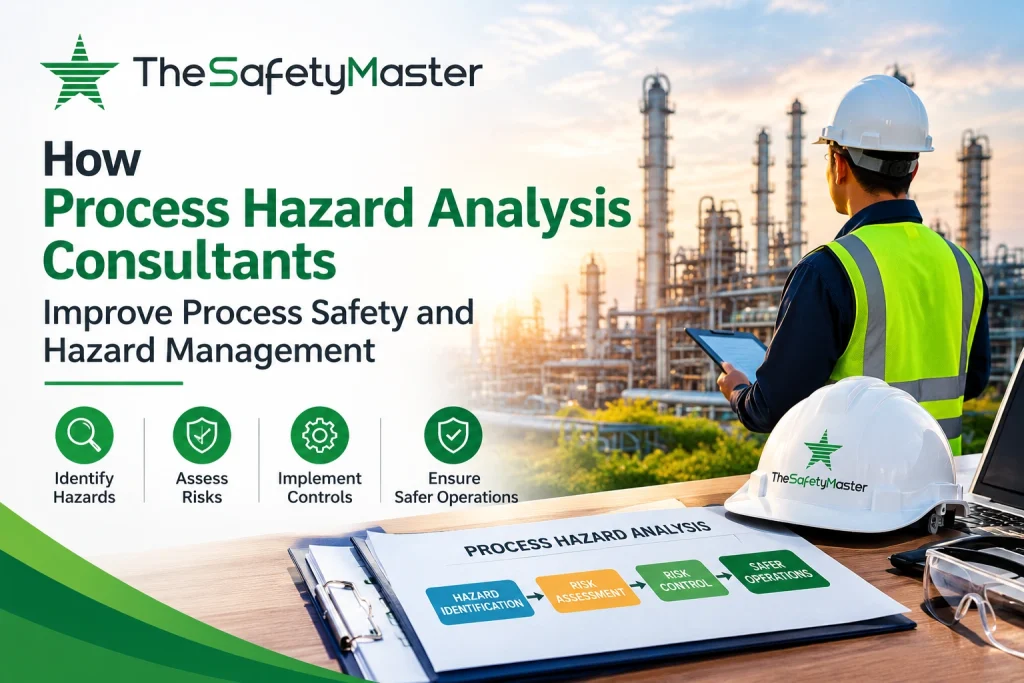
Process safety is important for industries that handle chemicals, flammable materials, high pressure, high temperature, and other hazardous processes. A small process failure can lead to fire, explosion, toxic releases, equipment damage, or serious injuries. This is why companies need a structured approach to identify and control process hazards.
Process Hazard Analysis Consultants help organizations identify hazards, evaluate risks, review existing safeguards, and recommend practical improvements. Their work supports better hazard management and helps companies build stronger process safety systems.
The Safety Master provides safety knowledge, training, consulting, and risk management support to help organizations improve their process safety performance.
What Is Process Hazard Analysis?
Process Hazard Analysis (PHA) is a systematic method used to identify potential hazards in a process and evaluate how those hazards could affect people, equipment, the environment, and business operations.
A PHA normally examines:
- Process equipment and operating conditions
- Chemicals and hazardous materials
- Process deviations
- Potential failure scenarios
- Existing safeguards
- Human factors
- Emergency controls
- Consequences of incidents
- Recommendations for risk reduction
The objective is not only to identify hazards but also to understand the causes, consequences, and safeguards associated with each scenario.
Why Are Process Hazard Analysis Consultants Important?
1. Identify Process Hazards
Consultants use structured techniques to identify hazards that may not be obvious during normal operations. They review process information, operating procedures, equipment, instrumentation, and potential deviations.
2. Evaluate Risk
After identifying hazards, consultants evaluate the likelihood and potential consequences of different scenarios. This helps organizations determine which risks require additional controls.
3. Review Existing Safeguards
A PHA can examine safeguards such as:
- Alarms
- Interlocks
- Emergency shutdown systems
- Pressure relief devices
- Fire protection systems
- Detection systems
- Operating procedures
- Preventive maintenance
- Personal protective equipment
4. Recommend Risk Reduction Measures
Consultants can recommend engineering, administrative, and procedural controls based on the identified hazards and risk levels.
5. Improve Process Safety Management
PHA findings can support broader process safety activities, including Management of Change (MOC), Pre-Startup Safety Review (PSSR), operating procedures, emergency planning, and safety training.
Process Hazard Analysis Methods
Different PHA methods may be suitable depending on the type and complexity of the process.
HAZOP
Hazard and Operability Study (HAZOP) uses guide words to identify deviations from the intended process design.
Common guide words include:
- No
- More
- Less
- Reverse
- Other than
- As well as
HAZOP is widely used for detailed examination of process systems and operating deviations.
What-If Analysis
What-If Analysis uses questions such as:
- What if the cooling system fails?
- What if pressure increases?
- What if an operator opens the wrong valve?
- What if power supply is lost?
The team evaluates the possible consequences and existing safeguards.
FMEA
Failure Mode and Effects Analysis (FMEA) examines individual equipment or component failure modes and their possible effects on the process.
Fault Tree Analysis
Fault Tree Analysis (FTA) starts with an unwanted event and works backward to identify possible combinations of failures that could cause it.
Layer of Protection Analysis
LOPA evaluates whether independent protection layers provide sufficient risk reduction for specific hazardous scenarios.
Process Hazard Analysis Example
Consider a chemical storage tank containing a flammable liquid.
A PHA team may identify the following scenario:
Hazard: Tank overpressure
Possible cause: Failure of pressure control system
Consequence: Tank damage, vapor release, fire, or explosion
Existing safeguards:
- Pressure alarm
- High-pressure shutdown
- Pressure relief device
- Preventive maintenance
Additional recommendation: Review relief capacity, inspection requirements, alarm response procedures, and emergency controls.
This example shows how PHA connects a potential hazard with its causes, consequences, safeguards, and recommended actions.
Process Hazard Example
A process hazard can occur when a flammable chemical is released from a damaged pipeline.
Possible Causes
- Corrosion
- Mechanical damage
- Improper installation
- Valve failure
- Excessive pressure
- Poor maintenance
Possible Consequences
- Fire
- Explosion
- Toxic exposure
- Environmental release
- Equipment damage
- Production interruption
Possible Controls
- Corrosion monitoring
- Inspection programs
- Leak detection
- Emergency isolation
- Pressure protection
- Preventive maintenance
- Operator training
A systematic PHA helps organizations examine these factors before they develop into major incidents.
Process Hazard Analysis Checklist
A Process Hazard Analysis checklist helps the PHA team conduct a consistent and organized review.
Process Information
- Is the process description available?
- Are process flow diagrams updated?
- Are P&IDs available?
- Are chemical properties documented?
- Are operating limits defined?
- Are equipment specifications available?
Hazard Identification
- Have fire hazards been identified?
- Have explosion hazards been reviewed?
- Have toxic release scenarios been considered?
- Have pressure and temperature hazards been examined?
- Have chemical incompatibilities been reviewed?
- Have utility failures been considered?
Safeguard Review
- Are alarms available?
- Are interlocks functioning?
- Are emergency shutdown systems provided?
- Are relief systems adequate?
- Are fire and gas detection systems available?
- Are emergency procedures established?
Human Factors
- Are operating procedures clear?
- Has human error been considered?
- Is operator training adequate?
- Are control room interfaces appropriate?
- Are maintenance activities considered?
Recommendations
- Are PHA recommendations clearly documented?
- Is each recommendation assigned to a responsible person?
- Is a completion target established?
- Is corrective action tracked?
- Has the effectiveness of completed actions been reviewed?
Process Hazard Analysis PPT: What Should It Include?
A Process Hazard Analysis PPT can be useful for training employees, presenting PHA findings, or explaining the methodology to management.
A basic PHA presentation can include:
Slide 1: Introduction to PHA
Definition, purpose, and importance of Process Hazard Analysis.
Slide 2: Objectives of PHA
Explain hazard identification, risk evaluation, safeguard review, and risk reduction.
Slide 3: PHA Methods
Cover HAZOP, What-If Analysis, FMEA, FTA, LOPA, and other applicable techniques.
Slide 4: Process Hazard Example
Present a simple process scenario showing causes, consequences, safeguards, and recommendations.
Slide 5: PHA Checklist
Show the key areas that should be reviewed during a PHA.
Slide 6: Action Tracking
Explain how PHA recommendations are assigned, monitored, and closed.
A well-structured presentation can help employees understand the importance of process hazard identification and risk management.
How Consultants Support Hazard Management
Hazard Identification
Consultants bring a structured approach to identifying hazards throughout the process lifecycle.
Risk Assessment
They help teams understand the potential severity and likelihood of hazardous scenarios.
Safeguard Evaluation
Consultants review whether existing protection systems are appropriate for identified scenarios.
Action Management
PHA recommendations need effective follow-up. Consultants can help organizations prioritize and track corrective actions.
Documentation
Proper documentation creates a useful record of identified hazards, risk controls, decisions, and recommendations.
Benefits of Working With Process Hazard Analysis Consultants
Organizations can use PHA consulting to improve several areas of process safety:
- Better hazard identification
- More systematic risk assessment
- Improved understanding of process deviations
- Stronger safeguards
- Better emergency preparedness
- Improved process safety documentation
- Support for regulatory and internal requirements
- Improved safety awareness
- Better tracking of corrective actions
The value of a PHA depends on the quality of process information, team participation, methodology, documentation, and implementation of recommendations.
The Role of The Safety Master in Process Safety
The Safety Master supports organizations with safety training, risk assessment, process safety, and hazard management services.
A structured approach to Process Hazard Analysis can help companies understand their major process risks and identify opportunities for improvement. PHA should be treated as an ongoing process safety activity rather than a one-time exercise.
Frequently Asked Questions
What is Process Hazard Analysis?
Process Hazard Analysis is a systematic approach used to identify potential process hazards, evaluate their consequences and risks, review safeguards, and recommend risk reduction measures.
What are the main Process Hazard Analysis methods?
Common methods include HAZOP, What-If Analysis, FMEA, Fault Tree Analysis, and Layer of Protection Analysis (LOPA). The appropriate method depends on the process and assessment objective.
What is a Process Hazard Analysis example?
A simple example is evaluating a chemical tank that could become overpressurized because of a control system failure. The PHA examines the cause, consequences, existing safeguards, and additional recommendations.
What is a process hazard?
A process hazard is a condition or event associated with a process that can potentially cause injury, fire, explosion, toxic release, environmental damage, equipment damage, or other losses.
What is included in a Process Hazard Analysis checklist?
A checklist may cover process information, equipment, chemicals, operating conditions, hazards, safeguards, human factors, emergency systems, procedures, and follow-up of recommendations.
Why use Process Hazard Analysis Consultants?
Process Hazard Analysis Consultants provide structured expertise for identifying process hazards, evaluating risks, reviewing safeguards, documenting findings, and supporting corrective actions.
Conclusion
Process Hazard Analysis is an important part of effective process safety and hazard management. By systematically examining hazards, causes, consequences, safeguards, and recommendations, organizations can better understand their process risks and identify opportunities for improvement.
Experienced Process Hazard Analysis Consultants can support this work through methods such as HAZOP, What-If Analysis, FMEA, FTA, and LOPA. With proper assessment, documentation, and action tracking, companies can build stronger process safety practices.
The Safety Master helps organizations strengthen their approach to safety, risk assessment, and process hazard management through practical safety solutions and professional expertise.