What is HAZOP? Hazard and Operability Study

Warehouse Safety: Protect People, Materials and Operations
May 6, 2022
Online safety training for your employees: Things to Look
May 9, 2022
HAZOP stands for Hazard and Operability Study. It is a structured and systematic technique used to identify potential hazards, operational problems, and process deviations before they result in accidents, equipment damage, production losses, or environmental incidents.
HAZOP is widely used in process industries such as oil and gas, petrochemicals, chemicals, pharmaceuticals, power generation, manufacturing, and other industries where hazardous materials or complex processes are involved. The Safety Master helps organizations and safety professionals understand and apply process safety methodologies such as HAZOP, risk assessment, and process safety management.
A HAZOP study examines a process against its intended design by using guide words and process parameters to identify possible deviations. The team then evaluates the causes, consequences, existing safeguards, and recommendations for each deviation.
What Is HAZOP?
HAZOP is a team-based process hazard analysis technique used to systematically identify deviations from the intended design or operating conditions of a process.
The basic idea is simple: What could happen if the process does not operate as intended?
For example, a process may be designed to maintain a particular flow rate. A HAZOP team may examine deviations such as:
- No flow
- More flow
- Less flow
- Reverse flow
- Intermittent flow
The team then identifies possible causes and consequences of each deviation and reviews whether existing safeguards are adequate.
IEC 61882 provides guidance on HAZOP studies, including study definition, preparation, examination sessions, documentation, and follow-up.
HAZOP Full Form
The full form of HAZOP is Hazard and Operability Study.
- Hazard refers to a condition or event that can cause harm to people, equipment, property, or the environment.
- Operability refers to problems that can affect the safe, reliable, or efficient operation of a process.
Therefore, a HAZOP study does not focus only on major safety hazards. It can also identify operational problems that may affect production, equipment reliability, or process performance.
Why Is HAZOP Important?
HAZOP is important because industrial processes can involve hazardous chemicals, high pressure, high temperature, flammable materials, toxic substances, and complex equipment.
A small deviation from normal operating conditions can sometimes develop into a serious incident if it is not identified and controlled.
A properly conducted HAZOP study helps organizations:
- Identify potential process hazards.
- Find deviations from design intent.
- Understand causes and consequences.
- Review existing safeguards.
- Identify potential human and equipment failures.
- Recommend additional risk-reduction measures.
- Improve process and operational safety.
- Support safer plant design and modifications.
- Improve process reliability and operability.
- Reduce the possibility of major incidents.
Objectives of a HAZOP Study
The primary objective of HAZOP is to identify hazards and operability problems associated with deviations from the intended process conditions.
Main Objectives
A HAZOP study aims to:
- Identify hazardous process deviations.
- Determine possible causes of deviations.
- Evaluate potential consequences.
- Review existing safeguards.
- Identify gaps in risk controls.
- Recommend appropriate corrective actions.
- Improve the safety and reliability of the process.
- Support informed engineering and operational decisions.
The objective is not simply to create a report. The important part is ensuring that significant findings are properly evaluated, assigned, documented, and followed up.
How Does a HAZOP Study Work?
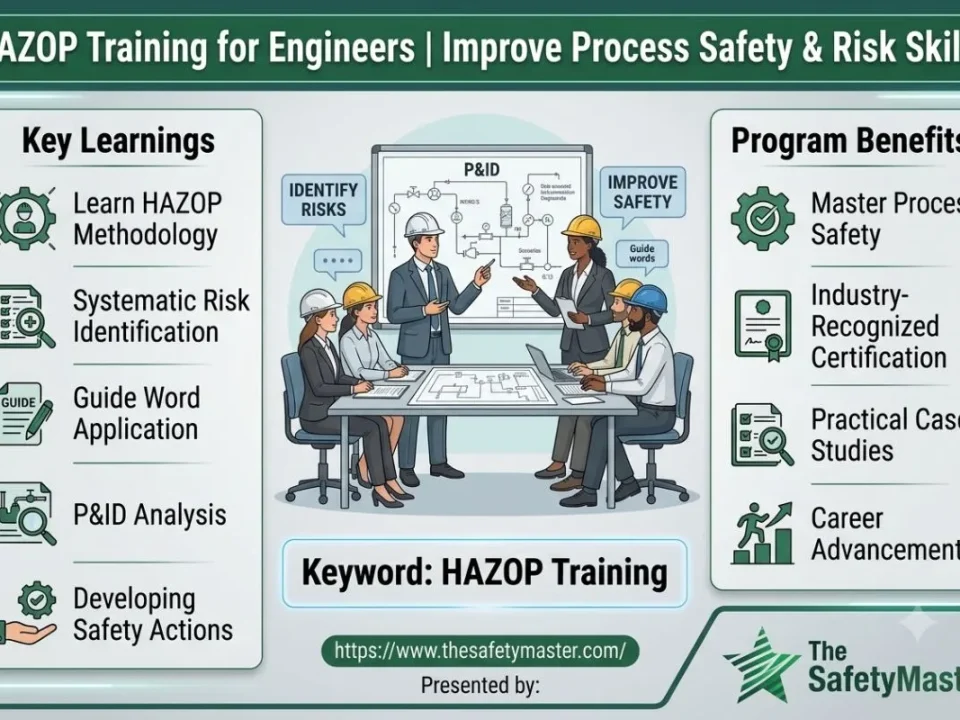
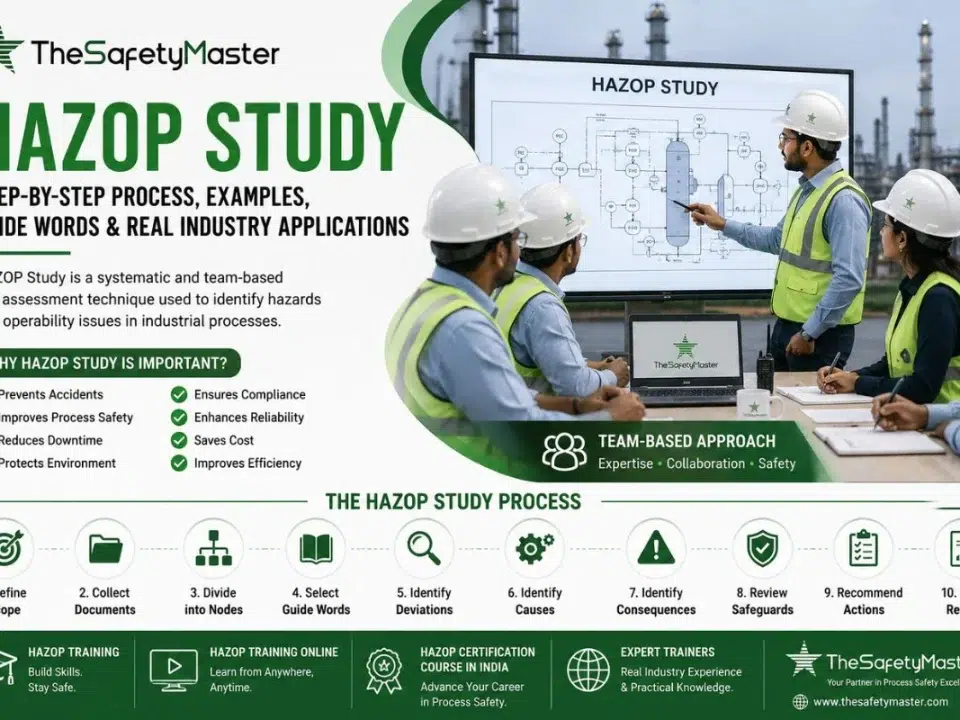
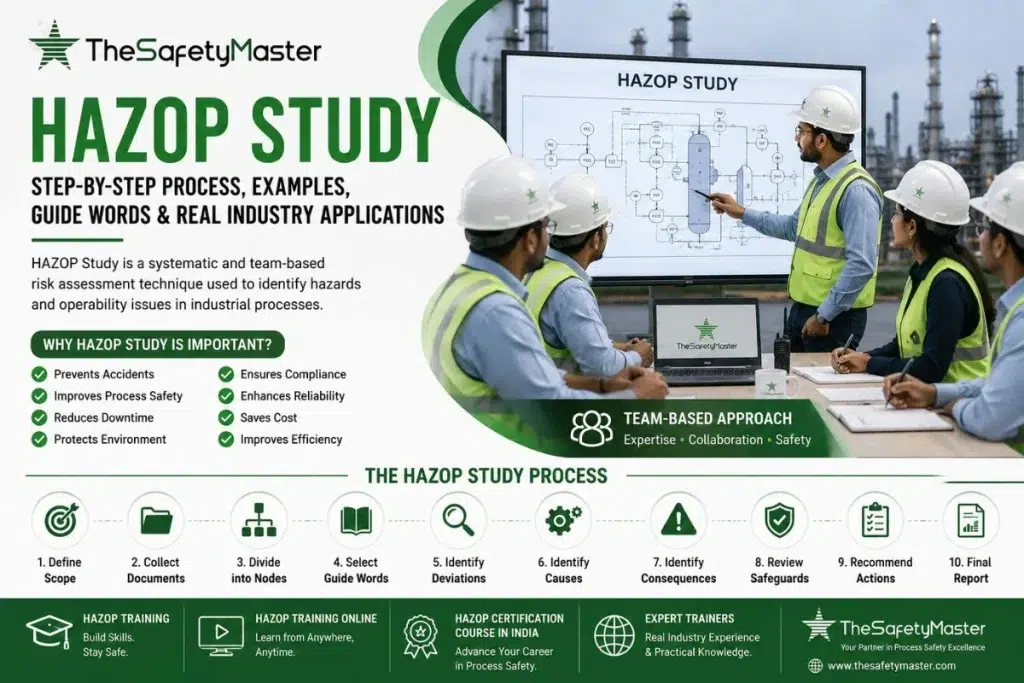
A HAZOP study generally follows a systematic process. A multidisciplinary team reviews the process in manageable sections, commonly called nodes, and examines deviations from the intended design.
1. Define the Scope
The first step is to establish the scope and objectives of the study.
The team determines:
- Which process or plant will be reviewed.
- The boundaries of the study.
- Equipment and systems included.
- Available design information.
- Study assumptions.
- Required participants.
2. Form a Multidisciplinary HAZOP Team
HAZOP works best when people with different areas of expertise participate.
The team may include:
- Process engineers
- Design engineers
- Operations personnel
- Instrumentation engineers
- Mechanical engineers
- Electrical professionals
- Maintenance personnel
- Safety professionals
- Process safety specialists
Different perspectives help the team identify hazards and operational problems that may otherwise be overlooked.
3. Collect Process Information
Before the study begins, relevant technical information should be reviewed.
Typical documents include:
- Process Flow Diagrams (PFDs)
- Piping and Instrumentation Diagrams (P&IDs)
- Equipment specifications
- Process descriptions
- Operating procedures
- Control philosophy
- Cause-and-effect diagrams
- Safety data
- Previous incident information
- Relevant design and operating information
4. Divide the Process Into Nodes
A complex plant is divided into manageable sections known as nodes.
For example, a node could represent:
- A pump system
- A reactor
- A storage tank
- A pipeline section
- A heat exchanger
- A distillation column
The team then systematically examines each node.
5. Apply HAZOP Guide Words
Guide words are used with process parameters to identify possible deviations.
Common HAZOP guide words include:
| Guide Word | Example Meaning |
|---|---|
| No/None | Complete absence |
| More | Quantitative increase |
| Less | Quantitative decrease |
| Reverse | Opposite direction |
| As Well As | Additional condition |
| Part Of | Partial composition or function |
| Other Than | Something different from the intended condition |
For example, applying “No” to the parameter “Flow” gives the deviation “No Flow.”
6. Identify Causes and Consequences
Once a deviation is identified, the team considers why it could occur and what could happen as a result.
For example:
Deviation: No Flow
Possible Causes:
- Pump failure
- Valve closed
- Blocked pipeline
- Loss of power
- Instrument failure
Possible Consequences:
- Loss of cooling
- Equipment overheating
- Process interruption
- Pressure increase
- Potential equipment damage
The actual causes and consequences depend on the process being studied.
7. Review Existing Safeguards
The team then identifies safeguards already available to prevent or reduce the consequences.
Examples include:
- Alarms
- Interlocks
- Emergency shutdown systems
- Pressure relief devices
- Automatic control systems
- Operator procedures
- Fire and gas detection
- Containment systems
The team considers whether the existing safeguards are adequate for the identified scenario.
8. Record Recommendations
Where additional controls are considered necessary, the team records recommendations.
Recommendations should be clear and actionable. Each action should ideally have an appropriate responsible person or department and a defined follow-up process.
HAZOP Study Example
Consider a simple process involving a chemical transfer line.
The intended condition is:
Chemical flows from Tank A to Reactor B at the specified flow rate.
The team may examine the following deviation:
Deviation: No Flow
Possible Causes:
- Transfer pump failure
- Valve accidentally closed
- Pipeline blockage
- Power failure
Possible Consequences:
- Reactor does not receive required material.
- Process conditions may become abnormal.
- Production may stop.
- Other process parameters may move outside their intended range.
Possible Safeguards:
- Flow alarm
- Pump status monitoring
- Operator inspection
- Automatic shutdown or interlock, where applicable
Recommendation:
Review the existing detection and control measures and determine whether additional safeguards are required.
This example demonstrates the basic logic of HAZOP: Deviation → Causes → Consequences → Safeguards → Recommendations.
Benefits of HAZOP
A well-planned HAZOP study can provide significant safety and operational benefits.
1. Early Hazard Identification
HAZOP can identify potential problems during design or modification stages, when changes may be easier to implement.
2. Improved Process Safety
It helps organizations understand how process deviations could lead to hazardous situations and whether suitable controls are available.
3. Better Operational Reliability
HAZOP can identify operability problems that may result in downtime, equipment problems, or inefficient operation.
4. Stronger Risk Controls
The study helps teams review existing safeguards and identify opportunities for additional risk reduction.
5. Better Team Understanding
Because HAZOP involves multiple disciplines, it encourages communication between engineering, operations, maintenance, and safety teams.
When Should a HAZOP Study Be Conducted?
HAZOP is commonly conducted during important stages of a process lifecycle.
It can be useful:
- During detailed plant design.
- Before commissioning.
- Before starting a new process.
- When making major process modifications.
- When introducing new hazardous chemicals or equipment.
- After significant process changes.
- During periodic review or revalidation, where applicable.
- When significant operational experience indicates a need for reassessment.
The appropriate timing and frequency depend on the process, organization, applicable requirements, and risk profile.
Industries Where HAZOP Is Used
HAZOP is particularly useful in industries involving complex processes and hazardous materials.
Oil and Gas
Used to identify potential deviations in production, processing, storage, and transportation systems.
Chemical Industry
Chemical processes can involve hazardous reactions, toxic materials, high temperatures, and pressure. HAZOP helps systematically examine these risks.
Pharmaceutical Industry
HAZOP can be applied to process equipment, utilities, chemical handling, and manufacturing systems.
Petrochemical and Refining
Refineries and petrochemical facilities contain interconnected systems where process deviations can have significant consequences.
Power Generation
HAZOP may be used for process systems involving fuel, steam, water, chemicals, pressure, and other critical operating conditions.
Manufacturing
Depending on the process, HAZOP can help identify hazards associated with complex equipment, material handling, utilities, and automated systems.
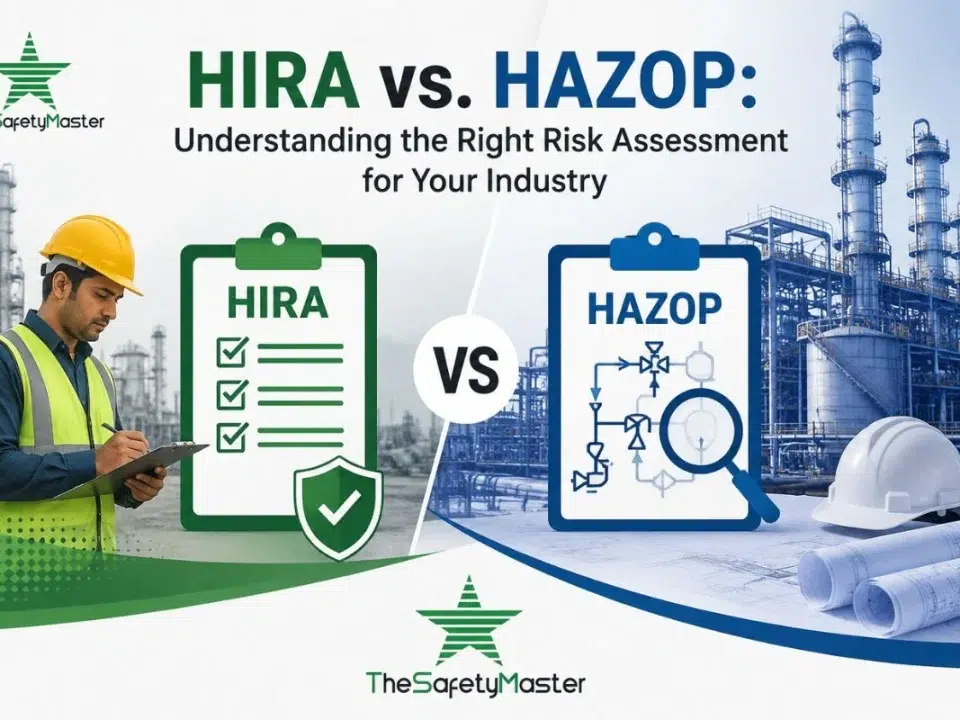
HAZOP vs HIRA
HAZOP and HIRA are both used for hazard identification and risk management, but they are not identical.
HAZOP is a structured technique that focuses strongly on deviations from process design intent and is particularly suited to complex process systems.
HIRA, or Hazard Identification and Risk Assessment, is a broader risk assessment approach that identifies hazards, evaluates risk, and determines suitable controls.
In practice, organizations may use both methods as part of a wider process safety and risk management program.
HAZOP vs HAZID
HAZID means Hazard Identification.
HAZID is generally used to identify hazards at an earlier or broader level, while HAZOP provides a more detailed, systematic examination of process deviations.
A project may therefore use HAZID and HAZOP at different stages depending on its objectives and risk assessment requirements.
Common HAZOP Mistakes to Avoid
A HAZOP study can lose effectiveness if it is poorly planned or documented.
Incomplete Process Information
The team needs accurate and suitable process information to perform an effective review.
Lack of Multidisciplinary Participation
A team with limited expertise may overlook important causes, consequences, or safeguards.
Poorly Defined Nodes
Nodes that are too broad can make the review difficult, while overly small nodes can make the study unnecessarily lengthy.
Focusing Only on Major Hazards
HAZOP should also consider operability problems and less obvious deviations that may contribute to incidents.
Weak Recommendations
Recommendations should address the identified issue clearly rather than simply restating the problem.
Poor Action Follow-Up
A HAZOP is valuable only when important findings are properly evaluated and appropriate actions are completed.
How The Safety Master Can Help
The Safety Master supports organizations with process safety and industrial safety solutions, including HAZOP-related services, training, documentation, audits, and other risk management activities.
A professional HAZOP approach can help organizations systematically identify process deviations, understand potential consequences, review safeguards, and develop appropriate recommendations.
For organizations working with complex processes, HAZOP can form an important part of a broader process safety management strategy.
Conclusion
HAZOP, or Hazard and Operability Study, is a systematic method for identifying potential hazards and operational problems by examining deviations from intended process conditions. It uses a structured team-based approach involving process information, nodes, guide words, parameters, causes, consequences, safeguards, and recommendations.
When properly planned and conducted, HAZOP can help organizations identify process risks before they develop into incidents and improve the safety, reliability, and operability of industrial processes.
The Safety Master provides safety training, consultancy, audits, and process safety solutions to help organizations strengthen their overall safety management practices.
Frequently Asked Questions About HAZOP
Q-What is HAZOP in safety?
HAZOP stands for Hazard and Operability Study. It is a systematic technique used to identify potential hazards and operational problems by examining deviations from the intended design or operating conditions of a process.
Q-What is the full form of HAZOP?
The full form of HAZOP is Hazard and Operability Study.
Q-What is the main purpose of a HAZOP study?
The main purpose of a HAZOP study is to identify potential hazards and operability problems associated with process deviations, understand their causes and consequences, review existing safeguards, and recommend appropriate risk-reduction measures.
Q-What are the main steps of HAZOP?
The main steps include defining the study scope, forming a multidisciplinary team, collecting process information, dividing the system into nodes, applying guide words to process parameters, identifying deviations, analyzing causes and consequences, reviewing safeguards, documenting findings, and following up on recommendations.
Q-What are HAZOP guide words?
HAZOP guide words are structured words used to identify deviations from design intent. Common examples include No, More, Less, Reverse, As Well As, Part Of, and Other Than.
Q-What is a HAZOP node?
A HAZOP node is a defined section of a process or system selected for detailed examination. A node may be a pipeline section, pump system, vessel, reactor, heat exchanger, or another manageable part of a process.
Q-Who participates in a HAZOP study?
A HAZOP team generally includes people from multiple disciplines, such as process engineering, operations, instrumentation, mechanical engineering, maintenance, and safety. The exact team composition depends on the process and study scope.
Q-Is HAZOP only used in chemical industries?
No. HAZOP is widely associated with process industries but can also be applied to other complex systems where systematic examination of deviations can provide value. It is commonly used in oil and gas, petrochemical, pharmaceutical, power, chemical, and manufacturing environments.
Q-What is the difference between HAZOP and HIRA?
HAZOP focuses on systematically examining deviations from process design intent, while HIRA is a broader hazard identification and risk assessment methodology. Both can be used together as part of an organization’s overall risk management and process safety program.
Q-When should HAZOP be conducted?
HAZOP may be conducted during detailed design, before commissioning, when significant modifications are made, when new processes or hazardous materials are introduced, and during appropriate periodic reviews or revalidation activities.
Q-What are the benefits of HAZOP?
HAZOP can help identify hazards early, improve process safety, identify operability problems, evaluate safeguards, support risk reduction, improve communication between disciplines, and strengthen process safety decision-making.
Q-Is HAZOP mandatory?
Whether HAZOP is specifically required depends on the applicable legislation, industry requirements, company standards, project specifications, and risk profile. Organizations should determine the appropriate process safety studies based on applicable requirements rather than assuming that one technique is mandatory for every facility.
Q-What documents are required for a HAZOP study?
Common inputs include PFDs, P&IDs, process descriptions, equipment information, operating procedures, control philosophy, cause-and-effect diagrams, safety information, and other relevant engineering and operational documents.